The other day I walked in to the art classroom at one of our elementary schools. Third graders were on a mission.
As artists, how might we use our creative voices to affect change in
our school?
our community?
our world?
Specifically:
To get humans to use less plastic and/or dispose of plastic properly to protect our ocean creatures.
In order to tell the story of plastic’s toxic impact on the ocean, students planned a public art piece depicting the ocean, with the creatures and such made of plastic. It was ambitious, and meaningful. And they needed the help of the art teacher.
When I entered the classroom, it was hard to even find the art teacher. She wasn’t in front teaching the class. She was sitting with a group of students, encouraging them, inspiring them, and helping them turn their vision in to a reality. Other students were spread around the room working with different tools: saws, drills, paints, wire.
I also couldn’t find the classroom teacher! Oh wait…there she is. Not monitoring the room, or sitting in the corner grading papers, but she was making art right there with the students. With her goggles on. As equals.
Each student I talked to knew not only what he or she was creating and how it would tie in to the art piece, but each student also described for me why this art piece was important. I was told about jellyfish dying with plastic wrapped around them and dead fish full of plastic in their stomach. They asked me about my plastic usage, and if I knew how much of what I used would end up floating in the ocean.
They had a reason for their art. A passion for their art. Activists for a cause important to them.
It was truly a moment when I said, “Yes! This is what learning should be like for students every day!”
Plastic jellyfish
Empathy + Action = Activist
Teacher and student creating plastic bottle fishes
In the book Originals: How Non-Conformists Move the World, Adam Grant writes, “When we become curious about the dissatisfying defaults in our world, we begin to recognize that most of them have social origins: Rules and systems were created by people. And that awareness gives us the courage to contemplate how we can change them.”
He explains that people blame the absence of creativity for the lack of originality in the world. (Be honest: Have you said recently, “Why can’t they come up with a new movie idea instead of just refashioning old ones?” I have…)
Grant surmises that people think society would be better off if only we could come up with some more novel ideas. “But in reality,” Grant explains, “the biggest barrier to originality is not idea generation—it’s idea selection…It’s widely assumed that there’s a tradeoff between quantity and quality—if you want to do better work, you have to do less of it—but this turns out to be false. In fact, when it comes to idea generation, quantity is the most predictable path to quality.” And when focusing solely on quality, “many people fail to achieve originality because they generate a few ideas and then obsess about refining them to perfection.”
This reminded me of a Steve Jobs interview in which Jobs stated:
“When you grow up you tend to get told that the world is the way it is and your life is just to live your life inside the world. Try not to bash into the walls too much. Try to have a nice family life, have fun, save a little money. That’s a very limited life. Life can be much broader once you discover one simple fact: Everything around you that you call life was made up by people that were no smarter than you. And you can change it, you can influence it… Once you learn that, you’ll never be the same again.”
Creativity, originality, change… they all require stepping outside the societal norms and limitations placed on us. They require taking risks; ideating and iterating many, many, many times; and understanding that the capacity for creativity is in all of us, but maybe, just maybe, creativity requires work and a commitment to let all those ideas flow! Lots and lots of them. And of course, bashing into walls and living life outside the neat little world!
So how do we provide the conditions for students to bash into the walls (okay, maybe not literally!)?How do we encourage the mass generation of ideas instead of obsessively refining the few? How do we provoke students to question, or even change, rules and systems? In other words, how do we bash into the walls of a traditional, high-stakes educational system and empower students to become change agents (like the Marjory Stoneman Douglas students are trying to do!)?
Educational systems, structures, and beliefs create enormous pressure on students to “get it right” (as determined by people no smarter than us) the first time. One assessment to measure if you learned the chapter content. One essay to determine if you met the writing standard benchmarks. One grade for each assignment. One SAT exam. Each of these with its own set of rules and systems to prove conformity to societal expectation.
When students go against those rules and systems (again, as the Marjory Stoneman Douglas students are), adults get agitated and seek to put them back in their place. And yet, when students become adults and seek out jobs, the workforce bemoans their lack of originality and creative problem solving skills.
Our role as teachers and administrators should be, then, to bash into the traditional walls to provide students opportunities to:
Think and act like a designer
Solve real world problems
Connect with industry experts to experience the world of work from people living it, and not from a textbook
Use play as a way to learn
Learn from and with students, and not just teach to them
Experience personalized learning that embraces strengths, passions, and ideas
What walls are you bashing into? How about your students? I’d love to hear about your classroom or school experiences.
Sign up to receive an update when I post. Type your email address in the box and click the “Subscribe” button. My list is completely spam free, and you can opt out at any time.
World renowned psychologist and Stanford professor Albert Bandura has shown through his body of research that “our belief systems affect our actions, goals, and perception. Individuals who come to believe that they can effect change are more likely to accomplish what they set out to do… People with self-efficacy set their sights higher, try harder, persevere longer, and show more resilience in the face of failure.” (Creative Confidence: Unleashing the Creative Potential Within Us All by David Kelley)
Knowing that belief systems affect actions and that self-efficacy impacts perseverance, it becomes important to consider how we define goals. Consider, for example, the doctor that you visit for excruciating stomach pain. If the doctor’s performance goal was to identify and treat the pain in 75% of her patients, would you feel comfortable seeing her for your appointment? What if the doctor next door said that his goal was that 100% of his patients would experience a 75% or greater reduction in the pain? Which door would you choose?
When we discuss student learning and growth targets, do we truly believe that all children are capable… of learning? Of achieving? Of finding success? Do our student targets reflect that?
Proficiency Target: 28 of the 36 students in my class will receive a score of “Standard Met” on the CAASPP state assessment.
When meeting parents at Back to School night, are you comfortable telling parents that eight of them have children who won’t have a successful year? Are you comfortable telling the students that?
Growth Target: All students will increase their pre-assessment scores by 20 points on the post-assessment.
When meeting parents at Back to School night, are you comfortable telling parents that, regardless of their child’s current academic level, each child will show marked growth during the school year? Are you comfortable telling the students that?
Belief systems affects our actions.
A team of psychologists from Stanford, Yale, and Columbia tested the effects of feedback provided on an essay. They found that one particular form of feedback significantly boosted student effort and performance. This “magical feedback” (as they deemed it) had nothing to do with writing. It simply said:
“I’m giving you these comments because I have very high expectations and I know you can reach them.”
That’s it. One simple sentence, showing belief in the student, had more impact than any specific writing feedback. So when considering how we create and communicate student growth and proficiency targets, how do we ensure that actions, goals, and perceptions build a positive belief system? How are you building self-efficacy?
Sign up to receive an update when I post. Type your email address in the box and click the “Subscribe” button. My list is completely spam free, and you can opt out at any time.
Kathleen: One of the things I saw in the organizations that I interviewed is that they prioritize storytelling, not only at the executive director or CEO level, but at every single level of the organization. Everyone within the organization can be a brand ambassador for the cause, whether it’s a staff member who happens to be at a cocktail party and comes across a donor, or whether it’s a beneficiary talking to a funder about the effectiveness of the work.
Some of the organizations that I interviewed actually did storytelling practice in their staff meetings. IDEO.org does this storytelling roulette where they spin a wheel, and on the spot, a staff member has to tell a story about a project that they worked on. It’s that repetitive practice that really helps build storytelling skills.
Nadine: One of the great benefits of doing that is that within the organization, it builds cohesion and alignment around the messaging and the brand. It’s really a powerful internal development tool, as well as an external development tool.
How are you empowering both staff and students to tell the story of learning at your site? I just spent a day of professional learning with every teacher in our district. Based on an activity in Ron Ritchhart’s Creating Cultures of Thinking, we looked at the story of learning we were told growing up through beliefs, behaviors, expectations, etc. Phrases such as compliance, tracking, and worksheets kept rising up.
Our district has already spent a year researching what education should look like for our students. We met with industry experts, read countless books, went to conferences across the country, and most importantly, talked to our stakeholders: students, parents, staff, and community.
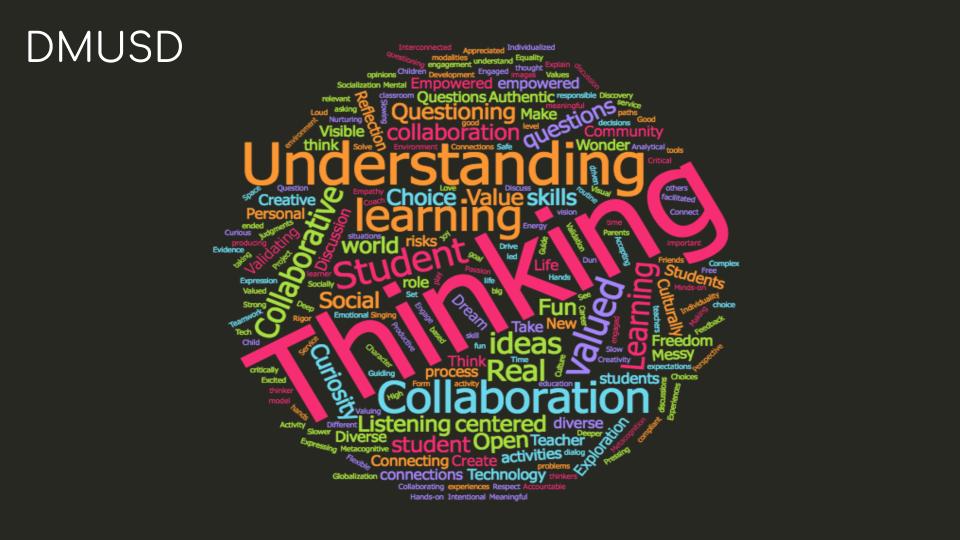
With this information, as well as some video and article reads during our professional learning day, we began crafting a new story of education; one that values the unique geniuses of all students through strong instructional practices that promote student agency, collaboration, personalization, cultural intelligence, and design thinking. Our new story has much different phrases:
So how do we build a storytelling culture amongst all our stakeholders? That’s the next chapter we’re writing.
How are you telling your story? Do you have a storytelling culture, or is a lone storyteller writing your book?
Sign up to receive an update when I post. Type your email address in the box and click the “Subscribe” button. My list is completely spam free, and you can opt out at any time.
“Ideas are cheap. Execution is everything.” — Chris Sacca (on Shark Tank)
Makerspaces are fun. I love seeing students discover new ideas, and new ways to represent those ideas, within a makerspace. There’s just something magical about turning twine, an egg carton, and a plastic spoon into a prototype for a prosthetic arm.
Ideation Wall: Inspirations from Michael diTullo, Industrial Designer frame the student concepts
Tamara, former industry Product Manager and current Library Tech, explains the “cost” of the MakerSpace items
But today I saw a twist on the makerspace concept. 5th grade students, ideating and designing prototypes for a Shark Tank product and pitch they were developing, had to strategically “purchase” makerspace supplies within the confines of a budget. Every pipe cleaner, every egg carton, had a cost associated, and project teams found out today that they have only $40 allocated to build the prototype. Need to hire an expert to drill a hole for you? There’s a cost. Want to try to do it yourself? Sure, but you’ll need to rent the drill. Buy 6 pipe cleaners but only need 3? Sorry, no refunds. Maybe another project team will buy your surplus materials, but chances are, they’ll want a reduced price.
For some, this may seem like a stifling of the makerspace experience. But for these students, understanding the cost to build the prototype is important. Tamara, the school Library Tech, uses her experience as a former Product Manager to teach students how businesses develop, build, and market new products so that students can create a solid business plan to present to the Shark Tank panel. The panel, consisting of local business leaders in technology, real estate, and angel investing, are looking for products that not only engage the target user, but have a profit margin that will earn them money.
“Schools are turning to makerspaces to facilitate activities that inspire confidence in young learners, and help them acquire entrepreneurial skills that are immediately applicable in the real world” (NMC Horizon Report: 2015 K-12 Edition, p. 39).
“Schools are turning to makerspaces to facilitate activities that inspire confidence in young learners, and help them acquire entrepreneurial skills that are immediately applicable in the real world” (NMC Horizon Report: 2015 K-12 Edition, p. 39). These students are making so much more than a prototype in the makerspace; They are making their way into the future with the skills that matter most.
In 2012, Tony Wagner wrote a book called Creating Innovators: The Making of Young People Who Will Change the World. After interviewing over 150 innovative changemakers, Wagner seeks to find the shared experiences that result in innovative mindsets. Sadly, but not shocking, it typically was not school that provided that spark. It was parents, or an adult figure who believed in the child’s ability and provided the nudge to venture outside the box. Wagner also calls out the educational system, both K-12 and higher ed, for not providing the meaningful learning experiences that nurture innovation, entrepreneurship, and social change.
Statements that stood out to me:
“Most policy makers—and many school administrators—have absolutely no idea what kind of instruction is required to produce students who can think critically and creatively, communicate effectively, and collaborate versus merely score well on a test.”
This doesn’t surprise me. Policy makers and educators have something in common: a lack of experience working in industry. Most educators have never left the academic environment, having entered it at age four or five, and choosing to make a career of it. Policy makers, or people who make plans, don’t carry those plans out. Like educators, they seem to be absent of the experiences happening in corporate America.
“In this journey from play to passion to purpose they learned … ‘creative thinking skills’ and gained real ‘expertise,’ but most often in ways that encouraged intrinsic motivation. They also learned the importance of taking certain risks and persevering – and why IDEO’s motto of ‘fail early and fail often’ is so important.”
Wagner mentions Montessori schools as being a common denominator in many of the young innovators interviewed. The Montessori classroom encourages independence, freedom within limits, and a sense of order. When public schools provide classroom opportunities such as those of the Montessori, they are considered an outlier. Schools like High Tech High are singled out often as outliers bucking the traditional education system. Why, though, if we know play leads to passion which leads to purpose, do we insist on kindergarten looking more and more like an high school AP course and less like sandboxes and imaginative play?
In our district, we are using Design Thinking methodology to provide risk taking opportunities that (re)kindle the passion and purpose in our students. We are focused on creating a place for students to learn that the only failure is not learning from the mistake and trying again. As one engineering student explained to Wagner when asked about the role of failure in his learning, ” I don’t think about failure – I think about iterating.”
Our education system does not encourage risk-taking and penalizes failure, and too many parents and teachers believe that a “safe” and lucrative career in business or law or medicine is what young people should strive for—rather than something to do with “changing the world.”
After all, the parents and teachers who believe in the “safe” careers are victims of the same institutionalized system. For years my daughter wanted to be a marine biologist and save the sea turtles. And all it took was one person, one educator, to crush her dream by saying, “You’ll have to marry rich if you want to be a marine biologist. They don’t make any money.” This mentality needs to go away. Like George Couros says in his presentations, we need to stop scoffing at the student that wants to be a YouTube star.
Wagner quotes one executive who states, ‘We can teach new hires the content, and we will have to because it continues to change, but we can’t teach them how to think — to ask the right questions — and to take initiative.’
Increasingly in the twenty-first century, what you know is far less important than what you can do with what you know. The interest in and ability to create new knowledge to solve new problems is the single most important skill that all students must master today. All successful innovators have mastered the ability to learn on their own “in the moment” and then apply that knowledge in new ways.
Providing students an opportunity to create new knowledge to solve new problems. This should be the mission of every school, of every teacher. Whether it’s through a Design Thinking challenge, or contributing to a Wikipedia page, or staging a march against social injustice, students need to see connections between what they learn and what problems need solving.
Albert Einstein said it best, “Education is what remains after one has forgotten what one has learned in school.” Has school changed much since Einstein’s days? Are we still insistent on mastery of knowledge, of data points, of bubbling in the right answer on the test? Do we continue to teach to the middle, to the distribution curve, and not to the unique individuals in front of us?
Our students want to become innovators. Our economy needs them to become innovators. The question is: As educators, do we have the courage to disrupt conventional wisdom and pursue the innovations that matter most?


 , Adam Grant writes, “When we become curious about the dissatisfying defaults in our world, we begin to recognize that most of them have social origins: Rules and systems were created by people. And that awareness gives us the courage to contemplate how we can change them.”
 World renowned psychologist and Stanford professor Albert Bandura has shown through his body of research that “our belief systems affect our actions, goals, and perception. Individuals who come to believe that they can effect change are more likely to accomplish what they set out to do… People with self-efficacy set their sights higher, try harder, persevere longer, and show more resilience in the face of failure.” (
 )
)


 In 2012, Tony Wagner wrote a book called
  . After interviewing over 150 innovative changemakers, Wagner seeks to find the shared experiences that result in innovative mindsets. Sadly, but not shocking, it typically was not school that provided that spark. It was parents, or an adult figure who believed in the child’s ability and provided the nudge to venture outside the box. Wagner also calls out the educational system, both K-12 and higher ed, for not providing the meaningful learning experiences that nurture innovation, entrepreneurship, and social change.