Category: Personalization and Agency

  • Innovate Forward: Our Story

    Innovate Forward: Our Story

    When you know your ‘why’ then your ‘what’ has more impact,
    because you’re working towards your purpose.
    – Michael Jr. 

    Today I was fortunate to present at the online #InnovateSD conference hosted by San Diego County Office of Education, thanks to an invitation extended to me by PowerSchool Senior Director of Educator Engagement Mike Lawrence.

    At around 1 hour and 18 minutes of this YouTube video is my presentation.

    Screen Shot 2018-11-02 at 11.46.11
    Sorry – it won’t allow embedding

    I’ve asked about the story of learning to over 300 educators over the past year, and regardless of age, background, or socioeconomic status, the answers were largely the same. The story of learning has been one largely comprised of compliance. Even those who shared about projects and experiential learning still shared a common message that you must do what you are told if you are to be labeled successful.

    Many of our practices and our beliefs are so ingrained that they are institutionalized. After all, most educators have been in the school system since the age of four or five. It’s all many of us have ever known so it’s not a surprise that we don’t notice the messages we send through our systems, structures, and beliefs, or why we send them.

    This video is about how Del Mar Union is pushing back on those systems, structures, and beliefs. It’s about the importance of providing students with the foundations and the experiences needed to think and to know their voice matters. It may be the story of Del Mar, but I am hopeful that it becomes the story of learning for all of us.

  • Empathy is Always Worth the Time

    There are days when we all probably ask ourselves, “Is anyone actually listening?!?” Then I read tweets from teachers like this, and I realize the ripple effects from a pebble can travel much farther than seen from shore.

    A Tweet from Meg Money about using empathy mapping with her students

    Meg is one of those teachers I get excited to know and work with because she is willing to reflect on her practices as she continuously looks for connections that make a difference for students. After the above tweet, I asked her to blog this experience for others. Since she doesn’t have her own blog, I am giving her the space here to share. So this is Meg’s story in her own words…


    There’s a little saying that goes, “a stitch in time saves nine.”  
    Is Empathy Mapping worth the time?
    By: Meg Money, Sycamore Ridge 4th Grade teacher

    “As teachers, how do you want to invest your time?” Ron Ritchhart, Harvard’s Project Zero, asked a cohort of DMUSD teachers recently. This question has replayed in my mind time after time since.  Last week I was at a crossroads; time or making a difference? You see, our 4th grade class was in the thick of a Design Thinking challenge. All groups were collaborating ferociously and productively…all but one. But hey, it was my fault. I designed that group knowing that it had a 50-50 chance of working. This group of three included  kids who were bright and capable in their own right but different as day and night. Unfortunately I didn’t play my cards right, and now I had a group on my hands that had potential but was so far behind because productivity and collaboration were nonexistent.

    Now comes in the saying, “Timing is everything.” Fast forward two weeks to another training led by our very own DMUSD Design Team.  Paula (@CDMDreamers) and Sarah (@SarahZRaskin) led us through a Empathy Mapping exercise, and a light bulb went on. This is what my lagging group lacked… Empathy! However, this would take time; time a group was running out of.

    “How should I invest my time?” replayed one more time in my head. Yes, this is exactly what this trio of budding engineers deserved. They deserved to feel safe in a group and showcase their talents. Their assigned grouping shouldn’t be the barrier holding them back.

    I wasted no time and asked the group how they were feeling halfway through the research/prototyping phase. As you can imagine, they were frustrated and asked if they could just work alone. It was then I suggested that we come together and build empathy through the mapping exercise.

    What happened from there surpassed every expectation I’d anticipated. The kids were open, honest, polite and so insightful. They really didn’t need much prompting; they got it! They created NEED statements that immediately inspired them to hurry back to their learning. I watched in AWE as this group of young scholars immediately started approaching a difficult task with empathy and producing with the maturity of adults. I’m not going to lie, I had tears, goosebumps, and a swollen heart.

    So, was this worth the TIME? Oh, you have no idea. Just ask the group members.

    “Ms. Money, thank you for taking the time to do the mapping with us,” said one student.

    “This was the best day of the year,” another added with a hug.

    “Ms. Money, hurry, come see our idea!” shouted one from across the room.

    I will forever be reminded of this experience that truly confirmed that helping students find their potential and giving them a chance at success is absolutely worth the time. Empathy Mapping is now the frontrunner of my long list of “Must Explore and Practice” list. It is worth every second of TIME!

    Connect with Meg on Twitter at @mmoneydmusd

  • So You Want to Create a Flexible Learning Environment…

    So You Want to Create a Flexible Learning Environment…

    A colleague asked me for resources on flexible learning spaces. Her goal is for 6th students to use the Design Thinking mindset to redesign their own classroom. Because we know it’s not just about cool chairs and bright walls, it’s important that students and the teacher understand the WHY behind the decisions being made.

    Luckily, Twitter hashtag #learningspaces has a treasure trove of resources for teachers looking for a place to start. And attending CUE BOLD in May also provided me with access to amazing presenters and ideas around classroom environment.

    So here is the list of resources I curated for the students, in case it helps any of you:

    Tips for Designing Amazing Learning Spaces with Dr. Robert Dillon
    And here’s a visual for that YouTube video.

    Edutopia article showcasing some flexible K-8 classrooms.

    Video Series on the book The Space by Dr. Robert Dillon and Rebecca Hare

    This tweet may be good to spark a deeper conversation questioning why we need so many desks/chairs/etc in the room.

    12 Ways to Upgrade Your Classroom Design takes ideas from The Space and presents them in an easy to read blog post.

    Consider adding a Peace Corner to provide quiet spaces for reflection and emotional centering.

    Designing Brain Friendly Spaces by Dr. Robert Dillon is a short article with some targeted questions to ask while considering how space is used.

    CUE BOLD has made all the presentation slides available for those wanting to learn more. There are quite a few on learning spaces that are worth checking out. Look for Rebecca Hare, Michael Morrison, and Michelle Ho & Danielle Roja for relevant links.

    And of course, as you consider all this, please keep in mind that Pinterest is awesome for beautiful wedding decor, scrumptious recipes, and creative Outfits of the Day, but Pinterest-designed classrooms don’t always meet the needs of the learners (and they’re expensive to create!). My original blog post on that topic is still one of my most popular ones.

    Please let me know in the comments what else should be added to this list.


    And hey, if this post made you smile, or think deeply for a moment, or just scratch your head and go HMM… then share it with a friend. Or two. And subscribe to keep the posts coming!

  • Death by Syllabus

    It’s that time of year … back to school! Teachers are excited to meet students, and students are excited to meet their teachers.

    Back to school also means a lot of discussion about how best to establish relationships and culture when students walk in the door. I’ve seen tweets suggesting teachers hold off on “doing school” at first so as to focus on getting to know the students, and establishing the positive culture of the classroom.

    Part of “doing school” is, for many teachers, passing out the course syllabus, or class introductory letter. This document, often read and treated like a terms and conditions contract, outlines objectives, grading procedures, behavior and academic expectations, consequences for violating those expectations, and rewards for following them, which is often the grading scale.

    It outlines what students will learn, how they should learn it, and in what timeline it is expected to be learned. It requires multiple signatures to signify understanding, and is filed away in case any of the signatory parties disagree with the terms and conditions at a later date.

    So yes, I can see why this would be quite a downer on day one for teachers trying to establish a culture of joy, of lifelong learning, and of collaborative discovery with their students.

    “Hey students. This year is going to be AWESOME. But first, you all must agree to the terms and conditions… potential side effects include dizziness, heart palpitations, anxiety, and death…” Screen Shot 2018-08-20 at 10.16.21

    Umm, yea, about that… Total downer!

    That makes me wonder… if the syllabus is so disconnected from the culture being established in the classroom, what message does it send to parents who are asked to read and sign it? For many parents, this is the first impression. The first handshake. The first “Nice to meet you.” If it doesn’t represent the culture you want to establish with students, then I have to ask what culture it establishes with the parents who are being handed this paper to sign without any other context.

    And what contradictory message does it send to students? “Hey, I know I told you that I value you as an individual and we had all  fun week one getting to know each other, but the reality is, if your work is late, I will dock you a half letter grade. And if you use the bathroom pass three times, you owe me detention.”

    If the syllabus doesn’t reflect the culture of your classroom: a culture of thinking, of learning, of student agency, and of growth mindset, then the only place that syllabus should go is in the trash.

    If it’s in the trash, how might we develop a new, student-centric syllabus that reflects our values? What questions should it answer? How about these for a start:

    • What does the teacher value about teaching and learning?
      • What does the teacher believe about how students learn?
      • What does the teacher believe about the conditions that need to be in place for students to thrive in a learning environment?
      • What does the teacher believe about the whole child, and his/her role in supporting individual development?
    • What do students value about learning?
      • What conditions do the students in the room right now need to thrive?
      • What passions do the students in the room right now possess?
    • What do parents value about learning?
      • What does it mean for parents to be partners in their child’s education?
      • What do parents need to feel like a valued partner?

    In addition, we should consider how language sets a tone. Is it a “we” document or a “me” document? Does the font and spacing encourage reading? Hey, maybe add some graphics and resource links.

    By creating a document that exudes relationships, culture, learning, and voice, we are breaking down one of the traditional structures that serves as barriers to our values.

    … Have you already transformed your syllabus? Would love to see a copy! Post a link in the comments, or send me a message. Let’s get the word out and encourage a movement!



  • My Boyfriend Is Smarter Than Me…

    I have five degrees. Five! An Associate degree, a Bachelor’s degree with a double major, a Master of Arts degree, a Master of Science degree, and a Doctorate in Education.  I love school.

    And yet, even with all those fancy certificates, my boyfriend is smarter than me. He’s a welder. No fancy college degrees. But he can build and create and fix and imagine in ways my brain can’t comprehend.

    Screen Shot 2018-06-19 at 14.40.40
    John fabricating seat mounts for our ’68 Jeep I nicknamed Wabi Sabi.

    Case in point: We bought a Jeep. A ’68 Jeep that hadn’t been loved in a very long time. It had been parked in a field for 15 years, stripped of its elements and left abandoned to nature. No seats. No pedals. No steering assembly. All wiring stripped and sitting in a pile in the cab. Rusty nuts and bolts that belong somewhere filled a coffee can.

    And yet he is rebuilding it. There’s no manual for this. No YouTube video series that connects all the dots. He has to figure it out. He IS figuring it out. Sometimes with parts that are there. Sometimes with new parts he is purchasing. And sometimes with parts he fabs up on his own. Watching him work mesmerizes me. His ability to see in three dimensions, and to understand the interdependency of systems and how they contribute to the overall form and function, is a form of genius I don’t possess.

    I share all this with you not just because I am insanely proud of his skills (although I am!), but because I think it’s important to remember that there is not one best way to learn. As much as I love school and books and conversations about school and books, John would shrivel up in that environment.

    Our experiences often have a greater impact on us than degrees ever will!
    — Jonathan Spike (@Mr_JSpike)


    When I started play teaching my dolls and neighborhood friends at age six, I knew everything and dispensed my knowledge to them through worksheets I drew, and books I read, and homework I made them complete (my poor friends!). When I started actual teaching twenty years later, not much had changed. I still made worksheets for my students, and read books with (and to) them, and assigned homework. Over the years, I learned and adapted to a 1:1 environment, and brought in Genius Hour and Project Based Learning. But sadly, and I am not proud to admit this, I controlled much of the learning structure in my room.

    But our role as teachers is changing. We need to be cognizant of the needs of our learners. All our learners. Not just the ones that are compliant. Not just the ones that are college bound. Not just the ones that look like and sound like we do.

    And part of that change is the realization that the best way to support a learner may simply be to get out of his/her way and let the learning figure itself out, like it does for John.

    ***

    If you like Jeeps, or just watching things come to life, feel free to follow along via Instagram @wabisabi68jeep as we get this thing desert ready!

    Screen Shot 2018-06-19 at 16.11.30

    Subscribe via email or WordPress to get notified about new posts!
  • Design Thinking the Design Thinking Process

    Design Thinking the Design Thinking Process

    “Empathy should be used in every situation.
    We should think with empathy throughout life.”
    – 6th grade student

    Why are there so many design thinking framework graphics? Why do they have different shapes? Different elements? Different flow patterns?

    Those were the questions 6th graders asked when we looked at a variety of design thinking framework graphics, ranging from Stanford d.school to IBM to Intuit and the Henry Ford Institute. These students had spent this past year diving into the design thinking process through a variety of experiences ranging from creating a student chair to redesigning the school experience. Because they had spent so much time exploring the process, looking through other frameworks raised an important question:

    What does Design Thinking look like in Del Mar Union School District, and how might we develop a Design Thinking visual that represents what Design Thinking means for students and staff?

    We realized that we had a unique challenge – unlike corporations or colleges, we have to represent design thinking to five year olds who cannot read all the way up to 6th graders (who think they know everything!). How could we adapt our visual for our customers?

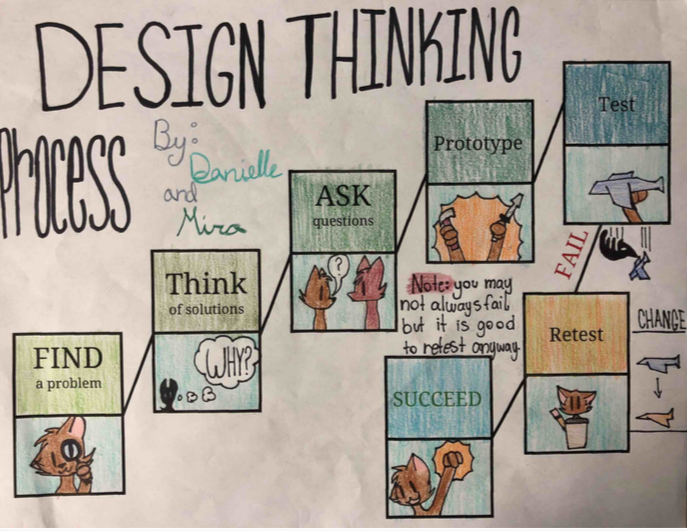
    Luckily for me, 6th graders were up to the task. A week later, and they had prototypes to present. And I must admit, WOWZA was the term that kept coming to mind during their presentations. I’m sharing their concepts here, but what you’re missing is the rich dialogue around WHY they made their concepts the way they did.

    Some key takeaways from the student dialogues:

    “The Design Thinking process adapts to how you’re using it.”

    “I thought it was linear at first, but now I know I can move around as I need to.”

    “The process restarts again and again, going broad and narrow at the same time.”

    “I didn’t understand the value of going back until I did it so many times on this project.”

    Beyond the graphic, we also talked about the design thinking process as a holistic entity. This is where the conversation really intrigued me. One student commented that the trouble with using the design thinking process in schools is that the non-linear cyclical process runs counter to traditional teaching and learning. Content standards and state tests require classes to keep moving in a forward momentum, even when the design thinking process would have us circle back around and around again to dig deeper into a complex problem. It can be frustrating having to move beyond an experience when students know there’s still so many layers to unravel. Finding balance, as a teacher, is critical to the learning.

    But the students all saw that the value of design thinking went beyond the process itself. Students realized that using design thinking taught them time management and backwards planning. They learned the power of constraints, like deadlines, to push creative thought into action.

    Most importantly, students discovered that empathy is the start of it all. It allows people to understand what others are going through. As the students explained, empathy has a use in every situation. If we all would think with empathy throughout our lives, many problems could be averted, or solved, in compassionate ways.

    If only we were all as smart as these 6th graders!

    So… which model strikes a chord with you? Why? What do you think propelled the students to create that version?


    Thanks Mrs. Tanner for letting me spend time with your students! I appreciated how you identified this process as an authentic assessment possibility.