Category: Personalization and Agency

  • Compliant Geniuses? Think Again.

    Compliant Geniuses? Think Again.

    downloadOur district mission statement centers around our calling to  “ignite genius and empower students to advance the world.” That’s a pretty tall order!

    Especially when, as Seth Godin explains (“The Long Term” podcast), students typically spend 90-95% of their school day on either doing what they’re told, aka compliance, or finding the right answer, also compliance!

    If only 5-10% of the day is open for a student to think bigger thoughts, then how in the world can we ever expect students to find their genius?

    Looking for the right answer? It’s easy. You can’t.

    If we truly want students to find their genius, then we need to provide the opportunities for them to dig in to complex problems. Complex problems does not mean a calculus problem, or balancing scientific equations. What I’m talking about here are complex LIFE problems. Problems that, quite honestly, don’t have answers. Things like:

    • Overpopulation and resource scarcity (Although, if you watched the last Avengers movie, this problem does have a potential solution… No Spoilers allowed!)
    • Economic development of the global poor
    • Nuclear security

    When we allow students time, resources, and freedom to explore complex problems like these, and even more so, when we let them explore the world of no resolutely right answer, we are building their capacity for original thought. We are building their capacity for grit. We are building their capacity for learning from failure.

    And in doing so, we are building their capacity to ignite their own genius.


  • Is It Possible to Do Good Better?

    Is It Possible to Do Good Better?

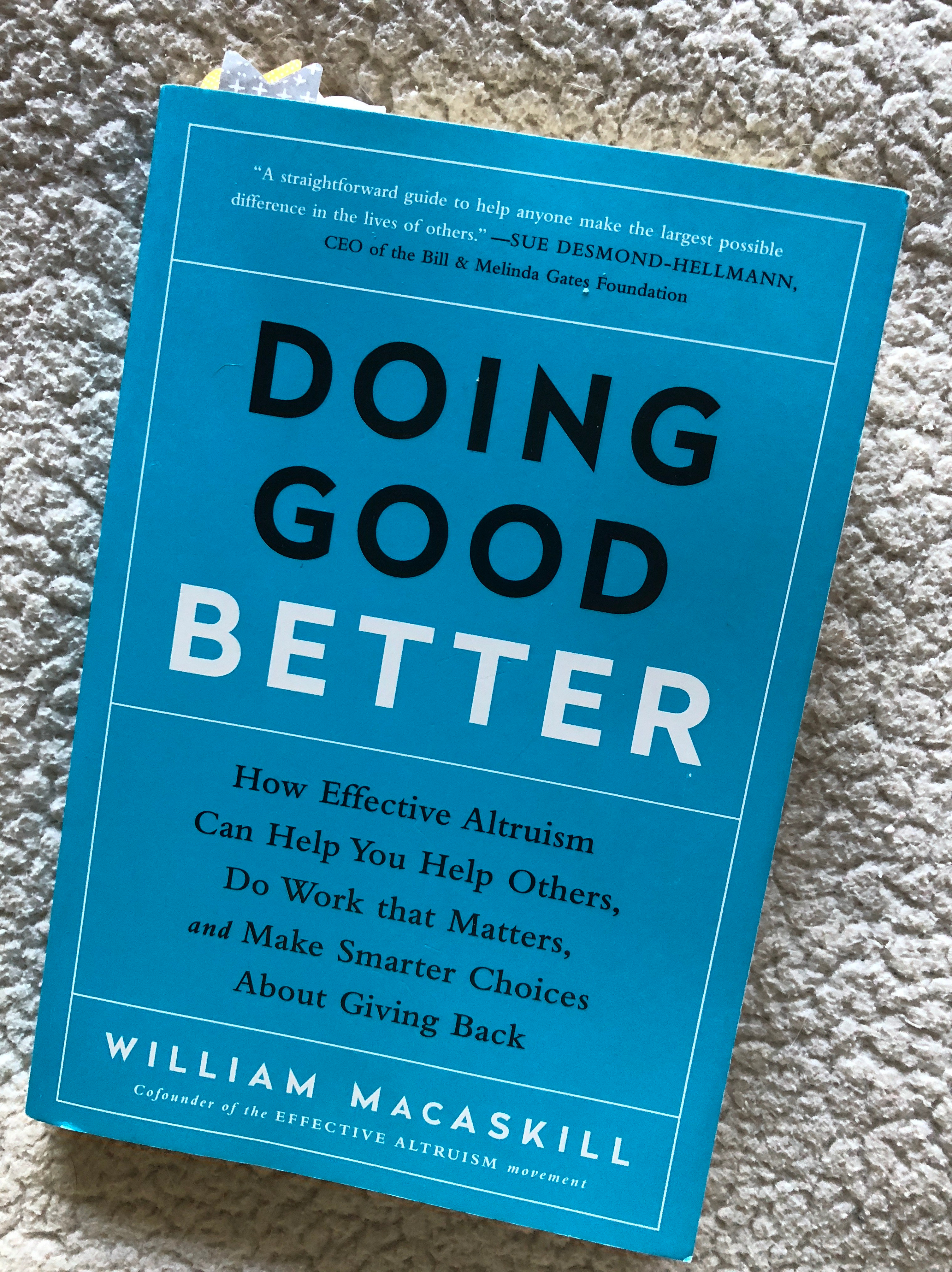
    Doing Good Better bookAccording to William Macaskill, it is. That’s the premise behind his book, Doing Good Better: How Effective Altruism Can Help You Help Others, Do Work That Matters, and Make Smarter Choices About Giving Back. 

    Macaskill and colleagues developed effective altruism, which uses data and some snazzy principles to help people make a huge difference in the world. It’s about asking “How can I make the biggest difference I can?” and then using evidence and reasoning to find the answer. It’s not about more money, or volunteering more hours. It’s more about being impartial in analyzing the options to choose what’s best for the world. (Spoiler alert: many of the options that we choose aren’t the best ones!)

    I picked up this book because of Design Thinking. Weird, maybe… but as we ask students to prototype solutions to complex problems, I’ve been grappling with what to do with those solutions. Are they solutions that warrant being pushed into the world? Have similar solutions already been tested? Should we tap into the passion students show towards specific subjects and encourage them to do something to make a difference, or redirect their energy to areas in which it is possible to truly make a difference? And hey, are we even tackling the right problems?

    According to Macaskill, it’s not enough to do something. It needs to be the best thing, so that the thing done makes the difference it should make. When it comes to helping others, Macaskill says that “being unreflective often means being ineffective.” He shares multiple examples of programs that sound great on paper, like PlayPumps  and Fair Trade but in actuality do little good for the people they intend to serve. In fact, some programs not only don’t do good, but they can cause harm, like Scared Straight, and boycotting sweat shops (seriously…!)

    So what does this have to do with elementary students and design thinking?

    If we are going to present students with opportunities to solve complex problems, and build in them a sense of agency that they can make a difference in the world, then isn’t it also our responsibility to make sure that they do good in a way that actually helps others? Shouldn’t we teach them how to identify work that matters? And how to make smart choices about ways to give back?

    Although I’m not sure I agree with all of Macaskill’s premises, I do think this is an area which warrants a deeper dive. If we are going to teach advocacy, global citizenship, and cultural intelligence, then it is important that we also provide students with the tools needed to help them make smart decisions, just like we need to do with media literacy and fake news. We need to make sure that critical thinking stays prominent in this work.

    We need to ask ourselves if we are doing good, or if we are doing good better.


  • Countdowns Suck. Yes, I said it.

    71xhwxJpRsL._SY606_

    I wanted to write earlier…I really did. So many blog posts have been ruminating in my brain the past few weeks.

    But I’ve had a major life event happen. And I needed time to process. And that meant taking a break from my blog.

    So what happened? My oldest daughter, Alexandra, enlisted in the U.S. Navy. In fact, she leaves for basic training in 21 days. 30200 minutes.

    I’m so insanely proud of her. Having served in the U.S. Army myself, I know how scary it can be to give control of your life over to the government in the name of freedom. But she did it, and not only did she do it, but she was chosen to participate in the cryptology program, which is the same program in which my dad served during the Vietnam War.

    So if I am so proud, why haven’t I blogged? Because I am also scared to death! I vacillate between proud momma and “Oh my gosh… how will I survive eight weeks without talking to her, without seeing her, without knowing she is okay?”

    The days are counting down until she leaves… 21 days… 30175 minutes since I started writing this blog post. 21 days until her exciting new life begins and my angst-ridden new life begins.

    Makes me wonder how many of our students have similar angst with those “Countdown to Summer Vacation” signs that are found in so many classrooms these days. If a child’s summer is spent traveling to Hawaii, that countdown is amazing. If that summer is spent babysitting younger siblings or wondering if there is enough food for lunch and dinner, those numbers are pretty darn scary.

    Sign up to receive an update when I post. Type your email address in the box and click the “Subscribe” button. My list is completely spam free, and you can opt out at any time


  • A Rubric is Not an Authentic Audience

    A Rubric is Not an Authentic Audience

    If students have only experienced a rubric as an audience to their writing, we have failed them miserably.

    Ron Berger, known for his work with Expeditionary Learning Outward Bound school network, Harvard Project Zero, and the Carnegie Foundation for the Advancement of Teaching, created a Hierarchy of Audience graphic to show how valuable authentic audiences are. He explains:  “When we finish school and enter the world of work, we are asked to create work of value — scientific reports, business plans, websites, books, architectural blueprints, graphic artwork, investment proposals, medical devices and software applications. This work is created over weeks or months with team consultation, collaboration and critique, and it goes through multiple revisions.”

    hierarchy of audience

    So how can we create opportunities for students to stretch beyond the rubric?

    Our 6th graders are about to embark on a collaborative project with an international corporation to solve an actual problem the corporation is facing. They will be required to convey their proposals using business communications methods such as those Berger listed. Their audience will be the engineers, corporate executives, and marketing teams of the corporation.

    Third graders, embarking on a classroom fundraising project, developed business plans and presented proposals based on a craft they wanted to sell at Open House. They had to identify their customer, develop a cost analysis, and a marketing plan.

    My 16 year old daughter, wanting to share a message of female empowerment with others her age, started a blog… which ironically receives more viewers than me on many days!

    Rubrics have their place as a formative assessment tool. But let’s not make it the destination. Our students have much more to contribute to the world than can be conveyed on a 4 point rubric!

  • Jidoka: Applying the “Human Touch”

    When I met my boyfriend, he was driving a 1991 Toyota Corolla. It was quite the jalopy. The upholstery had seen better days. There were dents and rust.  But it ran. It always ran. Not only did my much newer Ford have more service appointments than that Corolla, but the Corolla also got better gas mileage. It was like the Energizer Bunny… it just kept going.

    I never appreciated that Corolla. Until today. When I learned about lean manufacturing, Toyota, and the power of Jidoka.

    Jidoka (or autonomation) is a Japanese manufacturing term that means applying the “human touch” to immediately address manufacturing problems at the moment they are detected. Employees are empowered to stop production line and solve problems without having to get permission from supervisors. But it’s not just about stopping production and fixing the immediate issue. It’s also about figuring out why the issue came to be in the first place, and working with teammates to prevent it from happening again.

    There are four elements to Jidoka:

    1. Detect the abnormality.
    2. Stop.
    3. Fix or correct the immediate condition.
    4. Investigate the root cause and install a countermeasure.

    The purpose, therefore, is that it makes possible the rapid or immediate address, identification and correction of mistakes that occur in a process.

    Take for example this simple autonomation on the factory floor:

    The problem of the containers tipping sideways could be fixed by the employee turning them upright every time, which fixes the immediate issue. But instead, the countermeasure of the rope reduces the odds of that same issue continuing to cause issues down the path. Toyota mastered this approach, and as a result, their cars are some of the most dependable (and lasting!) cars on the road.

    Do you see the education analogy?

    We can’t depend on formal assessments to detect “abnormalities” in student learning. We also can’t assume a packaged curriculum will address all student needs. Or think a personalized, adaptive computer program will fill in all the deficit areas.

    We are the “human touch” students needs. The Jidoka.

    When we let the tipped container of knowledge continue down the line, we have failed the child.

    We are the ones that need to pull the cord and stop production if a child isn’t learning.

    We are the ones who need to find a different method, a different resource, a different context to ensure that student’s needs are met.

    We are the ones who need to reflect on our practice to determine why the learning isn’t happening.

    And we are the ones who need to provide countermeasures to support each child’s growth.

    We are the “human touch” students needs. The Jidoka.

    Jidoka Source:
    Autonomation on Wikipedia

    Sign up to receive an update when I post. Type your email address in the box and click the “Subscribe” button. My list is completely spam free, and you can opt out at any time

  • Use the [Internal] Force, Luke!

    When people feel like they can experience success in a situation, they have more reason to put forth the effort to do so. If they feel like a situation is hopeless, or out of their control, why bother? This is the concept behind Attribution Theory. In other words, if I work hard (internal) at this, will I succeed? Or should I not bother because I know my boss never likes anything I do (external)?

    This is why Carol Dweck is so popular in education circles. Dweck states that “individuals who believe their talents can be developed (through hard work, good strategies, and input from others) have a growth mindset. They tend to achieve more than those with a more fixed mindset (those who believe their talents are innate gifts). This is because they worry less about looking smart and they put more energy into learning.”

    Basically, people with a growth mindset use an internal locus of control to explain their successes and failures. Therefore, they are more motivated to put forth the effort needed to learn.

    Use the Internal Force, Luke

    In my post “I Believe in 28 out of 36 of You” I discussed Bandura and his research which shows how beliefs impact action. And that people with self-efficacy set their sights higher, try harder, persevere longer, and show more resilience in the face of failure. Sounds pretty internal, right? Not much to attribute to external forces there.

    So when we talk about students and goals, how we frame the conversation has a profound impact not only on our perceived ability in their success, but also their own perceived ability in their success, which ultimately creates the conditions to internally and externally impact their success.

    If we say 28 out of 36 students will pass, we can easily attribute the eight failures to external causes such as poverty or already being academically deficient when they walked in the door. But when our goal is for all students to increase their score by 20 points, external factors don’t carry the same weight. The goal requires an intentional, unrelenting focus on internal causes … on effort and belief and efficacy … for every student to feel and achieve success.