
The recent buzz around AI in education, exemplified by Elon Musk’s assertion that AI-assisted learning can already outperform human teachers, has sparked important conversations. However, I believe we’re focusing on the wrong question.
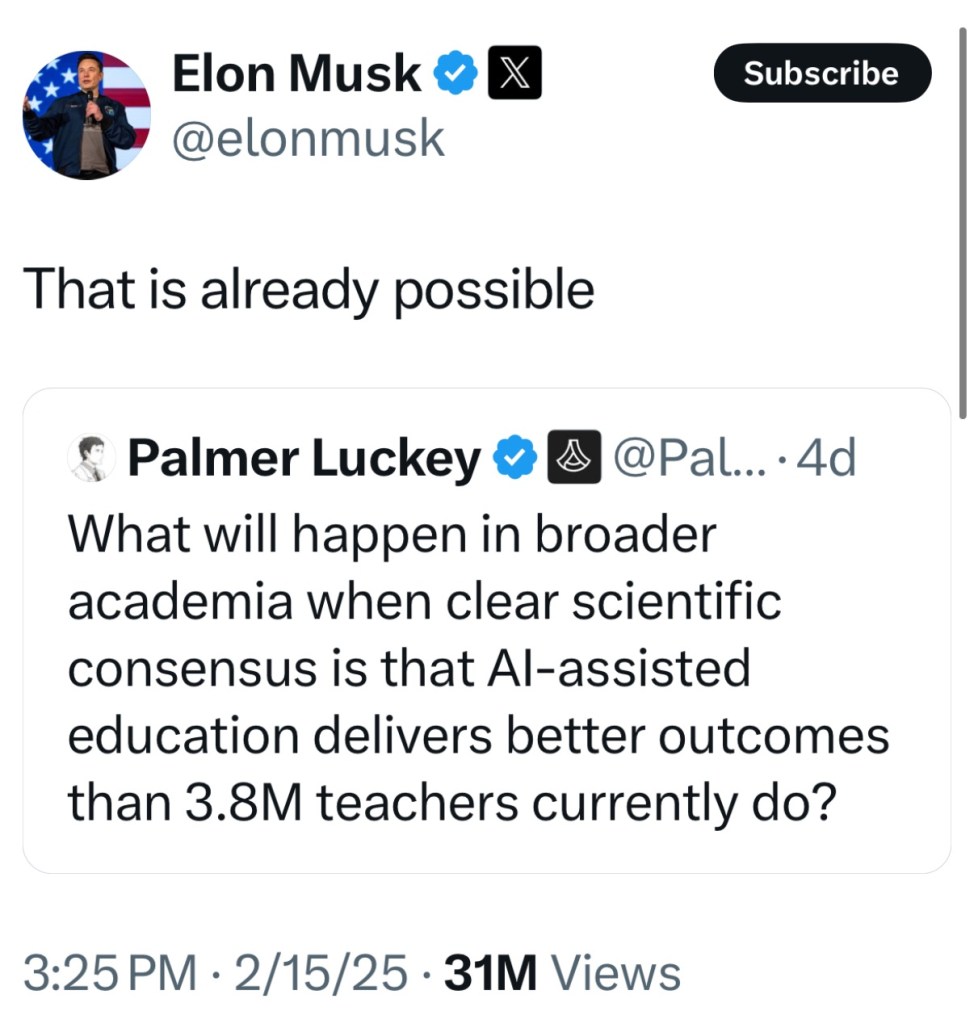
We’re asking if AI will replace teachers, but we should be asking: is AI already replacing students in their own learning process?
This question was recently raised on LinkedIn by Elena Beretta, who shared her observations of students leveraging large language models (LLMs) for everything from writing essays and solving homework to debugging code and even drafting theses. The driving force behind this widespread adoption? Increased productivity, she asserted. Students are drawn to the efficiency AI offers, allowing them to complete assignments in a fraction of the time. As Beretta points out, this isn’t necessarily about cheating – universities are addressing that – but about a fundamental shift in how students perceive learning.
Beretta’s insights highlight a crucial trifecta of concerns: the shifting definition of learning, the delegation of “worthwhile” knowledge to AI, and the increasingly difficult role of educators. When productivity becomes the primary goal, the process of learning is devalued. If AI can instantly generate answers, what incentive do students have to grapple with critical thinking, problem-solving, and the development of structured arguments – skills that only improve through dedicated practice? This leads to AI effectively dictating what is “worth” learning, as students bypass the struggle inherent in developing these crucial skills. Consequently, educators are finding themselves in an exhausting loop, becoming less teachers and more AI-police and content verifiers. This begs the question: how can we equip students with the skills they truly need when AI makes it so easy to circumvent the learning process?
I believe this situation underscores a pre-existing and deeply rooted problem in our educational system: the transactional view of schooling. For too long, students have been conditioned to see education as a series of tasks, points, and high-stakes tests, prioritizing metrics and data over genuine intellectual growth and the joy of learning. This transactional approach has already diminished the value of deep learning, and the advent of AI only amplifies this crisis. The “hustle” mentality, focused on efficiency and output, has become even more entrenched.
If we don’t address this fundamental issue, we risk losing any hope of real learning taking place in schools. We need a paradigm shift, moving away from a system obsessed with productivity and embracing a performance-based model that prioritizes meaningful topics and the cultivation of essential skills. What matters most is fostering critical thinking, creativity, and a genuine love of knowledge – qualities that cannot be replicated by AI.
Perhaps the disruption caused by AI can serve as a much-needed wake-up call. It’s time to fundamentally rethink our approach to education and ensure that learning isn’t just about completing tasks quickly, but about developing skills that are truly valuable and relevant for the future. This reality check could be precisely what we need to redefine learning for the better, shifting our focus from mere efficiency to the cultivation of human potential.

 Laura K Spencer, Ed.D.