Tag: AI

  • Trusting Reality: The Impact of AI-Generated Deception

    Trusting Reality: The Impact of AI-Generated Deception

    Plato never heard of a deepfake, but he understood the prison it could build for the human mind.

    I remember reading his Allegory of the Cave my first semester of community college. In the allegory, prisoners are chained to a wall, forced to watch shadows dance across the stone. They have never known anything else, so they believe the shadows are the world. To them, the flickering shapes are not illusions but fundamental truths.

    Does the darkness feel familiar? (Hint: It should…)

    In our time, we are all inhabitants of a new, digital cave. The shadows are no longer cast by firelight but by algorithms designed for engagement at any cost. New AI makes it scarily easy to create believable fakes. It can make fake videos of world leaders saying things they never said, or create totally computer-generated news anchors. It can also make videos of events that never happened, or copy the voices of your family and friends so perfectly it’s chilling.

    Our minds, wired over millennia to trust what our senses tell us, are being turned against us. For most of human history, the simple act of seeing was believing. Then, as photo manipulation became common, our collective skepticism adapted. The mindset shifted from “I’ll believe it if I see it” to a more cynical, “I’ll only believe it if there’s video.” We instinctively clung to the moving image and the human voice as a higher, more reliable bar for truth. But now, that final refuge of sensory trust has collapsed. With AI able to fabricate convincing video and clone voices with chilling precision, that instinct has become our greatest vulnerability. The puppeteers casting shadows on our walls are no longer human. They are automated, relentless, and they leave us all asking, “Now what can I possibly believe?”

    The Corrosion of “I’ll Believe It When I See It”

    When Plato’s prisoner was dragged from the cave into the sunlight, the truth was blindingly painful. For us, stepping into the light means navigating a media landscape so fractured that the very idea of certainty feels like a relic. The danger is not just being fooled by a single fake, but the slow, corrosive effect on our ability to trust anything at all.

    This is the new psychological tax of modern life: that quiet, persistent whisper of doubt. Is this real?

    • Deepfakes don’t just create lies; they breed distrust in the truth.
    • Synthetic images go viral, while the corrections are buried, leaving a permanent stain of doubt.
    • AI can replicate the voice of a trusted colleague or family member, turning our most intimate connections into potential scams.

    That hesitation, that constant, low-level cognitive friction, is the true damage. When we can no longer trust our own eyes and ears, the foundations of our reality begin to crumble.

    When Our Shared World Fractures

    This is more than a crisis of information; it’s a crisis of connection. Plato warned that people who mistake shadows for reality will fiercely defend their illusions, even against those trying to show them the light.

    Today, we see that happening in real-time. The consequences are deeply human:

    • Isolation: We stick to our own groups, where everyone shares the same opinions. This makes us feel validated, but it makes it easy to forget that the people who disagree with us are just as human as we are. We start seeing them as simple “enemies” instead of real people.
    • Erosion of Empathy: Social media sites are built to promote posts that get a big, angry reaction because that’s what gets the most clicks and attention. They don’t care about spreading calm or helpful understanding. This just makes everyone more divided and helps us forget that we’re arguing with real people, not just a username on a screen.
    • Learned Helplessness: With so many lies coming at you all at once, it’s exhausting. It feels easier to just disengage and stop paying attention, instead of doing the hard work of separating fact from fiction.

    This isn’t a distant, dystopian future. It is the world we inhabit now. And unlike Plato’s cave, there is no single, easy exit.

    What It Means to Find the Light Now

    Escaping this new cave doesn’t mean finding one ultimate “truth.” It means reclaiming the human capacity for critical thought, empathy, and discernment. It means choosing to be active participants in reality, not passive consumers of it.

    This requires a conscious, human-centered shift:

    • Question Your Emotions. The most powerful misinformation is designed to trigger an immediate, emotional response. If a post makes you angry, fearful, or self-righteous, pause. That feeling is a signal to scrutinize, not to share.
    • Invest in Human Connection. Rebuild trust in small, tangible ways. Have conversations with people you disagree with. Prioritize local, verifiable sources of information that are accountable to a real community.
    • Embrace Humility. The goal is not to be the person who knows everything, but to be the person who is willing to learn, to admit uncertainty, and to change their mind. Certainty is a trap; curiosity is a path forward.
    The Choice We All Must Make

    Plato’s story wasn’t just about shadows. It was really a warning: people often prefer a comforting lie to a hard truth. It’s easy to get lost in the “shadows,” especially when they’re designed to perfectly match our own opinions, hopes, and fears.

    But our ability to connect as human beings relies on us being brave enough to look away from the screens and toward each other. In this age of AI fakes, being able to see clearly isn’t just a skill. It’s a basic survival tool.

  • The AI Revolution: A Wake-Up Call for Real Learning

    The AI Revolution: A Wake-Up Call for Real Learning


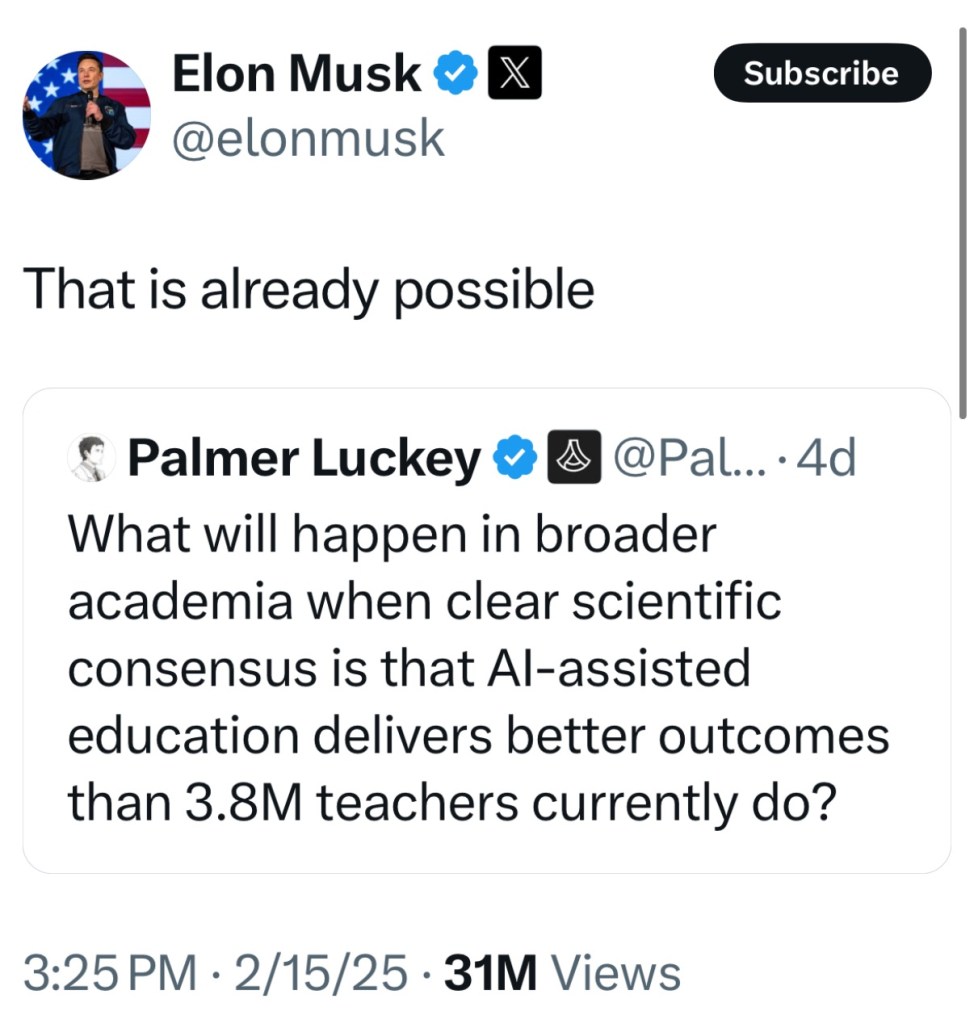
    The recent buzz around AI in education, exemplified by Elon Musk’s assertion that AI-assisted learning can already outperform human teachers, has sparked important conversations. However, I believe we’re focusing on the wrong question.

    We’re asking if AI will replace teachers, but we should be asking: is AI already replacing students in their own learning process?
    This question was recently raised on LinkedIn by Elena Beretta, who shared her observations of students leveraging large language models (LLMs) for everything from writing essays and solving homework to debugging code and even drafting theses. The driving force behind this widespread adoption? Increased productivity, she asserted. Students are drawn to the efficiency AI offers, allowing them to complete assignments in a fraction of the time. As Beretta points out, this isn’t necessarily about cheating – universities are addressing that – but about a fundamental shift in how students perceive learning.
    Beretta’s insights highlight a crucial trifecta of concerns: the shifting definition of learning, the delegation of “worthwhile” knowledge to AI, and the increasingly difficult role of educators. When productivity becomes the primary goal, the process of learning is devalued. If AI can instantly generate answers, what incentive do students have to grapple with critical thinking, problem-solving, and the development of structured arguments – skills that only improve through dedicated practice? This leads to AI effectively dictating what is “worth” learning, as students bypass the struggle inherent in developing these crucial skills. Consequently, educators are finding themselves in an exhausting loop, becoming less teachers and more AI-police and content verifiers. This begs the question: how can we equip students with the skills they truly need when AI makes it so easy to circumvent the learning process?
    I believe this situation underscores a pre-existing and deeply rooted problem in our educational system: the transactional view of schooling. For too long, students have been conditioned to see education as a series of tasks, points, and high-stakes tests, prioritizing metrics and data over genuine intellectual growth and the joy of learning. This transactional approach has already diminished the value of deep learning, and the advent of AI only amplifies this crisis. The “hustle” mentality, focused on efficiency and output, has become even more entrenched.
    If we don’t address this fundamental issue, we risk losing any hope of real learning taking place in schools. We need a paradigm shift, moving away from a system obsessed with productivity and embracing a performance-based model that prioritizes meaningful topics and the cultivation of essential skills. What matters most is fostering critical thinking, creativity, and a genuine love of knowledge – qualities that cannot be replicated by AI.
    Perhaps the disruption caused by AI can serve as a much-needed wake-up call. It’s time to fundamentally rethink our approach to education and ensure that learning isn’t just about completing tasks quickly, but about developing skills that are truly valuable and relevant for the future. This reality check could be precisely what we need to redefine learning for the better, shifting our focus from mere efficiency to the cultivation of human potential.

  • Learning Through Technology: AI in Education

    Learning Through Technology: AI in Education

    I recently had the privilege of being a guest on the Learning Through Technology podcast, where I engaged in a fascinating discussion about the legal and ethical implications of AI in education. Guesting with me was Gretchen Shipley from F3 Law, whose expertise in education law brought valuable insights to our conversation.

    As educators, administrators, and members of the education community, we’re all navigating the rapidly evolving landscape of AI technology in our classrooms and institutions. During the podcast, we explored critical questions about how to harness AI’s potential while ensuring we maintain ethical standards and comply with legal requirements.

    Some of the key topics we covered include:

    • The current state of AI adoption in educational settings
    • Legal considerations when implementing AI tools in the classroom
    • Ethical frameworks for decision-making around AI use
    • Practical guidelines for educators and administrators
    • The importance of maintaining academic integrity while embracing innovation

    I believe this conversation comes at a crucial time as more schools and districts are developing their AI policies and guidelines. Whether you’re an educator already using AI tools, an administrator crafting policy, or simply interested in the future of education, I encourage you to listen to the episode and share your thoughts.

    You can find the episode on the Learning Through Technology podcast platform. After listening, I’d love to hear your perspectives:

    • What has been your experience with AI?
    • What challenges have you encountered?
    • What opportunities do you see for the future?

    Let’s continue this important conversation in the comments below. Your insights and experiences can help shape how we collectively approach AI, both in education and the workforce.

    Check out the podcast episide:

    Fame Host
    Spotify
    Apple podcast


    If you found this discussion valuable, please share it with your colleagues and professional network. The more voices we have in this conversation, the better equipped we’ll be to shape the future of education.

  • From Self-Discovery to Team Symphony: Conducting Collaboration with AI

    From Self-Discovery to Team Symphony: Conducting Collaboration with AI

    In my last post, I shared my excitement about using personality assessments and AI to understand my team and myself better. Since then, I’ve embarked on a fascinating journey of discovery and growth. Remember how I mentioned using AI to analyze our different strengths and preferences? Well, things have gotten even more interesting!

    One of the biggest “aha!” moments came when I started using AI to analyze my communication styles. As a Storyteller-Guide, I naturally lean towards sharing anecdotes and offering guidance. However, AI revealed that some of my team members, particularly those with a strong preference for factual data and concise language, sometimes found my communication style a bit overwhelming.

    This realization was a bit of a wake-up call! I was initially a little disheartened, wondering if my natural way of communicating was hindering rather than helping. But then, I remembered the core principle of this whole exercise: understanding and appreciating our differences.

    So…with the help of AI, I started experimenting with different communication approaches. For instance, when presenting ideas, I am making a more conscious effort to balance my storytelling with clear action plans and post-meeting concise summaries (which AI tools like Fireflies have been so helpful in creating!). I also encourage others to share their perspectives, ensuring everyone feels heard and understood.

    The results have been remarkable. Not only have meetings become more efficient and focused, but I feel like there is a greater sense of collaboration and mutual respect. We’re learning to “speak each other’s language,” leveraging our diverse communication styles to achieve common goals.

    This experience has reinforced my belief that AI can be an invaluable tool for fostering growth and connection within teams. It’s not about changing who we are, but rather about using AI to bridge the communication gaps and create a more harmonious and productive work environment.

    I’d love to hear your thoughts! How are you using AI to enhance communication and collaboration in your own workplace?

    Let’s continue this conversation in the comments below!

  • My AI-Powered Teamwork Adventure: It’s More Than Just a Label!

    My AI-Powered Teamwork Adventure: It’s More Than Just a Label!

    I’ve always been fascinated by personality assessments. There’s something intriguing about uncovering those hidden strengths and quirks that make us who we are. Lately, I’ve been on a quest to understand not just myself, but my entire team, using a combination of powerful tools and a little help from AI.

    It all started a few years back when I first took the Clifton Strengths assessment. Discovering my top strengths – Strategic, Problem Solver, Catalyst, Storyteller, and Philomath – gave me a new lens through which to view my work and my passions. More recently, I delved into the Kolbe A™ Index, which highlighted my high Quick Start score. This validated my love for innovation and finding new ways to approach challenges. And just recently, I explored Connector Types as part of my executive leadership coaching with Brian Fretwell, which revealed I’m a Storyteller-Guide. This resonated deeply, confirming my inherent desire to inspire and empower others through narratives.

    But here’s the thing: these assessments aren’t just about self-discovery. They’re about understanding how we interact with others. As one of my team members put it, “It’s like having a user manual for each other!”

    That’s where AI comes in. I’m using it to analyze these results and uncover those “aha!” moments that can transform how we work together. For example, AI helped me see that while I thrive on brainstorming and new ideas, some of my colleagues prefer more structure and detailed information.

    This insight has been a game-changer. I am now making a conscious effort to provide clear agendas and detailed follow-up notes, ensuring everyone feels comfortable and informed.

    It’s not about labeling ourselves; it’s about using this knowledge to build stronger relationships and communicate more effectively. It’s about recognizing that “different” doesn’t mean “difficult.” Instead, it means we have a diverse set of strengths to leverage.

    I believe AI can be a powerful tool for personal and team development. It’s like having a coach in your corner, helping you navigate the complexities of human interaction.

    What are your thoughts? Have you used AI in your own development journey? Share your experiences in the comments below!

  • Leading in the Age of Distraction: Clarity, Communication, and AI

    Leading in the Age of Distraction: Clarity, Communication, and AI

    In today’s world, leaders aren’t just battling competing priorities and urgent deadlines; they’re also fighting for their team’s attention. We’re drowning in a sea of information – emails, messages, notifications – all vying for a slice of our already fragmented focus. It’s no wonder that even with constant communication, many teams still struggle to stay aligned and informed.

    Years ago, I came across a powerful concept from Patrick Lencioni, author of The Advantage: employees don’t truly believe a leader’s message until they hear it seven times. Seven times! This highlights the critical need for clarity and consistent reinforcement in leadership communication.

    But how can leaders achieve this level of clarity and repetition without overwhelming their teams with even more information? The answer lies in strategic messaging and leveraging the power of AI.

    Strategic Messaging: The Foundation of Effective Communication

    Before we even consider AI, we need to ensure our messages are strategically crafted. Ask yourself:

    • Is the message clear and concise? Can it be easily understood and remembered?
    • Is it relevant to the audience? Does it address their needs and concerns?
    • Is it aligned with the overall goals and values of the organization?
    • Is it being communicated through the most effective channels?

    Once we have a clear and compelling message, we can leverage AI to amplify its impact.

    AI-Powered Communication: A Concrete Example

    One powerful way AI can enhance communication is through personalized messaging. Imagine being able to tailor your communication to each individual on your team, taking into account their preferred communication style, their learning preferences, and their level of understanding. I promise, it’s not as hard as you think.

    Here’s how you can do this using AI-powered tools:

    1. Gather data on your team’s communication preferences: Use surveys, feedback forms, or even analyze past communication patterns to understand how each individual prefers to receive information. Some might prefer concise bullet points, while others might respond better to visual aids or storytelling. You’d be surprised how many different responses you will get.
    2. Utilize an AI writing assistant: Tools like Jasper.ai or GrammarlyGO allow you to input your core message and then generate variations tailored to different audiences. You can specify the tone (formal, informal, encouraging), the style (concise, detailed, persuasive), and even the desired emotional impact. You can, of course, also use the basic tools like ChatGPT for this.
    3. Personalize the delivery: Some might prefer email, others might prefer a messaging platform like Slack, and some might benefit from a personalized video message. You may be able to use AI to automate the delivery of your message through the preferred channels of each team member. (I’m still playing with this option, but it’s limited depending on what tools you use.)

    By personalizing your communication in this way, you can increase the chances that your message will be heard, understood, and acted upon. You’ll not only reach the magical “seven times” but also ensure that each interaction is meaningful and impactful.

    The Future of Communication

    AI is not about replacing human connection; it’s about enhancing it. By leveraging AI to communicate more strategically and effectively, leaders can build stronger relationships, foster greater understanding, and drive better outcomes. In a world of distractions, AI can help us cut through the noise and ensure our messages truly resonate.