Tag: technology

  • The AI Revolution: A Wake-Up Call for Real Learning

    The AI Revolution: A Wake-Up Call for Real Learning


    The recent buzz around AI in education, exemplified by Elon Musk’s assertion that AI-assisted learning can already outperform human teachers, has sparked important conversations. However, I believe we’re focusing on the wrong question.

    We’re asking if AI will replace teachers, but we should be asking: is AI already replacing students in their own learning process?
    This question was recently raised on LinkedIn by Elena Beretta, who shared her observations of students leveraging large language models (LLMs) for everything from writing essays and solving homework to debugging code and even drafting theses. The driving force behind this widespread adoption? Increased productivity, she asserted. Students are drawn to the efficiency AI offers, allowing them to complete assignments in a fraction of the time. As Beretta points out, this isn’t necessarily about cheating – universities are addressing that – but about a fundamental shift in how students perceive learning.
    Beretta’s insights highlight a crucial trifecta of concerns: the shifting definition of learning, the delegation of “worthwhile” knowledge to AI, and the increasingly difficult role of educators. When productivity becomes the primary goal, the process of learning is devalued. If AI can instantly generate answers, what incentive do students have to grapple with critical thinking, problem-solving, and the development of structured arguments – skills that only improve through dedicated practice? This leads to AI effectively dictating what is “worth” learning, as students bypass the struggle inherent in developing these crucial skills. Consequently, educators are finding themselves in an exhausting loop, becoming less teachers and more AI-police and content verifiers. This begs the question: how can we equip students with the skills they truly need when AI makes it so easy to circumvent the learning process?
    I believe this situation underscores a pre-existing and deeply rooted problem in our educational system: the transactional view of schooling. For too long, students have been conditioned to see education as a series of tasks, points, and high-stakes tests, prioritizing metrics and data over genuine intellectual growth and the joy of learning. This transactional approach has already diminished the value of deep learning, and the advent of AI only amplifies this crisis. The “hustle” mentality, focused on efficiency and output, has become even more entrenched.
    If we don’t address this fundamental issue, we risk losing any hope of real learning taking place in schools. We need a paradigm shift, moving away from a system obsessed with productivity and embracing a performance-based model that prioritizes meaningful topics and the cultivation of essential skills. What matters most is fostering critical thinking, creativity, and a genuine love of knowledge – qualities that cannot be replicated by AI.
    Perhaps the disruption caused by AI can serve as a much-needed wake-up call. It’s time to fundamentally rethink our approach to education and ensure that learning isn’t just about completing tasks quickly, but about developing skills that are truly valuable and relevant for the future. This reality check could be precisely what we need to redefine learning for the better, shifting our focus from mere efficiency to the cultivation of human potential.


  • Learning Through Technology: AI in Education

    Learning Through Technology: AI in Education

    I recently had the privilege of being a guest on the Learning Through Technology podcast, where I engaged in a fascinating discussion about the legal and ethical implications of AI in education. Guesting with me was Gretchen Shipley from F3 Law, whose expertise in education law brought valuable insights to our conversation.

    As educators, administrators, and members of the education community, we’re all navigating the rapidly evolving landscape of AI technology in our classrooms and institutions. During the podcast, we explored critical questions about how to harness AI’s potential while ensuring we maintain ethical standards and comply with legal requirements.

    Some of the key topics we covered include:

    • The current state of AI adoption in educational settings
    • Legal considerations when implementing AI tools in the classroom
    • Ethical frameworks for decision-making around AI use
    • Practical guidelines for educators and administrators
    • The importance of maintaining academic integrity while embracing innovation

    I believe this conversation comes at a crucial time as more schools and districts are developing their AI policies and guidelines. Whether you’re an educator already using AI tools, an administrator crafting policy, or simply interested in the future of education, I encourage you to listen to the episode and share your thoughts.

    You can find the episode on the Learning Through Technology podcast platform. After listening, I’d love to hear your perspectives:

    • What has been your experience with AI?
    • What challenges have you encountered?
    • What opportunities do you see for the future?

    Let’s continue this important conversation in the comments below. Your insights and experiences can help shape how we collectively approach AI, both in education and the workforce.

    Check out the podcast episide:

    Fame Host
    Spotify
    Apple podcast


    If you found this discussion valuable, please share it with your colleagues and professional network. The more voices we have in this conversation, the better equipped we’ll be to shape the future of education.

  • Beyond the Cat Pictures: How AI is Reshaping Our World

    Beyond the Cat Pictures: How AI is Reshaping Our World

    Remember that blog post I wrote back in 2020 about AI being “dumb” (Here’s a link if you forgot)? It’s funny to look back at it now and see how much has changed. Back then, I was marveling at AI’s limitations – the wonky cat faces, the bizarre ice cream flavors. It seemed like AI had a long way to go before it could truly be useful.

    But here we are in 2024, and the AI landscape has undergone a dramatic transformation. AI is no longer just a novelty; it’s rapidly becoming an integral part of our world, influencing everything from how we work and communicate to how we learn and make decisions.

    Remember how I talked about AI needing human supervision to be effective? That’s still true, but the potential for humans and AI to collaborate has expanded in ways I couldn’t have imagined back then.

    Think about it:

    • AI is helping us personalize experiences, from education to entertainment. Imagine a world where learning is tailored to individual needs and preferences, where entertainment is curated to match your unique tastes.
    • AI is empowering us to make more informed decisions, in our personal and professional lives. Imagine having access to tools that can analyze vast amounts of data and provide insights that would otherwise be hidden, helping us make better choices in everything from healthcare to finance.
    • AI is automating tasks, freeing us from mundane work and allowing us to focus on more creative and meaningful endeavors. Imagine a world where we have more time to pursue our passions, connect with others, and make a difference in the world.

    Of course, there are still challenges to address. We need to ensure that AI is developed and used ethically and responsibly, and we need to prepare ourselves for the changes that AI will inevitably bring to our lives and our work.

    But the possibilities are truly inspiring. AI has the potential to enhance our lives in countless ways, helping us to be more efficient, more creative, and more connected.

    Looking back, it’s clear that I underestimated AI’s potential. But I also see that my core belief – that human ingenuity and empathy are essential – remains as true as ever. As AI continues to evolve, it’s up to us to embrace these new tools and shape a future where AI empowers us to reach our full potential.

    And hey, let’s not forget to take a moment to appreciate how far AI has come since those days of weird cat pictures and questionable ice cream flavors! It’s been quite a journey, and the most exciting chapters are still to be written.

  • Breaking Free from Perfection: How AI Can Help Leaders Embrace a Growth Mindset

    Breaking Free from Perfection: How AI Can Help Leaders Embrace a Growth Mindset

    Part 1: Objective Feedback

    If you read my last post, you know I’m no stranger to AI-powered roasts. (Spoiler alert: I didn’t fare so well.) But beyond the virtual burns, that experience sparked a deeper reflection on the pressure we face as leaders to be perfect.

    Newsflash: it’s exhausting.

    Instead of chasing an impossible ideal, I think this is a good place to inject a growth mindset, and AI can actually help us do that. In this series, we’ll explore how AI-powered tools can provide objective feedback, helping us identify blind spots and become more authentic leaders.

    Ready to ditch the pressure and embrace a more human approach? Let’s dive in!

    The Feedback Dilemma

    As leaders, we all know that feedback is essential for growth. But let’s face it, seeking and receiving feedback can be challenging. We might fear negative criticism, encounter bias from human sources, or struggle to gather feedback consistently.

    This is where AI can step in. AI-powered tools can analyze our communication patterns, decision-making processes, and even our emotional intelligence to provide unbiased insights that might otherwise be missed. How cool is that?

    AI and the Art of Email Analysis

    One area where AI shines is in analyzing written communication, such as emails. Think about it: how often do we send emails without giving much thought to the tone or underlying message we’re conveying? I send dozens of emails a day and can honestly admit that I don’t often think twice about what I am sending.

    But AI can detect subtle nuances in our language that we might not even be aware of. It can identify hints of negativity, passive-aggressiveness, or even excessive formality that could be hindering effective communication.

    To illustrate this, imagine you have two employees, Employee A and Employee B. Employee A consistently exceeds expectations, while Employee B seems to be struggling. As a leader, you want to understand how your communication style might be impacting their performance.

    Now, imagine using an AI tool to analyze your email interactions with each employee. The AI could identify subtle differences in your tone, the types of feedback you provide, and even the frequency of your communication.

    Perhaps the AI reveals that you tend to be more positive and encouraging with Employee A, while your communication with Employee B is more critical and directive. It might also highlight that you provide more frequent feedback to Employee A, while Employee B receives less guidance and support.

    These insights can be invaluable in prompting self-reflection. Are you inadvertently contributing to Employee B’s struggles by creating a less supportive environment? Are you providing equal opportunities for growth and development to both employees?

    Armed with this objective feedback, you can take steps to adjust your leadership approach. You might make a conscious effort to provide more positive reinforcement to Employee B, offer more frequent guidance, and create a more encouraging environment for their development.

    Ethical Considerations

    Of course, it’s crucial to use AI responsibly and ethically. Privacy is paramount, and any personal identifiers should be removed before analyzing communication data.

    Furthermore, leaders should be mindful of the potential for misinterpretation of AI-generated insights. It’s important to use these insights as a starting point for reflection and discussion, rather than as absolute truths.

    Let’s Try It

    Ready to try this out for yourself? Here’s how you can use AI to analyze your emails and gain valuable insights into your communication style:

    Choose an AI Tool:

    Several AI writing assistants and language analysis tools are available. Experiment with a few to find one that suits your needs and preferences. (Note: Be sure to choose a tool that prioritizes privacy and data security.)

    Prepare Your Emails:

    De-identify: Remove any personal information, such as names, email addresses, and specific details that could compromise privacy. You can replace these with generic placeholders like “Employee A” or “Client X.”
    Format: Ensure your emails are in a format that the AI tool can easily process, such as plain text or a compatible document format.

    Craft Your Prompt:

    Here are examples of prompts you can use:

    For a Single Email:
    “Analyze the tone and language of this email. Identify any potential areas for improvement in terms of clarity, conciseness, and professionalism. Are there any subtle hints of negativity or passive-aggressiveness? How could this email be improved to ensure the message is conveyed effectively and respectfully?”

    For a Group of Emails:
    “Analyze this set of emails for patterns in communication style. Are there any inconsistencies in tone, level of formality, or types of feedback provided? Do any biases or preferences emerge in how I communicate with different individuals? What overall impression do these emails convey about my leadership style?”

    Experiment and Iterate:

    Don’t be afraid to experiment with different prompts and AI tools to find what works best for you. Remember to reflect on the insights you receive and consider how you can apply them to improve your communication and leadership skills.

    Important Note: Always review the AI’s analysis critically. Remember that AI is a tool, and its interpretations are not absolute truths. Use your own judgment and experience to determine how to best apply the insights you gain.

    The Journey of Growth

    Embracing a growth mindset is a continuous journey, and AI can be a valuable companion along the way. By providing objective feedback and helping us identify areas for improvement, AI can empower us to become more self-aware, authentic, and effective leaders.

    In the next installment of this series, we’ll explore how AI can help leaders identify their blind spots and leverage those insights for personal and professional growth. Stay tuned!

  • Reflect On Our Practice

    “We are generating more information and knowledge than ever today, but knowledge is only good if you can reflect on it.”

    Thomas L. Friedman, Thank You for Being Late: An Optimist’s Guide to Thriving in the Age of Accelerations

    I had the pleasure of being interviewed the other day by an educator pursuing an advanced degree in educational technology.

    It was a pleasure because her interview questions made me reflect on my current practices, my past practices, and my reasons for each.

    All great interviews should involve both parties walking away feeling like they have both contributed and learned something – whether it be for a job, or a research paper, or a podcast.

    I share with you abbreviated forms of her questions so that you, too, can reflect on the work you do. And hey, if you want to share an answer, that’d be fabulous.


    1. As part of my master’s program, I was asked to develop a professional development (PD) course around Universal Design for Learning.  This PD was designed for the learning to happen over several weeks.  However, in my current school district, PD days are booked at the beginning of the year, and there are many competing initiatives all promoted at the district level so that it becomes close to impossible to do any PD that extends beyond an hour because there is a need to provide PD for the wide range of initiatives.  Do you have similar issues in your district?  If so, how do you work to provide some long term, meaningful PD?

    2. Currently, our district provides PD as a one size fits all approach.  I believe part of this strategy is for accountability. How do you help move the district to more differentiated learning for staff?  How do you get administrative buy in?

    3. At one time, our 1:1 program encouraged parents to think of the Chromebook as a family tool.  Parents were encouraged to get their own email accounts and to log into their student’s device in order to look for jobs, pay bills and to work towards increasing their employable skills by becoming more proficient with technology.  However, concerns have prompted the tech department to lock down all devices so that they now may only be used with a district email address, thus taking the tech away from the parents. Can public schools close the digital access and equity divide for both students and families, or are 1:1 programs actually contributing to the divide?

    4. As part of our master’s program, we have been encouraged to become familiar with UDL, OER, Copyright, Creative Commons and Internet Use Agreements.  How would you prioritize the importance of these in your daily work and why?  When looking for new members for your educational technology team, which of these would you consider to be most important for an applicant to have expertise with?

    5. If you could suggest areas of focus for people entering the field of educational technology to have, what would you suggest?  Why?

  • BurnBook – An App Created for Bullying?

    BurnBook – An App Created for Bullying?

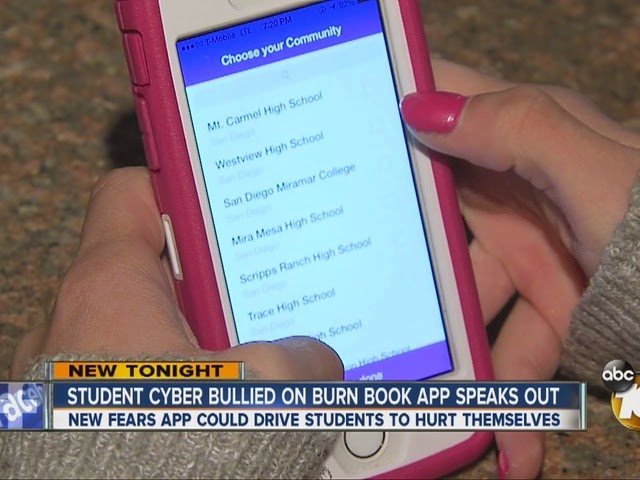
    Photo from 10News: http://goo.gl/HcKI4E

    I shared the below information with my management team today as Burn Book seems to be the latest and greatest way for high school students to cyber bully. Feel free to modify and use if needed.

    But more importantly, I encourage you to read this blog post by a high school student about the impact these types of apps have on people: http://goo.gl/Ls4Tv8
    By now, most of you have probably heard of an app called BurnBook.

    Burn book allows students to anonymously post comments about anything. They choose their school, and then start posting. There are a lot of mean comments about other students and teachers being posted on the app, and occasionally threats to the safety of the school’s campus.

    I began monitoring the app the other day, and so far, it seems to be focused on high schools. 

    The high school district personnel have started a campaign to talk to students on all their campuses about the seriousness of posting threats on the app. Because of this, there may be a temporary increase in student curiosity as older siblings come home and share the information. And this morning San Marcos responded to a school threat posted via the app (http://goo.gl/kP8f9z) so that will be on the news this evening. 

    Unfortunately, we can’t block access to the app because students are using their own devices to access it.  What we can do, however, is remind students about the impact cyberbullying can have on others. And also let students know that anonymous does not mean untraceable – IP addresses are recorded by the app and can be used to trace people posting serious threats.

    More Information: 
    Burnbook App CEO Promises Change After School Threat – http://goo.gl/Hqwahm 
    Burnbook: Can An Annonymous App Have a Conscience – http://goo.gl/Nsy1RC