Year: 2019

  • Imagining Joyful Learning Spaces

    Imagining Joyful Learning Spaces

    This past month our innovation team has been fortunate to work with a school staff that is looking to reimagine their library space. Currently a traditional space with plain walls, a large circulation desk, and giant book shelves, the staff is wanting to build a space that reflects the joy of learning they want students to experience every day. In their words:

    Imagine a space where students of all ages and adults could create, innovate, and explore the world in an inspiring and natural environment designed to enlighten and change the world! Students need a way to access a variety of learning and discovery spaces in order to respect their age and place in the world and ignite their inner genius and advance the world.

    We’ve been using the design thinking process to guide us on the journey, which has been a fabulous way to keep us grounded in the WHY of our work. Today, I realized that a consistent theme kept reemerging during every brainstorm or prototype session – JOY.

    Adults design schools. Adults who have been schooled for years on how to build buildings. And then adults come in and furnish those buildings. They paint the walls. They choose the chairs. Somewhere in that process, the children become secondary. And often times, so does joy.

    Which brings me to the book Joyful by Ingrid Fetell Lee.

    In her book, Fetell Lee points out that joy isn’t reserved for religious gurus that have attained enlightenment. In fact, it can be found all around us. She summarizes 10 big ideas in which joy can be found:

    1. Harness the power of color.
    2. Live abundantly.
    3. Find your freedom.
    4. Discover harmony.
    5. Fill your life with playful shapes.
    6. Surprise yourself.
    7. Go higher.
    8. Feel the magic.
    9. Spread the love.
    10. Start anew.

    Schools, and libraries, should truly be places of joy. They should allow for playful wonder. Fetell Lee explains that “play etches itself deeply into our memories for a good reason: it is the only known activity that humans engage in solely because it produces joy. ”

    Play lets us practice give-and-take, through which we learn empathy and fairness. It also promotes flexible thinking and problem solving, which increases our resilience and help us adapt to change. When we play, our awareness of time diminishes, and our self-consciousness fades. Play can put us in a powerful flow state, which allows us to let go of everyday worries and be absorbed in the joy of the moment.

    Joyful, by Ingrid Fetell Lee

    Children understand joy. All you have to do is listen to them dream up the new library to know that they can see that which adults often forget. Their vision of the space includes waterfalls, cafes, and a loft… they see color, comfortable seats, and places for both quiet and social gatherings. They hear music and feel texture. They break down the barriers and let in nature’s beauty. They get it.

    And so did the adults in the room today. I’m excited for the future wonder and joy that awaits the students and staff as they turn their prototypes into a joyful place that ignites genius and empowers students to advance the world.

    Stay tuned…

  • Empathy Can Sneak Up On You!

    “If we want people to fully show up, to bring their whole selves including their unarmored, whole hearts—so that we can innovate, solve problems, and serve people—we have to be vigilant about creating a culture in which people feel safe, seen, heard, and respected.”

    ― Brené Brown, Dare to Lead: Brave Work. Tough Conversations. Whole Hearts.

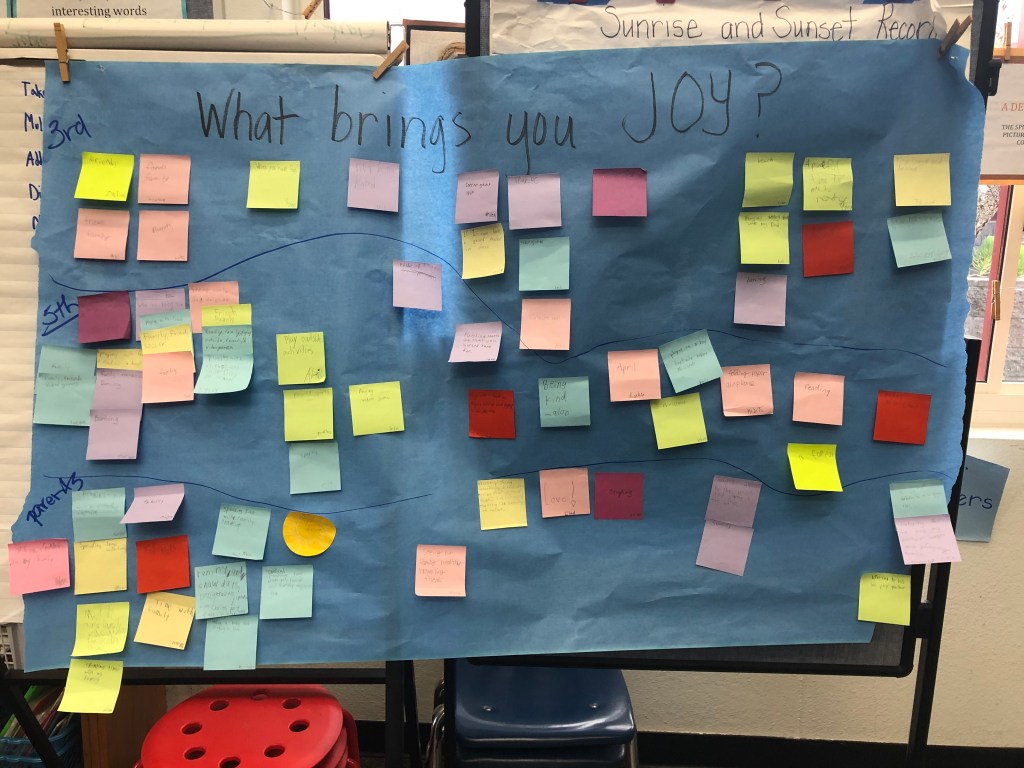
    A while back I received an email from a 3rd grade teacher asking me to help her and the music teacher develop an integrated design thinking challenge for the class that would meet both ELA standards and music class objectives. During our meeting, we decided to focus on the topic of JOY.

    How might we provide joy to our 5th grade buddies
    through an original music composition?

    We outlined a plan, and I left the teachers to work their magic.

    Today I met with the two teachers because they wanted to discuss how to help 3rd graders empathy map. As the classroom teacher recapped about the experiences thus far, I realized that something far more powerful than just design thinking had already taken place.

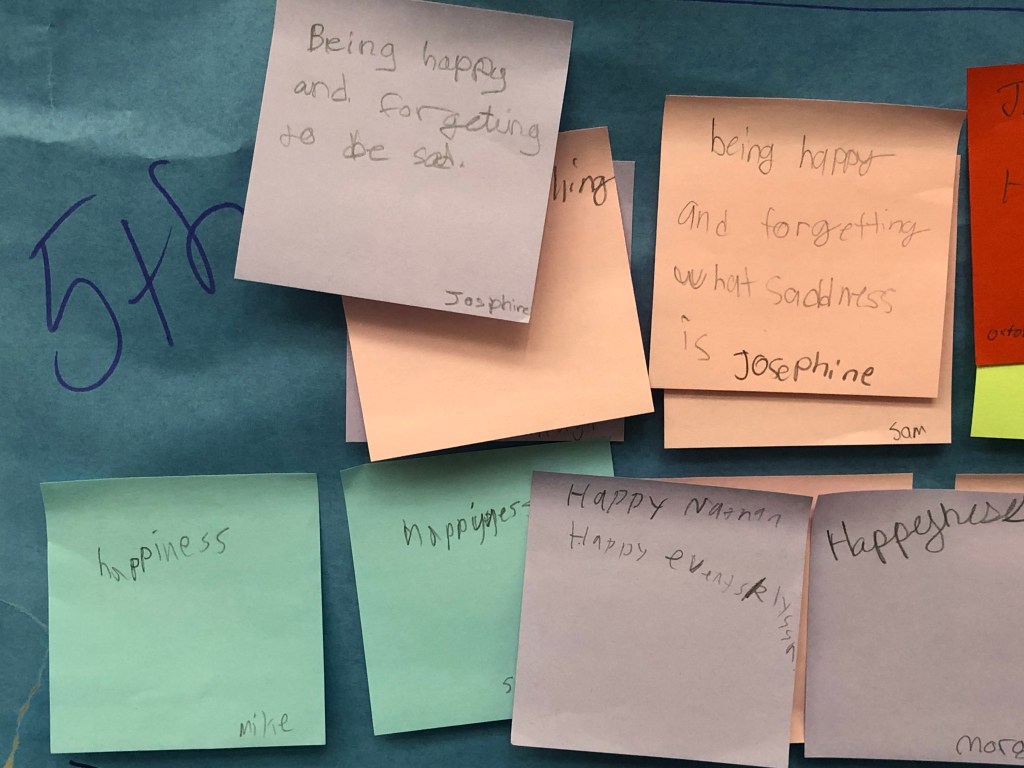
    As part of the empathy and define process of this challenge, students developed a definition of joy, through their own experiences as well as by interviewing 5th grade students and their parents. The 3rd graders quickly noticed some trends arising in the responses received – many noted happiness; an absence of sadness; and feelings of peace.

    When asked what brings people joy, parents shared moments like seeing family after a business trip, or hearing the laughter of their children.

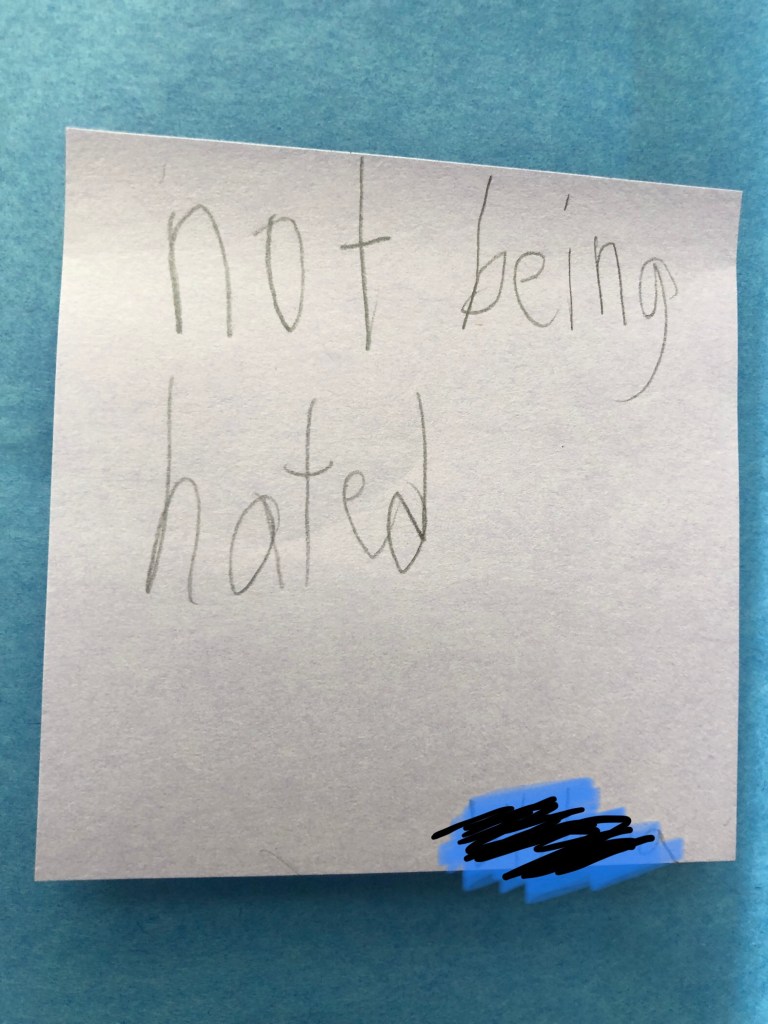
    But for one third grader, the answer was very different: not being hated.

    Post-It that says "not being hated"

    Whoa…

    What do you do with an answer like that? For this teacher, she tackled it head on. She asked the class, “Have you ever felt hated in this classroom?” Because she had created a safe place for them to share, a few did share moments when a peer situation made them feel less than loved…hated, even.

    Reflecting on the situation, the teacher shared that, even if their musical projects don’t turn out as well as she wants them to, this project is a success because it opened her eyes to the depth of feelings these kiddos have, the complexities of their lives at such a young age, and her need to continue with social-emotional lessons.

    That’s the thing about empathy… it can catch you when you least expect it. It doesn’t require an empathy map template or a Post-It. It requires an open heart and a receptive ear, and the capacity to be vulnerable so that you are open to the experiences of others.

    I’m always grateful to the teachers that take these risks for our students, and even more grateful when they share their learning with me. It reminds me of how valuable our role is, and how important these authentic moments are to both students and adults.

    Humble thanks.

  • Innovators Unite: Closing Day at #SXSWEDU

    Innovators Unite: Closing Day at #SXSWEDU

    When we go to conferences like this one, we load up on ideas that are going to get us to progress. We have our little tote bag – we’re going to fill it up with ideas. We hear about a new strategy…a new tech tool…we hear about all these great programs other people are doing… by the time we’re done, we are FIRED UP, we are PUMPED, we are ready to go to progress.
    And then we get back to our schools…”

    – Jennifer Gonzalez in her closing keynote

    I’m writing this post from San Diego. Although I am glad to be home with my family and sleeping in my comfy bed, I am sad to have left #SXSWEDU.

    Innovation is hard work, especially within an established institution like K-12 schooling. It can be isolating to realize that not everyone sees or believes in your vision for change.

    That’s why I love SXSWEDU so much. It’s like finding the holy grail of like-minded educators. Thousands of them! It feeds my soul, refills my bucket, and gives me hope and inspiration moving forward.

    So it was perfect that the final day’s keynote, by Cult of Pedagogy founder Jennifer Gonzalez, focused on the Aerodynamics of Exceptional Schools. Jennifer reminded the audience that our excitement and ideas and leaving a conference like SXSWEDU isn’t always met with open arms from eager colleagues. In fact, often it can be met with resistance or hostility. Therefore, how change is introduced is just as, if not more, important than the change itself.

    Her tips were on point, and I’d encourage you to watch the entire presentation on your own. But in the meantime, here’s the Reader’s Digest version of her tips:

    1. Take a breath – ask yourself – what problems does this solve? What are obstacles? Do I have proof? Can I find a guide? What is my long-term vision?
    2. Find allies – (as illustrated with the infamous Dancing Guy video) – When you have a group, it helps you to clarify your vision, it helps you to deal with negativity, and it also makes your crazy ideas seem a little less crazy to other people
    3. Set precise goals – different from dreams. “DO” Genius Hour is a dream. Goal is dates, specifics, etc. Backwards map the plan to reach the goal.
    4. Expect bumps – build in buffer time. Ask “what can we learn?” Celebrate small successes. Come at me, bro – attitude
    5. Invite – too much telling, and not enough asking. Why not a learning menu for adults like we provide to students?
    6. Validate – not same as agreeing. Recognize, affirm the feelings or perspective of another person. Ignoring pushback doesn’t make it go away. 
    7. Be transparent – especially about failures. Makes you more approachable, more accountable, easier to follow – blog, staff meetings, newsletter, bulletin board, video, podcast
    8. Praise – Seek out the positive in those around you, praise them for it, and include their skills in your process

    The final tip was to dig deep. She related the story of a Crossfit participant who always pushes himself further. He isn’t afraid to grunt, to sweat, to go all in when he’s tackling a tough challenge. She encouraged us all to be that guy.

    This talk really resonated with me. I’ll be honest, I feel like the “set precise goals” is a weakness of mine. I like to dream big and build big. Details aren’t always my thing. I want to create the vision and set it loose on others to carry forward.

    But dreams are weird things… think back to the last time you had a really vivid dream. You can picture it like it is still happening. And yet, when you try to explain the dream to a friend, they look at you like you’re crazy. You realize that you forgot part of the narrative, or you can ‘t quite explain the right shade of blue on the 3-headed monster chasing you through the candy store because you stole his favorite Hello Kitty band-aid box.

    When goals stay in dream mode, people have a hard time being part of the narrative. They need to see it all laid out so they can find their part, read their lines, rehearse their scenes. Therefore, I need to (and will) be better at laying out all the components.

    Thank you Jennifer for a fabulous end to the conference, and thank you SXSWEDU for filling my tote bag with ideas. Can’t wait for 2020!

    You can read my #SXSWEDU musings by catching up on Day 1, Day 2, and Day 3 or learn a ton by following the hashtag on Twitter.

  • Amplifiers Create a New Story: Day 3 at #SXSWEDU

    Amplifiers Create a New Story: Day 3 at #SXSWEDU

    …I may ramble in this post. It’s 1am. I’m tired! Have a head cold. But wanted to share my learnings…

    🤪🤪

    Do I really have to go home tomorrow?

    It’s going to be hard to walk away from the synergy of woke educators at this conference, but I know that I have much work to do when I return to San Diego.

    Not the work of answering emails and finishing tasks (although there is plenty of that as well), but the work of amplifying the conversations and ideas that have taken place here the past few days so that words don’t just stay words, but instead become actions.


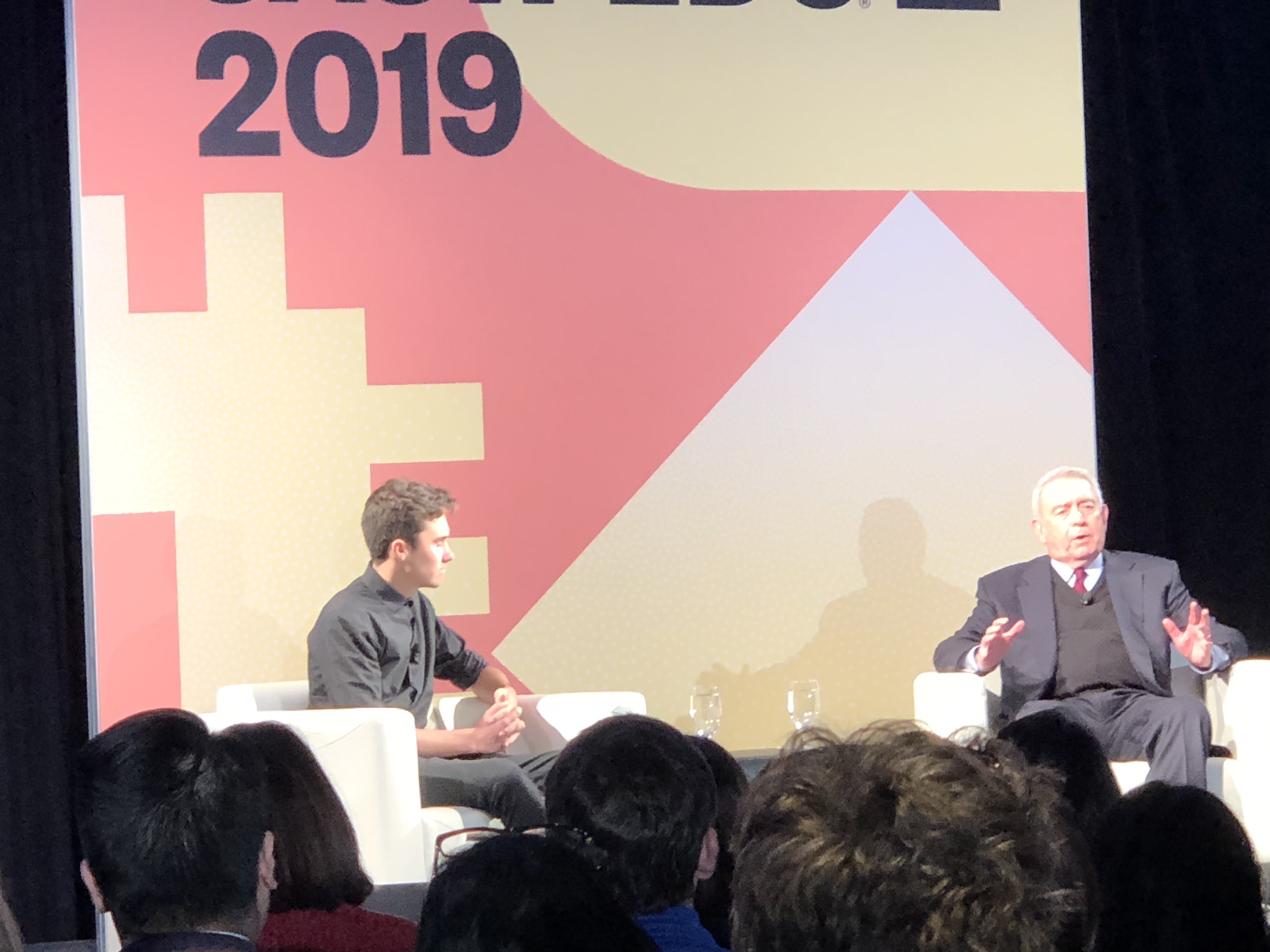
    David Hogg and Dan Rathers sitting in chairs talking
    David Hogg and Dan Rathers

    I started today hearing the voice of the new generation, David Hogg of March For Our Lives, rethink advocacy in this new era. He shared how he had never truly understood what empathy was until he saw his 14 year old sister collapse under the weight of finding out that four of her friends died in the Marjory Stoneman Douglas shooting. As.a teenage boy full of hormones, he didn’t know what to do with those emotions, but he knew he didn’t want shooting to be just another news story with no change/impact.

    Advocacy is born from passion, from desire, from need. So often in education we stifle that drive or relegate to an elective, after school, or GATE program. Education says it is preparing students for the world of work, but when a teenager can say that he never felt empathy until his senior year of high school, then what have we truly prepared them for? What kind of future doesn’t require empathy?

    When pressed as to what prepared Hogg, and others like him, to be advocates, he credited experience with speech and debate classes; theater, TV production, and journalism. The very nature of these programs built the skills needed for activism. Hogg learned that it is not his place to speak for others, because he has not shared their experiences. But he can certainly elevate their voices, spotlight them.

    When Hogg was asked what his advocacy work had accomplished, he paused before explaining, “We’ve accomplished a little in an area where nothing is expected so we’ve accomplished a lot.” This ability to see progress, to chart a path and stick with it, and to amplify voices through empathy… this is how schools should be preparing students not for the world of work, but for the world of life. The world they’re in now.


    There was also a panel of three female teenage entrepreneurs sharing their stories today, and although they weren’t activists like David Hogg, they had a voice that was being amplified through their start-up companies and non-profit organizations. But it wasn’t an easy journey to become a teen entrepreneur.

    Entrepreneurship is like a varsity sport, one of the women explained. “We’re working on it during ALL our spare time..thinking about it all the time. We need adult mentorship outside of the classroom to help us find our way.

    But instead, many received truancy letters for taking time out of school to pursue their passion. “Attending an economic summit in Boston shouldn’t result in punishment at school!” Reminds me of conversations yesterday as to what learning is valued, and how antiquated our current learning value system is. How ironic that students are penalized for being successful outside the school walls.

    Instead of punishing them, the young ladies asked for mentorship, for people to help them amplify their voice and their passions. People who would offer personal reciprocity by sharing their own struggles; helping alleviate self-doubt; and asking tough questions along the way. Sounds like they were asking for support with the soft skills, the skills that matter most.

    One of the women explained, problem solving is just as important as reading and math. As entrepreneurs, they are learning how to fail and grow early. They’re using their creativity to think outside the box to create positive change for society.

    And yet, these opportunities aren’t well integrated in elementary schools because the hard skills are pushed more than innovation. Only the gifted, the affluent, or the lucky get to participate. It doesn’t have to be this way. Some ideas shared were to run a pop up shop for a day as part of an entrepreneur project or to have students pick an inconvenience and design a solution.

    The advice given to one of the entrepreneurs is just as applicable to all the educators in the audience: You need to take the first step before you’re even ready to take it. A small step is better than no step.


    Amplifying voices should be happening all over our schools. “Libraries are like the quarterback [you never knew you had],” so why aren’t school and district leaders leveraging the power we have in our buildings? The library, in many schools, is the biggest classroom in the school. What if we reimagined the space as a systemic gateway to change?

    In the 30 minute Reinvention: Designing Future Ready Libraries session, Carolyn Foote articulated that students deserve access to inviting, accessible, collaborative, flexible, tech-rich and literacy centered libraries that support academic and enriching experiences. I’d add that those spaces also support student passions. They elevate the voice of the students by providing them with the resources needed to find and nurture that voice.


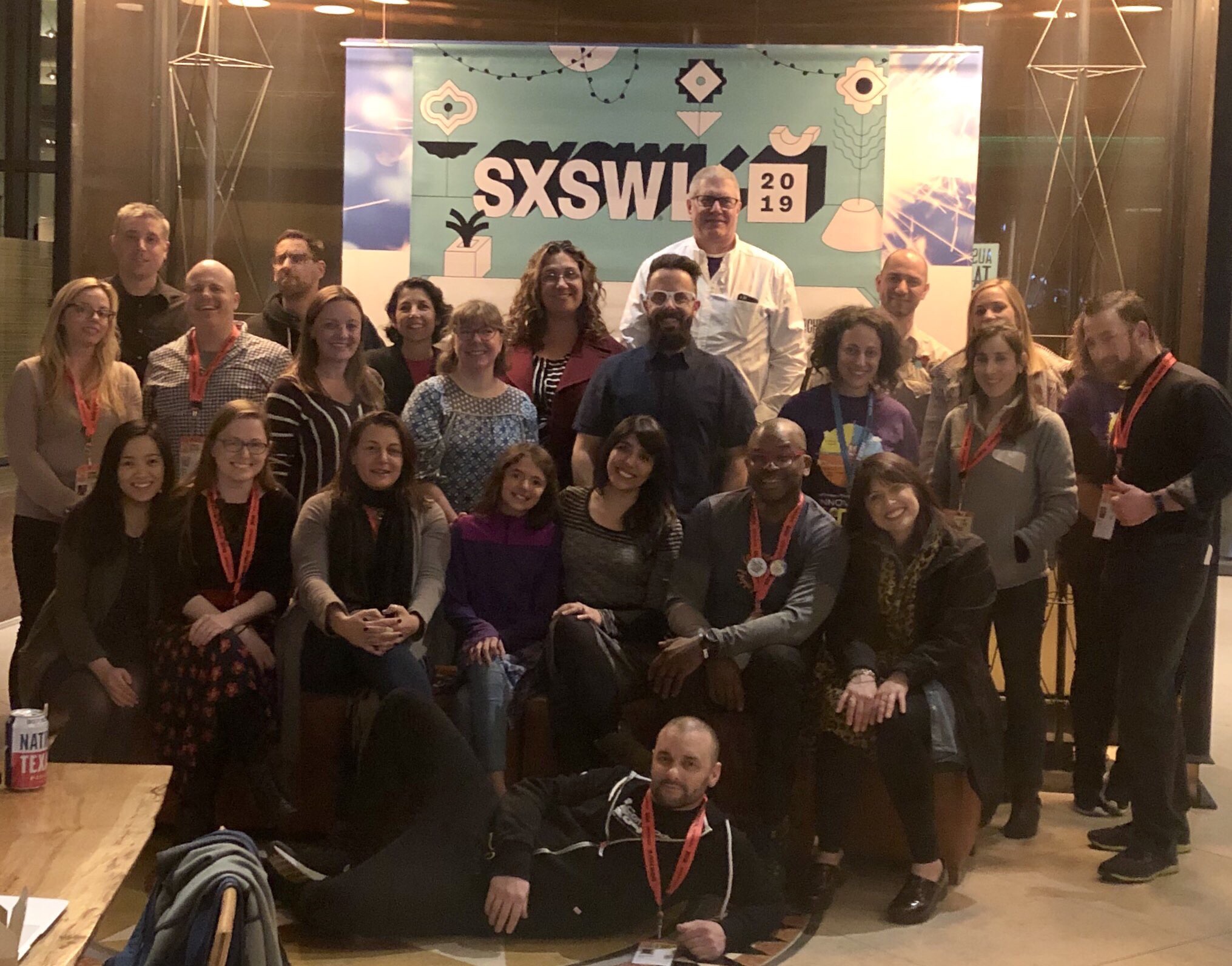
    #dtk12chat crew posing for a photo
    #DTK12Chat Live!

    Like every other day, today wasn’t just about the sessions. It was about the connections made between sessions. The best part of Wednesday at #SXSWEDU is actually the #dtk12chat that happens live from the Hilton lobby. There were so many inspiring stories shared about innovation, transformation, and creative change. More importantly, new friendships were forged, and old friends were embraced.

    Dan Rathers, in the panel conversation with David Hoggs, shared the line from a Barbra Streisand song, “Hearts can inspire other hearts with their fire.” Well, I certainly plan on bringing a fire back to San Diego!

  • Connectors Connect: Day 2 at #SXSWEDU

    Connectors Connect: Day 2 at #SXSWEDU

    Next time I decide to stay up and blog at 1am, I hope I remember how tired I am today and force myself to go to sleep! Seriously… what was I thinking?!?

    Today’s SXSWEDU experience was truly about connections. Yes, I attended some sessions, but a lot of the thought-provoking ideas came from conversations. Here’s my attempt to recap it for my readers (and for me!)

    This morning’s breakfast learning was centered on personalized learning. Elliot Washor from Big Picture Schools talked a lot about how we need a broader understanding of what smart is. Students should be given credit for how they’re learning outside of school. Unfortunately, our current system has biases around what smart is, and how students should learn and understand. If students don’t fit that mold, they are not deemed successful.

    Which is ironic, because school is probably the least likely place for learning to occur. It’s rigid…controlled. Time is predetermined. When to learn, what to learn, when to eat, where to sit, how to write, what to write, etc. It’s hard, virtually impossible, to have agency in that situation. And yet we expect these students to enter the work/college realm ready to make important decisions on their own.

    Testing is individual, but learning is communal. Think about that – Edward Clapp from Harvard discusses the false narrative of the lone creative genius, when we know that every genius got there through connections and conversations with others. Yet we test the individual, and not just test, but test on random knowledge that we have arbitrarily assigned to a grade level.

    Schools still promote a falsely constructed concept that learning is linear, which creates a huge inequitability situation (yes, I may have made up that word…) Students don’t need literacy/numeracy to have complex thoughts. They also don’t need it to develop and/or contribute to creative processes. So why do we take away the exploration courses from students who are in remedial classes…double math instead of robotics or engineering? We need to flip it around. Give those students access!!! Joe, Design 39 Principal, sums it up well. “Our school structures are human-made… if they get in the way, change it. That’s our role.”

    And all that thinking was before 10am! This is why I enjoy SXSWEDU.


    It was the perfect segue into the next session attended, which was The Gift of an Inclusive MakerSpace. Sam Patterson (@SamPatue) opened by reminding the audience that MakerSpace work is about teaching collaboration. It’s not about the circuits. Patrick Benfield elaborates. “If all you have is a hammer, then all the kids end up looking like nails.” Equity and personalization in education means we have to realize that we aren’t just a hammer and the students aren’t just nails. MakerSpaces are a great place to do that because it fosters the collective creative genius.


    Bridging Divides Through Verbatim Performance, a 30 minute presentation by NYU Professor Joe Salvatore (@profjoesal).

    Verbatim Performance is an arts-based investigation grounded in objective observation and precision. It’s not satire, but is a group of ethnodramatists/ ethnoactors who specialize in the techniques and ethics of the form. The performers are charged with ability to have empathy for the person/role they perform in order to truthfully render the performance.

    Why do they do all this, you ask? Because, as actress Anna Deavere Smith explains, “If you say a word often enough, it becomes you.” Verbatim performance disrupts preconceived notions and biases. These actors aren’t just recreating a moment in time. The gender or race roles are switched to force people to look at the moment through a different lens. Through these experiences, the audience is asked to consider what happens to perception and understanding of various moments when the gender of the speakers is flipped.

    There are a few applications of verbatim performance.

    Media literacy
    – Objective/subjective observation
    – Rhetorical devices
    – Point of view

    Building empathy
    – breathing as another person

    Analyzing & Strategizing
    – Embodied analysis
    – Seeing ourselves (much stronger/deeper than watching video)
    – ‘Knowing” the opponent

    Disrupting consumption
    – “Chewing our food” (consuming media – not chewing makes us sick, puke, choke…)

    So what is the role of verbatim performance in my world? I’m excited to explore how to use a simplified version as a way for students to explore empathy for each other, for characters in a book, for adults in society… Can this approach help with social-emotional learning?


    But in all honesty, like I said in the intro, the power of today’s learning was in the conversations.

    Breakfast conversations with Brooke (@TobiaBrooke) and Marisa (@MarisaEThompson) may have inspired Brooke to rethink the concept of learning in her classroom, but it also rekindled an idea to form a community of learners with our neighboring school districts, in which they teach.

    Spending time with the MakerSpace panel after the session to discuss the deconstruction of making and how to inspire students to understand how systems work gave me ideas for new student experiences.

    Talking to Professor Salvatore after his session connected me with an educator who is modifying his work for 3rd graders, and opened my mind to ideas for teachers who are working on a Humans of New York storytelling project.

    Lunch with a Twitter friend I had not yet met was an amazing connection. Kami Thordarson (@kamithor) is doing amazing work on personalized learning through design and technology. Her design camp for teachers has my gears spinning like crazy! And I’m excited to explore collaboration models for professional learning concepts.

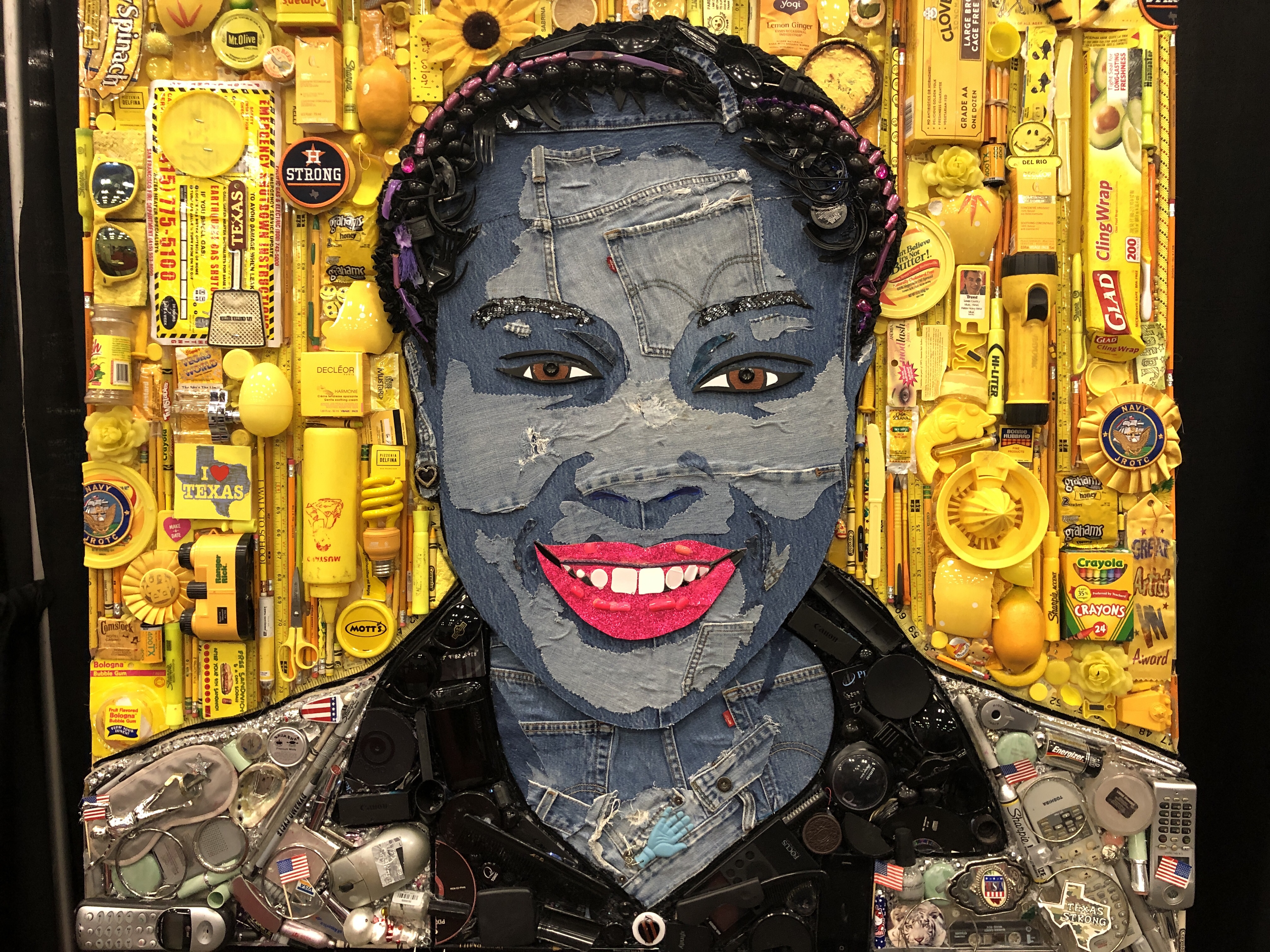
    Exhibition hall connections have me thinking about a variety of topics: different furniture configurations to create happy learning spaces; how to share our learning (#ShareYourLearning) on a larger scale; and how to tell the story of our learners through projects like What We Are Made Of, which is a mosaic portrait series created to uplift student voices and explore the multi-layered experiences of youth across America.

    A photo of a mosaic of an African-American woman surrounded by yellow objects that represent her background.
    What We Are Made Of is a mosaic portrait series created to uplift student voices and explore the multi-layered experiences of youth across America.

  • My Community of Weavers: Day 1 at #SXSWEDU

    My Community of Weavers: Day 1 at #SXSWEDU

    David Brooks, Executive Director of the Aspen Project, kicked off SXSWEDU with a call to all educators to build a community of weavers, and not rippers. According to the program guide, Weave: The Social Fabric Project, operates with the premise that social fragmentation is the central problem of our time—isolation, alienation and division. Weave seeks to work with people that are rebuilding communities and creating social capital to spur a movement to repair the national fabric—to identify and celebrate these groups, synthesize the values that move them, and help forge a common identity.

    These are some key ideas that resonated with me during Brooks’ talk:

    When you’re down in the valley, you can either be broken, or broken open …

    Pain that is not transformed gets transmitted.

    The soul gives us moral responsibility. It yearns for social righteousness

    I’ve never seen a program turn around a life. I’ve only seen relationships turn around a life.

    The thing the heart desires more than anything is fusion with another.

    During the panel discussion after, I felt drawn to Darius Baxter, who at 25 years old, was already co-founder and Chief Engagement Officer of GOODProjects. Darius believes that leading with love, with the heart is critical to get out there and solve problems. He said that we need to see the story of justice in every aspect of life.

    Darius also discussed the need for Localism in education. He reminded us that we experience America differently based on where we live. Southern hospitality is different than New York City hustle and bustle. Urban, rural, and suburban lives are different as well. Schools need to recognize that and innovate for their own needs. Standardized approaches don’t work. Won’t ever work.


    After the keynote, I attended Fact vs Fiction: Why Media Literacy Matters. In this panel talk, the focus was on why people need to be media literate in order to be considered literate in today’s society. Being an active citizen is a key of civics, and people have to understand media to fully participate as an informed citizen. Therefore, media literacy skills can and should be taught in every subject area, and should start in elementary school. Media literacy is a solution-based strategy to deal with information flow and disinformation. But just focusing on truth/false is limiting. Students need to learn the nuance of information and how we process/understand/make information.

    Unfortunately, teachers need training so they understand that critical thinking isn’t the ONLY component of media literacy. Create and Act are also part, since we live in a participatory culture now.

    The panel discussed how “Fake news” has become a cultural joke. Don’t like something? Just call it fake news. This is different than propaganda, which is an intentional spread of misinformation to shift beliefs and actions.

    I also learned about NewsGuard, a Chrome extension to help identify “fake” websites using a rating system algorithm.


    In the Unlocking Time to Fuel Student-Centered Learning session, the focus was on how the structures of time in a school impact and impede student learning.

    Everything in school is time-bound:
    – District/School calendar
    – school bell schedule
    – academic programming (master schedulule)
    – staff time/responsibilities outside the classroom

    Given that, is it any surprise that many students feel like they’re “doing time” instead of learning? How can educators change the mindset to not doing time, but doing learning? The shift needs to happen at all levels of school AND also in the community.

    When you’re “doing time” there is no opportunity for “flow.” The traditional school bell schedule pretty much ensures that once you get started in deep learning, the bell will ring and you have to get your brain to move to a different concept/place for the next class. What adult could function well in that type of environment?


    My last workshop for the day was Engaging Communities in Rethinking Schools. There were some great food for thought statements on the slides, such as:

    “For many years school improvement efforts have been “done to” communities – not “done with” them. That is slowly changing.

    Authentic community engagement begins with a mindset shift: listening first, then working in collaboration with parents and community stakeholders.

    “It takes careful planning and purposeful action to build partnerships that involve school, family, and community.” – Joyce Epstein

    Authentic engagement is not information sharing or feedback gathering, it is meaningful collaboration and shared decision-making

    When engaging stakeholders authentically, conduct outreach early on and report back about how feedback was used.

    Healthy Feedback Loop –
    – Cultivate strong relationships (build trust)
    – Seek Feedback (diverse array of stakeholders)
    – Listen and Learn (analyze feedback trends and share out)
    – Take Action (incorporate feedback into decision making)
    – Share Back (help stakeholders understand how feedback was used
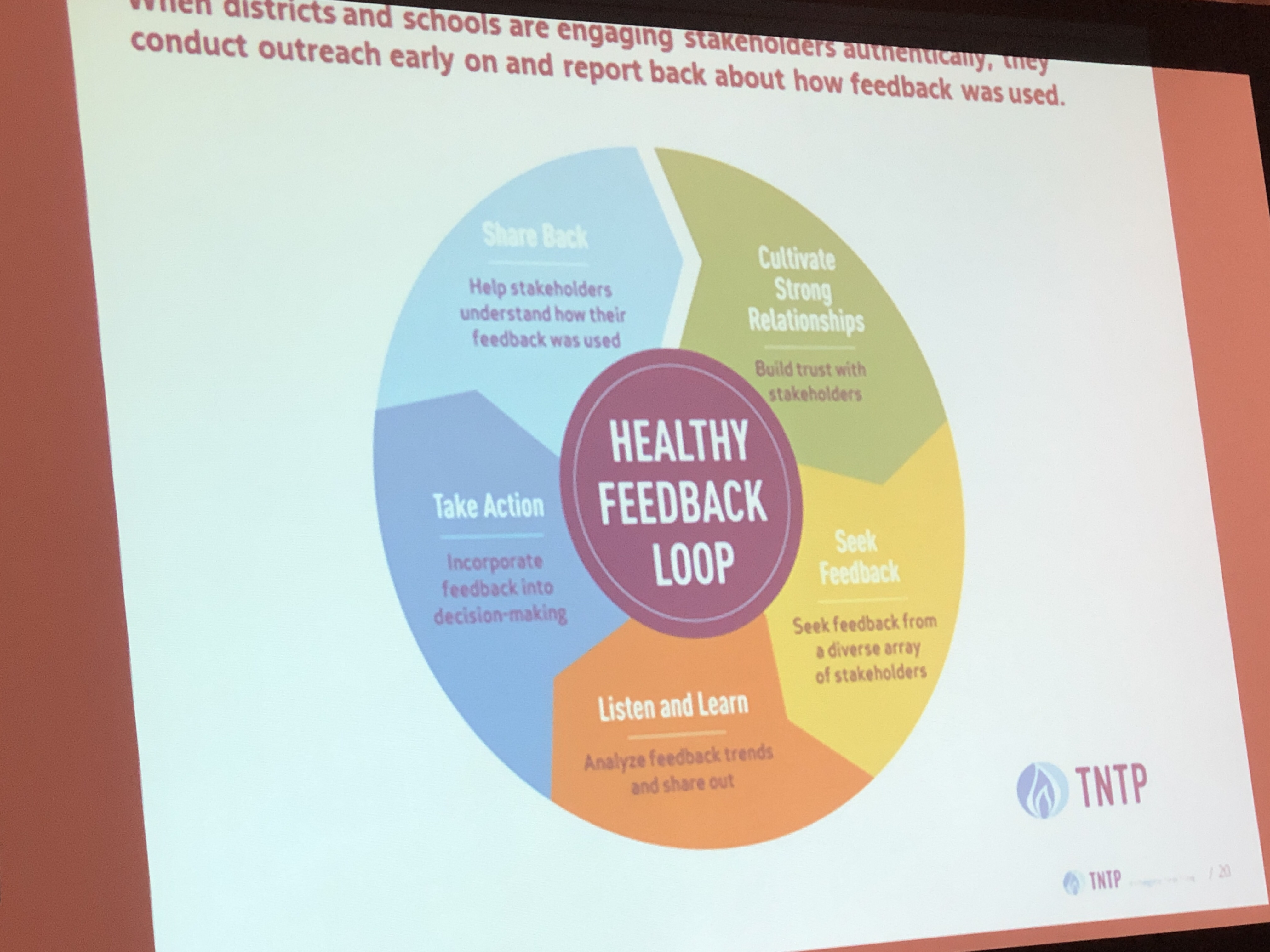
    Healthy feedback loop visual

    Kenya Bradshaw, VP of TNPT, said that many schools/districts place a false sense of urgency in the work we do and then say there was no time for community engagemen. She called “bullsh*t” on most of the excuses, reminding educators that we know the budget cycle and predictions way before cuts need to be made, and that most change initiatives are discussed behind closed doors long before they are brought to the stakeholders most impacted by those changes. And she cautioned that change initiatives won’t stay if you don’t engage the community – it will leave with changes in superintendent, school board, and/or other senior leadership.

    Bradshaw asked, How/When are students included in processes? We do stuff TO students in education, most often without involving them in the process. When done well, authentic engagement has a positive impact on student outcomes, as shown in various research studies cited in the presentation.
    Teachers posing for a groupie.

    The focus on authentic engagement seemed to be the theme today at SXSWEDU, not only in sessions but in my connections with colleagues I haven’t seen since last year’s event… or others I just met today. I’m looking forward to more authentic engagement tomorrow. And seeing that it is almost 1am, I think I need to get some sleep so I’m ready for that!