Tag: DD 2022

  • Speak Up, Rinse, Repeat

    Speak Up, Rinse, Repeat

    From Adam Grant’s Originals book:

    When Harvard professor John Kotter studied change agents years ago, he found that they typically undercommunicated their visions by a factor of ten. On average, they spoke about the direction of the change ten times less often than their stakeholders needed to hear it. In one three-month period, employees might be exposed to 2.3 million words and numbers. On average during that period, the vision for change was expressed in only 13,400 words and numbers: a 30-minute speech, an hour-long meeting, a briefing, and a memo. Since more than 99 percent of the communication that employees encounter during those three months does not concern the vision, how can they be expected to understand it, let alone internalize it? The change agents don’t realize this, because they’re up to their ears in information about their vision. If we want people to accept our original ideas, we need to speak up about them, then rinse and repeat.

    sgleyqm9a6kabbagnlaq

    So then … how often are you speaking up, rinsing, and repeating?

    Can students articulate their individual learning goals and why they have them? What about their parents?

    Can the class as a whole articulate the vision and beliefs of the teacher? Do they know the overarching goals for the school year?

    Do teachers understand the vision and mission of the school, and their role in that vision and mission? What about the rest of the school staff?

    Do principals and district leadership understand the vision and mission of the district, and their role in that vision and mission?

    What steps are needed to make those answers all a resounding YES?

    What’s your “speak up, rinse, repeat” strategy?


  • Crafting a Purpose-Filled Culture

    BookSnap from The Culture Code
    Be ten times as clear about your priorities as you think you should be.

    Three signals are required to create a great culture, according to Daniel Coyle, author of The Culture Code: The Secrets of Highly Successful Groups. One of these signals is crafting purpose.

    “Be Ten Times as Clear About Your Priorities as You Think You Should Be.”

    Executives at 600 companies were asked how many of their employees could name the company’s top three priorities. The executives estimated 64% would be able to name them. Sadly, only 2% were able to do so. Coyle explained that this is not the exception, but the rule, since leaders presume that the people who work for them see things the same way they do.

    This makes me think… As we transform our traditional education system, how do we create a culture in which everyone not only knows the priorities, or vision, but also know how to get there?

    One method Coyle describes is to use artifacts. When environments are filled with artifacts that embody purpose and identity, they reinforce the signal of what matters.

    I saw a fabulous example of this in a school the other day. As the school embraces the principles of design thinking, the principal has started documenting the journey on hallways throughout campus. Her displays reinforce the priority focus on design thinking while also providing a celebratory, collaborative environment for teachers as they embrace the change. And because the displays are in public, often-trafficked hallways, it’s not just teachers receiving the signal. Students, parents, visitors, and support staff are also receiving that signal. She’s crafting a purpose-filled culture.

    In what ways are you crafting purpose for your students? Your teachers? Your school or district?

    Sign up to receive one update when I post. Type your email address in the box and click the “Subscribe” button. My list is completely spam free, and you can opt out at any time.


  • Crafting a New Story of Learning

    Crafting a New Story of Learning

    This was a fascinating read the other night…

    From: Making the World a Better Place Starts with a Really Good Story

    Kathleen: One of the things I saw in the organizations that I interviewed is that they prioritize storytelling, not only at the executive director or CEO level, but at every single level of the organization. Everyone within the organization can be a brand ambassador for the cause, whether it’s a staff member who happens to be at a cocktail party and comes across a donor, or whether it’s a beneficiary talking to a funder about the effectiveness of the work.

    Some of the organizations that I interviewed actually did storytelling practice in their staff meetings. IDEO.org does this storytelling roulette where they spin a wheel, and on the spot, a staff member has to tell a story about a project that they worked on. It’s that repetitive practice that really helps build storytelling skills.

    Nadine: One of the great benefits of doing that is that within the organization, it builds cohesion and alignment around the messaging and the brand. It’s really a powerful internal development tool, as well as an external development tool.

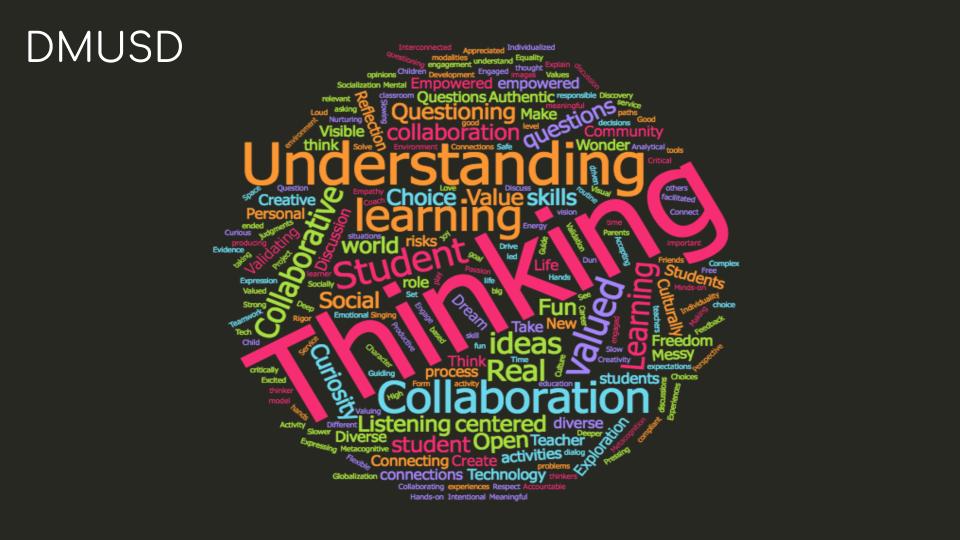
    How are you empowering both staff and students to tell the story of learning at your site? I just spent a day of professional learning with every teacher in our district. Based on an activity in Ron Ritchhart’s Creating Cultures of Thinking, we looked at the story of learning we were told growing up through beliefs, behaviors, expectations, etc. Phrases such as compliance, tracking, and worksheets kept rising up.

    Our district has already spent a year researching what education should look like for our students. We met with industry experts, read countless books, went to conferences across the country, and most importantly, talked to our stakeholders: students, parents, staff, and community.

    With this information, as well as some video and article reads during our professional learning day, we began crafting a new story of education; one that values the unique geniuses of all students through strong instructional practices that promote student agency, collaboration, personalization, cultural intelligence, and design thinking. Our new story has much different phrases:

    Word Clouds from New Sticky Notes

    So how do we build a storytelling culture amongst all our stakeholders? That’s the next chapter we’re writing.

    How are you telling your story? Do you have a storytelling culture, or is a lone storyteller writing your book?

    Sign up to receive an update when I post. Type your email address in the box and click the “Subscribe” button. My list is completely spam free, and you can opt out at any time.


  • Stupid Normal Distribution Curve

    “Life is all about getting A’s. Not some stupid normal distribution curve.”
    – Ken Blanchard, author of over 50 books on leadership

    Ken Blanchard has studied, and written books on, servant leadership. Servant leadership consists of two elements: The visionary role, which is the leadership element of servant leadership; and the implementation role, which is the servant element of servant leadership.
    Screen Shot 2018-02-21 at 8.35.18 PMAccording to Blanchard, the visionary aspect of servant leadership establishes a compelling vision that includes the purpose, the path forward, and the values that will guide the journey. It is, as Blanchard explains, the sense of direction.

    Once the vision is clear, the leaders role shifts into that of servant, in which the leader does all they can to help their team members accomplish goals, solve problems, and live according to the vision.

    The best educators are servant leaders. As leaders, they set the vision in the classroom. What is the purpose of learning this content? How will we learn it? And what experiences and connections will guide us along the way? It’s the lesson design. The framework build that connects standards in meaningful ways. The pedagogical conversations around thinking and learning and skills that matter most.

    Once that vision is established, the servant aspect carries out the implementation of those goals. What prior knowledge and skills do students need to learn this content? How will I assess if they have that knowledge/skill? What skills do students need to use this knowledge in a real world context? What experiences must I provide to create engaging and relevant connections? How will I ensure that each student gets what s/he needs to find success?

    No where in Blanchard’s servant leadership description does it include an element to ensure that only some employees are successful. Nowhere in the corporate HR manual does it say 30% of employees must be fired every year. So why is there a normal distribution curve in education? Why do we assume it’s okay that not every student achieves personal success? And why do we build assessments that are meant to trick students, or prove they don’t know it all? Ken Blanchard calls out the “stupid normal distribution curve” and he’s right.

    As a professor, Blanchard knows that it is his job to do all he can to ensure every student earns ‘A’ grades. “Don’t mark my paper” he and his friend Garry Ridge (WD-40 CEO) say. “Help me get an A.” That’s a true servant leader. That’s the type of leader I like to work for, and that’s the type of educator I want educating my children.

  • Personalization Isn’t a Fancy Computer Program

    Personalization Isn’t a Fancy Computer Program

    Laura presented the idea of “personalization of learning,” meaning more in how does the teacher understand the student, build on their interests, and create learning opportunities for the student.  I can get behind this idea.

    The personalization of learning creates the opportunity for more depth and authenticity, whereas “personalized learning” seems to be more about knowing the “stuff”.                                                      – George Couros

    When George Couros mentioned me in his post, “Personalized Learning Vs Personalization,” I was honestly a bit surprised when I started to receive tweets and messages asking for more information, because I just assumed everyone saw it the same way as I did. And then, serendipitously, an article in my inbox called “A Confession and a Question on Personalized Learning” explained the problem with personalized learning, as it is constructed now.

    Larry Berger, CEO of Amplify, shared how computerized personalized learning programs are failing to live up to the promise. Not only have they not been able to map out a scope and sequence for learning, they don’t know how to measure truly where students are and what they need, and the library of lessons that are needed to teach students is only about 5% complete. But more important than all that, Berger writes is that:

    Just because the algorithms want a kid to learn the next thing doesn’t mean that a real kid actually wants to learn that thing.

    So we need to move beyond this engineering model. Once we do, we find that many more compelling and more realistic frontiers of personalized learning opening up.

    Which brings me to the question that I hope might kick off your conversation: “What did your best teachers and coaches do for you—without the benefit of maps, algorithms, or data—to personalize your learning?”

    In asking the question of what the best teachers and coaches do to personalize learning, we get at the heart of this topic. Personalization is, at its core, about relationships. It’s about knowing your students as unique human beings, and then finding ways to let them explore their sense of self through experiences that are not laid out, step by step, in a neat package by the teacher but rather require the students to find their own way to the finish line.

    An example:

    Over the past month, third graders at one of our schools have been studying the Kumeyaay Native Americans. An area of focus, placed by the teachers, was on culture and traditions. As the Kumeyaay adapted to outside influences, and disruptions to their way of life, they found ways to preserve their traditions for future generations. As the culmination to this unit, students participated in a weeklong Design Sprint.

    Objective: How might we understand the Kumeyaay journey of change over time and their desire to retain cultural customs, so as to better understand how to tell our own story in an ever-evolving time?

    To kick off the week, students heard stories from a Kamishibai storyteller. They discussed the elements of storytelling, and participated in an improv activity called “Pass the Gift” to explore how body gestures can be used to convey a story.


    From there, we asked students to think about an important tradition in their family. Using a chalk talk thinking routine, students wrote a tradition down on butcher paper. After conducting a gallery walk to see what everyone else wrote, students came up with categories for the different tradition types – topics ranged from dinner with the family to summer vacations to SuperBowl parties.

    And then the true personalization happened… students were told to decide on the best method to preserve the story of that tradition. They didn’t have to write an autobiography, with 5 paragraphs and a hook opener. They had to really think about what could not only best capture their story, but what would the user (their family) respond to best. The mediums chosen varied: movies, slideshows, stop-motion animation, painting, sculptures, comic strips, written narratives, and even a few Kamishibai story boxes!

    After students finished their projects, they shared them with 6th grade buddies to receive feedback. They’ll adjust the prototypes after break to prepare them for Open House. One teacher commented, after the Design Sprint ended, “The students shared their projects today with their sixth grade buddies and it was truly one of the most powerful moments we have ever witnessed in the classroom.”

    Personalization can take many forms. In this case, the artistic medium not only let students express themselves creatively, but it also provided a way for both the introvert and the extrovert, the verbal-linguistic and the logical-mathematical, the second language learner and the gifted child, to connect with the academic standards in a meaningful, relevant way.

    ** This is the first in a series of posts on Personalization of Learning. Sign up to receive an update when I post. Type your email address in the box and click the “Subscribe” button. My list is completely spam free, and you can opt out at any time.

  • Design Thinking: One Bite at a Time

    Design Thinking: One Bite at a Time

    Today, my Design Engineering team, along with two 6th grade teachers, had the pleasure of engaging in a Google Hangout with Ellen Deutscher, co-founder of #DTK12Chat, inventor of Design Dot cards, and just an overall awesome Design Thinker, teacher, and human being. The original intent of the call was to discuss Design Dots. If you haven’t yet seen Ellen’s Design Dots, it’s a deck of 50 cards with quick ideas to integrate design thinking into ELA instruction.

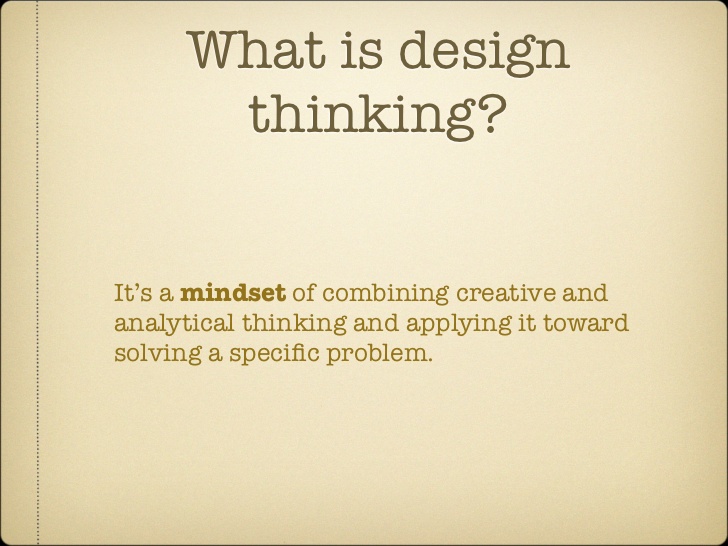
    What is design thinking?

    Quickly, the conversation became a rich conversation around how design thinking creates a mindset shift for students. When teachers build in students the core abilities needed to navigate the design thinking process, students not only develop a greater understanding of how to use design thinking processes to solve problems, but they also become more empathetic to the world around them. They begin to see needs in the world, and act as changemakers. But in order to make that thinking shift, teachers need to be intentional in using the language of design thinking in all they do, and not just during design thinking challenges. Key to this is realizing that design thinking does not have to be a start to finish project. It can happen in “little bites,” Ellen reminded us. Each element – empathy, define, ideate prototype, test – can stand on its own or be combined with the others, depending on the task at hand.

    Consider, during the course of a school day, the myriad of tasks students are completed. Now tweak them to reflect the design thinking approach. Can you ideate when writing an essay? What about when working to solve a math problem? When discussing story characters, can students build empathy for those characters? Can they define the problem the character is facing, and then develop a needs statement? How can students prototype during science labs? And test those prototypes? When the language becomes part of what teachers and students use throughout the day, students realize that Design Thinking is not just a project done once a year like a science fair. It’s a catalyst for change.

    When asked how to show parents the value in integrating design thinking with standards in the classroom, Ellen pointed us to Mary Cantwell, creator of DEEP Design Thinking. Mary, Ellen told us, had generated a list of the skills she observed students demonstrating through a design thinking experience.

    Not surprisingly, these skills match up with our district’s “Skills That Matter Most,” one of three key levers in our five year plan to ignite student genius by transforming the learning experience. And also not surprisingly, these skills are often listed by employers as being in high demand for the employees they hire.

    So how might we develop the design thinking mindset in today’s students so as to help them develop the skills that matter most for their future success? Well, for starters, we can do it one bite at a time.

    Sign up to receive an update when I post. Type your email address in the box and click the “Subscribe” button. My list is completely spam free, and you can opt out at any time.