Tag: DD 2022

  • Guest Blog Post: A Teacher’s Changing Mindset on Student Agency

    Guest Blog Post: A Teacher’s Changing Mindset on Student Agency

    By Emily Mackie, 5th grade teacher

    As mentioned in my Exploring Agency and Personalization blog on December 15th, I’ve been working with teachers to to better understand the principles of agency and personalization. As these are key elements of our district’s vision and mission, it is important to be able to articulate what those principles are, how they manifest in an elementary school classroom, and what impact they have on student learning. When I asked teachers to reflect on their growth, one teacher took the time to write an eloquent response. With her permission, I am sharing it here.


    I used to believe that all good teachers foster agency in their classroom. It is something that just naturally starts to happen for most kids, and something that might happen very slowly, or in a limited capacity for others. After all, the reality is that some kids just have more buy-in to their own learning than others. Our students come to us with different personalities, hopes, dreams, family values, and beliefs about their schooling. Our students come to us with a vast spectrum of experiences, fostered from within and outside of our school district. Changing or growing their pre-existing belief system is no easy task. But now I believe that supporting every student in the ways they approach their own learning is quite possibly our most important task as educators.

    @MrsMackieD3 Tweet: Sharing Learning@Home with our classmates = engaged learners

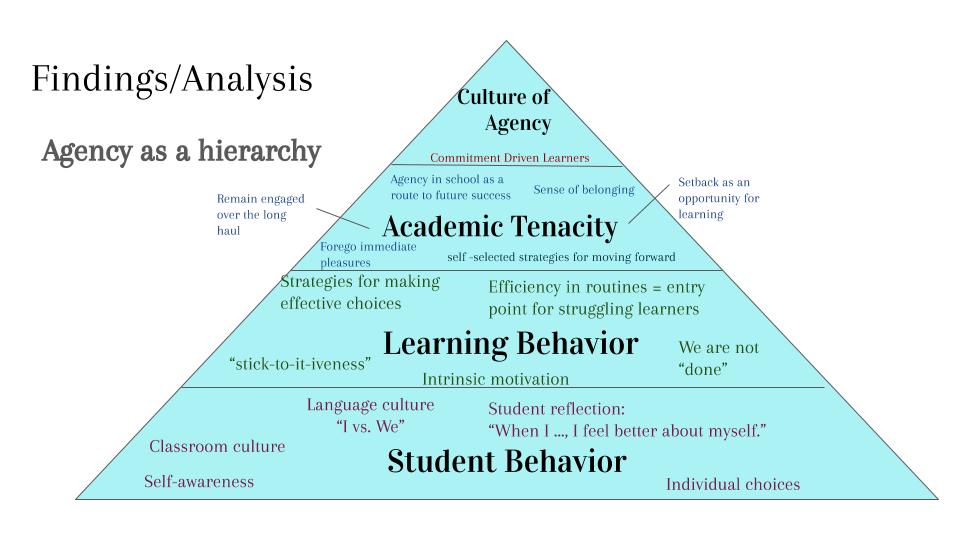
    After working closely with my team and the other hub participants, my thinking on student agency has really changed into a belief that supporting student growth in agency is slow and steady, and is fostered most effectively over time. When we can support students in building these habits of mind, they build a foundation for success in life that will extend beyond their school experience. Agency is grown through hard work and understanding. Building grit and academic tenacity takes focus, attention, and buy-in, from students and teachers alike. Growing agency for students is about goal setting and asking the tough questions about the WHYs of their learning experiences. Questions and considerations about learning that I have been asking my students to become aware of are: Why are you doing this? Why does it matter? Who are you doing this FOR? Is this for you, me, your parents? What you do, make, say, accomplish each day matters – for YOU. Otherwise, what is the point? Providing learning experiences and opportunities for students to grow this mindset should be the point…for all of us. Spending time, scaffolding opportunities for students to make decisions about their learning behaviors with intention is hard work. But it is important work. Helping students build an awareness about their own contributions and responsibilities toward their learning outcomes is one of the most important contributions we can make to them as lifelong learners. This is the work, the learning, the growing, that is most certainly worth doing.

    Emily Mackie has been teaching elementary students for 13 years. She strives to make the classroom a student-centered space which fosters curiosity, exploration, creativity, and FUN so that all children feel safe, valued, and loved. You can find her on Twitter at @MrsMackieD3

  • Exploring Agency & Personalization

    For the past few months, I’ve had the pleasure of working alongside our county office’s Assessment, Accountability, and Evaluation Unit, as well as some of our teachers, to better understand the principles of agency and personalization. As these are key elements of our district’s vision and mission, it is important to be able to articulate what those principles are, how they manifest in an elementary school classroom, and what impact they have on student learning. 

    To dive deeper in to these principles, I have been meeting with three teacher hubs to further explore the principles of agency and personalization. Hubs consist of a grade level team at a school site that meet weekly around this topic. By participating in a cycle of Plan, Do, Study, Act, teachers dig in to better understand how the principle they are focused on is developed in, and impacts, their students.

    For example, a hub studying student agency might ask:

    What is agency? What impact does it have on DMUSD students? What do we want to accomplish?

    What common activities will we engage students in to increase agency?

    How will we communicate the work, results, and resources to stakeholders?

    How will we measure agency?

    Each teacher hub meets weekly for approximately 6-8 weeks. During these meetings, teachers discuss articles read on the topic, ideate methods to bring these principles to life in the classroom, and after prototyping those ideas with students, time is spent reflecting and refining the idea. This cycle is repeated as many times as needed in order to gain a deeper understanding of the principle.

    Personalization Brainstorming
    This is an example of our initial ideation as to ways we personalize in an elementary classroom.

    In January, the three hubs will convene together to share their findings with each other. Their findings will be documented and passed along to new hubs. The new hubs will then analyze the findings of the group and expand on it within their own time together as a hub cycle. 

    This is part of a developmental evaluation approach, which is much like the R&D process private sector product development teams use. It allows us to provide feedback about how a major systems change is unfolding; generate evidence for how an innovation may need to change or adapt before taken to scale; and then spreading the resulting ideas/knowledge to have a broader impact.

    The idea is that, as the hubs expand, we will reach consensus as to what these principles mean for our students and can then provide districtwide professional learning so that all students, and all teachers, have a common vision and plan moving forward. It’s been an amazing experience to join these teachers on a learning journey. I’m excited to see the results.

  • Agency Through FortNite? Sure. Why not?

    Fortnite, and other games like it, require students to practice “teamwork, collaboration, strategic thinking, spatial understanding, and imagination,”  Stanford Graduate School of Education experts say. 5th graders would agree, although they didn’t realize it at first.

    I’ve been working with small groups of teachers to critically examine student agency, and how it is developed, nurtured, and grown in the learning environment. In one of our meetings, 5th grade teacher Dan Dahl shared with us that he has a group of students that love Fortnite. He asked them, “So what do you do when you get stuck in the game?” Students were quick to share their strategies:

    • Look at YouTube videos to see how others completed the task
    • Ask a friend who may have already beaten that level
    • Practice the skill needed in the online “playground mode”
    • Try other skills to see if the task can be accomplished other ways
    • And of course, keep trying!

    When Dan asked students what strategies they might use when they are stuck with a math problem, it took a moment…

    tenor

    and then…

    Oh snap! GIF

    The connection was made – the strategies students were using to find the path to success in Fortnite are the same strategies they could use to find the path to success in their academic life, too.

    For some, it was a #mindblown moment.

    Thing is, many of our students already exhibit agency, which is the capacity and propensity to take purposeful initiative. They just don’t always get the opportunity to do it at school. It’s up to us to connect those dots and provide meaningful ways for students to take their own initiative to learn.

    (Postscript: For those of you who are enraged at the prospect of 5th graders playing Fortnite, deep breath! We are not endorsing violent games in elementary schools… just engaging in conversations to better connect and understand the passions and joys of our students.)
  • Has It Only Been a Year?

    To culminate the school year, my Innovation and Design team published a blog post reflecting on all that we accomplished, and more importantly, all that we LEARNED, this past school year.

    It’s crazy to think we’ve only been working together for one school year, and yet in that time, we co-planned with classroom teachers to create 65 design thinking units. There were other design thinking opportunities provided to students that we weren’t directly involved in, too.

    Below is an excerpt from that reflection. I share it here because I think the learnings are universal to many. You can view the original blog post as well, which also includes a fun infographic.

    *****

    When people think and act like a designer, they must be able to see not just what is, but what might be (Berger, Cad Monkeys). The design thinking opportunities teachers facilitated for students this year truly exposed students to what might be by helping students discover their inner genius, and then empowering students to use that genius to advance the world. We watched in awe as students demonstrated sincere empathy and felt a call to action within, and outside of, design thinking experiences. We felt joy when watching the faces of teachers as they saw their students demonstrate their passion for learning. And we enjoyed seeing those proud parents listen to their children present their prototype solutions at packed exhibitions!

    And we learned a lot, too! We learned…
    – how important it is to always start with why and to know the priorities. When people understand the why and have an opportunity to be a voice in building the how and what, there is a greater success in change efforts.
    – that every site and teacher, just like every student, has unique qualities requiring a customized approach to integrate design thinking experiences.
    – connecting with industry experts to not only dive deeper into the content standards and relevant application to careers today, but to provide high-quality feedback on student thinking, exponentially increases student learning. And that expeditionary partnerships with local organizations is truly a game changer that leads to extraordinary experiences for students!
    – a constant feedback loop is important from all stakeholders. Feedback, or better yet, feedforward, is an art form, and we are all working towards being master artists.
    – our beliefs and experiences inform our actions. It is critical to give people an opportunity to experience something new for themselves so that they are empowered to contribute to leading change initiatives.

    DMUSD Innovation & Design Team
    DMUSD Innovation & Design Team


  • A Message to Our Young Design Thinkers

    A Message to Our Young Design Thinkers

    Today I was honored to give a speech at a 6th grade promotion ceremony.

    I will admit, I was scared to give a speech. I mean, I give presentations all the time. I consider myself really good at it (like, really!). But a speech? I don’t do speeches. So I struggled for about a week to come up with something to say. Luckily, I was speaking at a school that had embraced design thinking this year. In fact, that was what I was asked to speak to… easy, right?

    So after procrastinating for a week, I finally wrote it yesterday. I’ll admit to finding inspiration in the pages of Cad Monkeys by Warren Berger. (Thanks, Warren!) I decided to share it here, as I think there are a couple decent nuggets inside.

    *****

    Good morning everyone and welcome to today’s event. I’m honored to have been invited to speak on what I know is a very special day for both the students and families here today. My name is Dr. Laura Spencer. I am the Executive Director of Innovation and Design for the Del Mar Union School District. Basically, I have the coolest job in the district because my role is to work with your awesome teachers, as well as students like yourselves, to create opportunities that ignite the personal, inner genius of students and empower them to advance our world.

    This year, as part of District Design 2022, 6th graders started using the principles of Design Thinking to find ways to make a difference in their classroom, on their campus, and in the world. Design Thinking is a human-centered approach to solving complex problems. It uses empathy and creativity to find innovative solutions.

    In fact, this entire promotion ceremony is the result of a design thinking challenge to rethink how promotion can better meet the needs of the people here. Let’s give our students a hand for all their hard work organizing this special day…

    To the 6th graders, I challenge you to think and act like a designer always. Designers must be able to see not just what is, but what might be. It’s about looking for opportunities to make positive change. To advance our world. And the best part is that you don’t have to wait for adulthood to get started. You can start making positive change today. Find opportunities throughout middle and high school. And don’t stop there. Keep using your inner genius to advance the world!

    Think with empathy. Don’t presume to know what’s going on in someone else’s head. Get to know people. Understand them. Discover what makes them unique. Learn about their challenges. In doing so, you’ll also learn more about yourself.

    When you practice empathy, you’ll find problems in need of solutions. We’ve got large problems and challenges in the world, but there are answers, too. They’re all around you. Don’t be afraid to look. It doesn’t matter how old you are.

    Remember, your first idea is not always the best idea. Brainstorm! Wild and crazy ideas are sometimes the ones that take flight. Just think, when the adults here were kids, we were told to never get in a car with a stranger. Stranger danger was real. Now we use Uber or Lyft on our phone to ask strangers in cars to pick us up and bring us places. So never be afraid to chase after that crazy idea! (But hey, don’t get in cars with strangers!!)

    And remember, prototypes are meant to be rough at first. You won’t always get things right the first time. In fact, you’ll probably get it wrong more often than you’ll get it right, so keep building and seeking out feedback. Doesn’t matter if it’s a crazy complex math problem or a video game you’re designing. Keep refining that prototype until you get it figured out. Ask for help.

    Above all else, be human-centered in all you do.

    So congratulations to the almost 7th graders, congratulations to the families, and finally, congrats to the teachers and everyone else who supported our students along their journey.

    I’ll leave you with this final quote, from a great author with whom I imagine you are all familiar, by the name of Dr. Seuss.

    “You have brains in your head. You have feet in your shoes. You can steer yourself in any direction you choose. You’re on your own. And you know what you know. You are the guy who’ll decide where to go.”


  • Design Thinking the Design Thinking Process

    Design Thinking the Design Thinking Process

    “Empathy should be used in every situation.
    We should think with empathy throughout life.”
    – 6th grade student

    Why are there so many design thinking framework graphics? Why do they have different shapes? Different elements? Different flow patterns?

    Those were the questions 6th graders asked when we looked at a variety of design thinking framework graphics, ranging from Stanford d.school to IBM to Intuit and the Henry Ford Institute. These students had spent this past year diving into the design thinking process through a variety of experiences ranging from creating a student chair to redesigning the school experience. Because they had spent so much time exploring the process, looking through other frameworks raised an important question:

    What does Design Thinking look like in Del Mar Union School District, and how might we develop a Design Thinking visual that represents what Design Thinking means for students and staff?

    We realized that we had a unique challenge – unlike corporations or colleges, we have to represent design thinking to five year olds who cannot read all the way up to 6th graders (who think they know everything!). How could we adapt our visual for our customers?

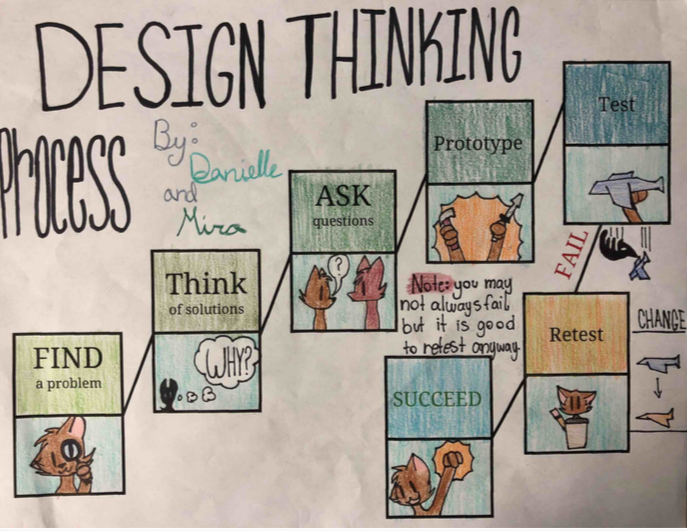
    Luckily for me, 6th graders were up to the task. A week later, and they had prototypes to present. And I must admit, WOWZA was the term that kept coming to mind during their presentations. I’m sharing their concepts here, but what you’re missing is the rich dialogue around WHY they made their concepts the way they did.

    Some key takeaways from the student dialogues:

    “The Design Thinking process adapts to how you’re using it.”

    “I thought it was linear at first, but now I know I can move around as I need to.”

    “The process restarts again and again, going broad and narrow at the same time.”

    “I didn’t understand the value of going back until I did it so many times on this project.”

    Beyond the graphic, we also talked about the design thinking process as a holistic entity. This is where the conversation really intrigued me. One student commented that the trouble with using the design thinking process in schools is that the non-linear cyclical process runs counter to traditional teaching and learning. Content standards and state tests require classes to keep moving in a forward momentum, even when the design thinking process would have us circle back around and around again to dig deeper into a complex problem. It can be frustrating having to move beyond an experience when students know there’s still so many layers to unravel. Finding balance, as a teacher, is critical to the learning.

    But the students all saw that the value of design thinking went beyond the process itself. Students realized that using design thinking taught them time management and backwards planning. They learned the power of constraints, like deadlines, to push creative thought into action.

    Most importantly, students discovered that empathy is the start of it all. It allows people to understand what others are going through. As the students explained, empathy has a use in every situation. If we all would think with empathy throughout our lives, many problems could be averted, or solved, in compassionate ways.

    If only we were all as smart as these 6th graders!

    So… which model strikes a chord with you? Why? What do you think propelled the students to create that version?


    Thanks Mrs. Tanner for letting me spend time with your students! I appreciated how you identified this process as an authentic assessment possibility.