Category: Leadership

  • Book Read: Design for Strengths

    “‘You can have all the right answers, but it doesn’t matter if you are answering the wrong question.’ The willingness to circle back and challenge the central question and continue to ask it in a better way – and potentially abandon the current exploration – that is the hallmark of Design Thinking.” – John K. Coyle in Design for Strengths


    In education, there is a lot of talk about students discovering their passions, their strengths, their interests, and then building upon those through personalized learning opportunities. What does that truly look like? Although Coyle’s book is not specific to education, there are so many nuggets of wisdom that we can apply to our school culture. 


    “Skill gaps are easy – you work at them until you master them. Gravity problems – you accept them, quit solving for them, and then design around them.”

    “Step Zero: Acceptance. You can’t solve a problem you are not willing to have.”

    “Just because you ‘accept’ something does not mean you agree with it or submit that it is ‘OK.’ It simply means you accept that it is.”

    “Most companies hire for diversity of talent, experience, and background – and then they waste it… more often than not, they ask each team member to do the same set of tasks in the very same way… they ignore the unique capabilities and contributions that individuals bring and, in so doing, waste all that unique talent they recruited in the first place.”

    “The ‘one size fits all’ fair approach to work task distribution is a recipe for an unengaged team.”

    “When all the team members have a reasonably good working knowledge of each other’s strengths, they will – on their own (with a nudge of encouragement from leadership) – start to self-organize for their strengths.”


    In all honesty, I probably have Post-Its on every other page in this book and could have put so many quotes in this post. It’d be a great book study for teacher groups looking to better understand ways in which to develop personalized, strengths-based environments for both students and staff.

    Design for Strengths
    Design for Strengths

  • Exploring Agency & Personalization

    For the past few months, I’ve had the pleasure of working alongside our county office’s Assessment, Accountability, and Evaluation Unit, as well as some of our teachers, to better understand the principles of agency and personalization. As these are key elements of our district’s vision and mission, it is important to be able to articulate what those principles are, how they manifest in an elementary school classroom, and what impact they have on student learning. 

    To dive deeper in to these principles, I have been meeting with three teacher hubs to further explore the principles of agency and personalization. Hubs consist of a grade level team at a school site that meet weekly around this topic. By participating in a cycle of Plan, Do, Study, Act, teachers dig in to better understand how the principle they are focused on is developed in, and impacts, their students.

    For example, a hub studying student agency might ask:

    What is agency? What impact does it have on DMUSD students? What do we want to accomplish?

    What common activities will we engage students in to increase agency?

    How will we communicate the work, results, and resources to stakeholders?

    How will we measure agency?

    Each teacher hub meets weekly for approximately 6-8 weeks. During these meetings, teachers discuss articles read on the topic, ideate methods to bring these principles to life in the classroom, and after prototyping those ideas with students, time is spent reflecting and refining the idea. This cycle is repeated as many times as needed in order to gain a deeper understanding of the principle.

    Personalization Brainstorming
    This is an example of our initial ideation as to ways we personalize in an elementary classroom.

    In January, the three hubs will convene together to share their findings with each other. Their findings will be documented and passed along to new hubs. The new hubs will then analyze the findings of the group and expand on it within their own time together as a hub cycle. 

    This is part of a developmental evaluation approach, which is much like the R&D process private sector product development teams use. It allows us to provide feedback about how a major systems change is unfolding; generate evidence for how an innovation may need to change or adapt before taken to scale; and then spreading the resulting ideas/knowledge to have a broader impact.

    The idea is that, as the hubs expand, we will reach consensus as to what these principles mean for our students and can then provide districtwide professional learning so that all students, and all teachers, have a common vision and plan moving forward. It’s been an amazing experience to join these teachers on a learning journey. I’m excited to see the results.

  • You Have To Find Ways Around Things

    I received this email from a colleague:

    In the mix of conferences…
    What if….
    We completely reimagined what that looked like??? How would we make that change?

    It made me think about IDEO’s blog vignettes called “Thoughtless Acts.”

    Human-centered design requires us to observe human behavior with beginner’s eyes, so that we can spot the innate ways people interact with the world around them. We call these intuitive and unconscious reactions Thoughtless Acts. – IDEO

    A recent Thoughtless Act called “Going with Gravity” described an old woman leaning over her small wall to pick an herb because it was easier on her body than bending down, and then having to get back up.  The woman, explaining her new moves to her grandson, shared that, “At my age, you have to find ways around things.”

    You have to find ways around things. 

    I would venture to guess that our teachers and students are always finding ways around things. They find ways around internet content filters. They find ways around limited supplies. They find ways around dress codes, outdated textbooks, and high-stakes testing. So many items that could be added to this list!

    Why do so many of the systems, structures, and beliefs of schooling require the users to find ways around them?

    Jose Vilson asks, “Why do we hold so tightly to the rigid ideas of what teaching used to look like and work with the generation of students we currently do, with different, valid values and diverse understandings of the way the world works?”

    If we aren’t constantly tackling educational systems, structures, and beliefs, then the changes schools make will continue to be Thoughtless Acts of working around the system, instead of working on the system.

    ux


  • I Want Your Absolute Worst Thinking

    I Want Your Absolute Worst Thinking

    “I want your absolute WORST thinking…”

    The other day I was co-presenting a session to educators that focused on why design thinking is needed in K-8 classrooms. We talked about the need for empathy, for designing a new future, for “soft” skill development, etc. You know how it goes… you sit and listen to a presenter talk about why their idea is going to revolutionize education, and you get all pumped up and ready to take on the world.

    Then I led them through a brainstorming activity in which I asked them to quickly brainstorm all the WORST possible ways to introduce design thinking in their classroom. They stared at me. Surely I had misspoke. “No,” I clarified, “I don’t want your best thinking. I want your absolute WORST thinking. The most TERRIBLE ideas you can come up with…” and off they went.

    The ideas they shared were eye-opening. Some were:

    • Present design thinking as a worksheet
    • Micro-manage every aspect of the design thinking process
    • Use a K-W-L at every stage of design thinking
    • Grade them on their final product
    • Provide no direction whatsoever and expect them to figure out what design thinking is
    • Make it a mandate

    And so on… from those terrible ideas, we were able to springboard into great ideas because underneath every bad idea is a great idea just waiting to get out. It was a fun activity, yes, but a meaningful one as well.

    Then today I read an article called “How You Can Get Better at Predicting the Future”  Steven Johnson, author of Where Good Ideas Come From, discussed the importance of a premortem before making an important decision. Opposite of a postmortem, a premortem figures out what killed a person before the person actually dies. It has fantastic implications for the edu sector.  In the premortem, you take your decision, or planned course of action, and describe how it proves to be a “catastrophic failure” in two years time. Why was the idea so terrible? How did it fail?

    Johnson explains that this forces people to look at their decision from a different angle. Usually, we ask, “Do you foresee any issues with this idea/program/solution?” and people say, “No, looks good” and we move forward with the idea. But when you ask people, “Okay, invent the story of how this path ends up leading to disaster,” they see flaws they might not have seen otherwise.

    How many school initiatives or even classroom lessons have been failures because we didn’t conduct a premortem? Even our best laid plans have room for improvement.

    Next time I conduct my “most terrible idea” brainstorm, I think I’m going to switch it up and also ask them to brainstorm the catastrophic failure of their best plan so that the plan can become even better. Maybe then, we can eliminate some of our silver bullet solutions and dig deeper for a real edu revolution.

  • Innovate Forward: Our Story

    Innovate Forward: Our Story

    When you know your ‘why’ then your ‘what’ has more impact,
    because you’re working towards your purpose.
    – Michael Jr. 

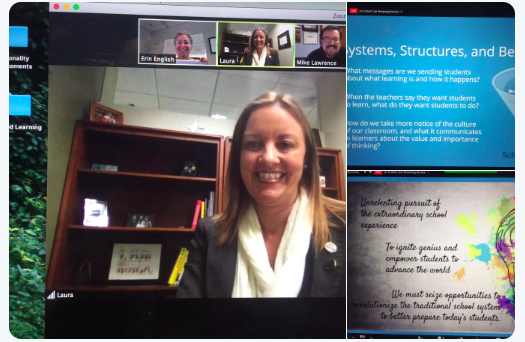
    Today I was fortunate to present at the online #InnovateSD conference hosted by San Diego County Office of Education, thanks to an invitation extended to me by PowerSchool Senior Director of Educator Engagement Mike Lawrence.

    At around 1 hour and 18 minutes of this YouTube video is my presentation.

    Screen Shot 2018-11-02 at 11.46.11
    Sorry – it won’t allow embedding

    I’ve asked about the story of learning to over 300 educators over the past year, and regardless of age, background, or socioeconomic status, the answers were largely the same. The story of learning has been one largely comprised of compliance. Even those who shared about projects and experiential learning still shared a common message that you must do what you are told if you are to be labeled successful.

    Many of our practices and our beliefs are so ingrained that they are institutionalized. After all, most educators have been in the school system since the age of four or five. It’s all many of us have ever known so it’s not a surprise that we don’t notice the messages we send through our systems, structures, and beliefs, or why we send them.

    This video is about how Del Mar Union is pushing back on those systems, structures, and beliefs. It’s about the importance of providing students with the foundations and the experiences needed to think and to know their voice matters. It may be the story of Del Mar, but I am hopeful that it becomes the story of learning for all of us.

  • Empathy is Always Worth the Time

    There are days when we all probably ask ourselves, “Is anyone actually listening?!?” Then I read tweets from teachers like this, and I realize the ripple effects from a pebble can travel much farther than seen from shore.

    A Tweet from Meg Money about using empathy mapping with her students

    Meg is one of those teachers I get excited to know and work with because she is willing to reflect on her practices as she continuously looks for connections that make a difference for students. After the above tweet, I asked her to blog this experience for others. Since she doesn’t have her own blog, I am giving her the space here to share. So this is Meg’s story in her own words…


    There’s a little saying that goes, “a stitch in time saves nine.”  
    Is Empathy Mapping worth the time?
    By: Meg Money, Sycamore Ridge 4th Grade teacher

    “As teachers, how do you want to invest your time?” Ron Ritchhart, Harvard’s Project Zero, asked a cohort of DMUSD teachers recently. This question has replayed in my mind time after time since.  Last week I was at a crossroads; time or making a difference? You see, our 4th grade class was in the thick of a Design Thinking challenge. All groups were collaborating ferociously and productively…all but one. But hey, it was my fault. I designed that group knowing that it had a 50-50 chance of working. This group of three included  kids who were bright and capable in their own right but different as day and night. Unfortunately I didn’t play my cards right, and now I had a group on my hands that had potential but was so far behind because productivity and collaboration were nonexistent.

    Now comes in the saying, “Timing is everything.” Fast forward two weeks to another training led by our very own DMUSD Design Team.  Paula (@CDMDreamers) and Sarah (@SarahZRaskin) led us through a Empathy Mapping exercise, and a light bulb went on. This is what my lagging group lacked… Empathy! However, this would take time; time a group was running out of.

    “How should I invest my time?” replayed one more time in my head. Yes, this is exactly what this trio of budding engineers deserved. They deserved to feel safe in a group and showcase their talents. Their assigned grouping shouldn’t be the barrier holding them back.

    I wasted no time and asked the group how they were feeling halfway through the research/prototyping phase. As you can imagine, they were frustrated and asked if they could just work alone. It was then I suggested that we come together and build empathy through the mapping exercise.

    What happened from there surpassed every expectation I’d anticipated. The kids were open, honest, polite and so insightful. They really didn’t need much prompting; they got it! They created NEED statements that immediately inspired them to hurry back to their learning. I watched in AWE as this group of young scholars immediately started approaching a difficult task with empathy and producing with the maturity of adults. I’m not going to lie, I had tears, goosebumps, and a swollen heart.

    So, was this worth the TIME? Oh, you have no idea. Just ask the group members.

    “Ms. Money, thank you for taking the time to do the mapping with us,” said one student.

    “This was the best day of the year,” another added with a hug.

    “Ms. Money, hurry, come see our idea!” shouted one from across the room.

    I will forever be reminded of this experience that truly confirmed that helping students find their potential and giving them a chance at success is absolutely worth the time. Empathy Mapping is now the frontrunner of my long list of “Must Explore and Practice” list. It is worth every second of TIME!

    Connect with Meg on Twitter at @mmoneydmusd