
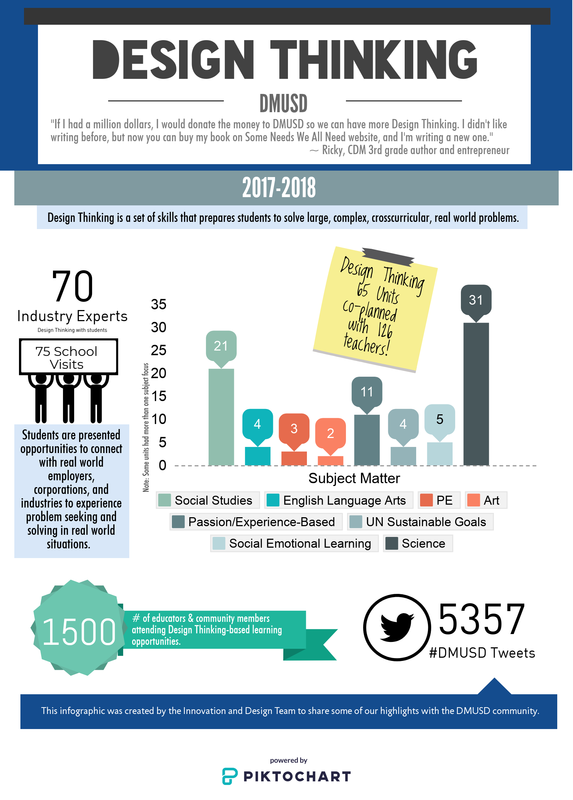
In August, Dr. McClurg challenged all of us to begin a journey from the tame to the wild, and as evidenced by some of the data Sarah, Paula, and I put together about our year, the DMUSD staff did just that. This year for us has been a monumental year of learning, creativity, and celebration, which would not have been possible if not for the amazing staff we were fortunate to work with throughout this school year.
When people think and act like a designer, they must be able to see not just what is, but what might be. The design thinking opportunities teachers facilitated for students this year truly exposed students to what might be by helping students discover their inner genius, and then empowering students to use that genius to advance the world. We watched in awe as students demonstrated sincere empathy and felt a call to action within, and outside of, design thinking experiences. We felt joy when watching the faces of teachers as they saw their students demonstrate their passion for learning. And we enjoyed seeing those proud parents listen to their children present their prototype solutions at packed exhibitions!
And we learned a lot, too! We learned…
– how important it is to always start with why and to know the priorities. When people understand the why and have an opportunity to be a voice in building the how and what, there is a greater success in change efforts.
– that every site and teacher, just like every student, has unique qualities requiring a customized approach to integrate design thinking experiences.
– connecting with industry experts to not only dive deeper into the content standards and relevant application to careers today, but to provide high-quality feedback on student thinking, exponentially increases student learning. And that expeditionary partnerships with local organizations is truly a game changer that leads to extraordinary experiences for students!
– a constant feedback loop is important from all stakeholders. Feedback, or better yet, feedforward, is an art form, and we are all working towards being master artists.
– our beliefs and experiences inform our actions. It is critical to give people an opportunity to experience something new for themselves so that they are empowered to contribute to leading change initiatives.
We have some hopes and plans moving forward to the 2018-19 school year. Besides continuing to support the momentum for implementing design thinking experiences in the classroom, we are looking to increase opportunities for expeditionary partnerships and industry expert connections. We’re building design thinking-ish mini-experiences that teachers can use within a lesson, as well as redesigning some of our planning tools to be more user-friendly.
We are thankful to each and every staff member and student of DMUSD for the opportunity to serve you, and look forward to continuing in our unrelenting pursuit to create the extraordinary school experience for all students.
Category: Design Thinking
-
Transforming Learning, One Experience at a Time
-
Design Thinking the Design Thinking Process
“Empathy should be used in every situation.
We should think with empathy throughout life.”
– 6th grade studentWhy are there so many design thinking framework graphics? Why do they have different shapes? Different elements? Different flow patterns?
Those were the questions 6th graders asked when we looked at a variety of design thinking framework graphics, ranging from Stanford d.school to IBM to Intuit and the Henry Ford Institute. These students had spent this past year diving into the design thinking process through a variety of experiences ranging from creating a student chair to redesigning the school experience. Because they had spent so much time exploring the process, looking through other frameworks raised an important question:
What does Design Thinking look like in Del Mar Union School District, and how might we develop a Design Thinking visual that represents what Design Thinking means for students and staff?
We realized that we had a unique challenge – unlike corporations or colleges, we have to represent design thinking to five year olds who cannot read all the way up to 6th graders (who think they know everything!). How could we adapt our visual for our customers?
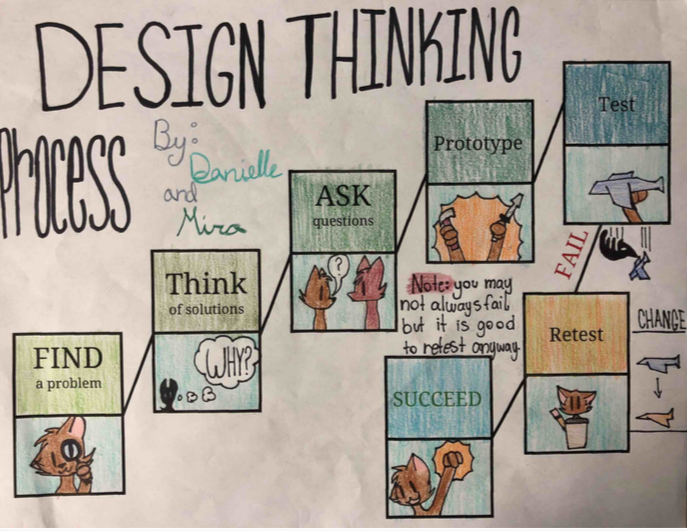
Luckily for me, 6th graders were up to the task. A week later, and they had prototypes to present. And I must admit, WOWZA was the term that kept coming to mind during their presentations. I’m sharing their concepts here, but what you’re missing is the rich dialogue around WHY they made their concepts the way they did.
Some key takeaways from the student dialogues:
“The Design Thinking process adapts to how you’re using it.”
“I thought it was linear at first, but now I know I can move around as I need to.”
“The process restarts again and again, going broad and narrow at the same time.”
“I didn’t understand the value of going back until I did it so many times on this project.”
Beyond the graphic, we also talked about the design thinking process as a holistic entity. This is where the conversation really intrigued me. One student commented that the trouble with using the design thinking process in schools is that the non-linear cyclical process runs counter to traditional teaching and learning. Content standards and state tests require classes to keep moving in a forward momentum, even when the design thinking process would have us circle back around and around again to dig deeper into a complex problem. It can be frustrating having to move beyond an experience when students know there’s still so many layers to unravel. Finding balance, as a teacher, is critical to the learning.
But the students all saw that the value of design thinking went beyond the process itself. Students realized that using design thinking taught them time management and backwards planning. They learned the power of constraints, like deadlines, to push creative thought into action.
Most importantly, students discovered that empathy is the start of it all. It allows people to understand what others are going through. As the students explained, empathy has a use in every situation. If we all would think with empathy throughout our lives, many problems could be averted, or solved, in compassionate ways.
If only we were all as smart as these 6th graders!
So… which model strikes a chord with you? Why? What do you think propelled the students to create that version?


Thanks Mrs. Tanner for letting me spend time with your students! I appreciated how you identified this process as an authentic assessment possibility.
-
Designing From The Heart
I have been reading quite a few books on design, but none have actually been designed with the elegance of this human: how to be the person designing for other people by Melis Senova, PhD. I did not want to finish reading it because I was enjoying the content and layout so much. Luckily, it’s the kind of book that serves as an ongoing reference, which means I will have the pleasure of rereading portions of it many times over the next few years.

this human book spread. Photo from: https://this-human.com/book Senova has an interesting background. Not only is she a pioneer in human-centered design, but she is also educated in both neuroscience and engineering. Oh, and a PhD in design! How’s that for multi-faceted? It’s this diverse perspective, I believe, that equips her with the insight to dig into the HUMAN piece of human-centered design. In other words, how can you design for others if you don’t understand “what it takes to be the human who is doing the designing?” (p. viii).
Senova’s book provides perspective and tangible exercises to help the designer understand the human experience through his/her own personal human experiences. It’s not about empathy mapping and ideating as much as it is about understanding personal biases, creating genuine human connections and designing from the heart.
What’s really awesome is that you don’t even have to be a designer to appreciate this book. There are so many parallels to the work educators do designing experiences for students that I could easily purchase this book for all my teacher friends (except that I’m broke so can you all just go buy your own copy?).
When designing lessons, it’s easy to assume that our view of reality is our students’ reality. The result of this assumption can be manifested in comments like, “I don’t know why they didn’t get it. I TAUGHT it!” or “Not doing homework is a sign of laziness.” However, if we are to design for positive impact, which is the ultimate goal of human-centered designers, than Senova reminds readers that “it is their truth that is important, not yours” (p.3).
With this tenet in mind, it is important that we set aside biases, open communication channels, and truly design from the heart, regardless of whether we are designing temporary housing for flood victims, a can opener for people with arthritis, or a unit to teach students about the role of the Bill of Rights in today’s society. As educators, we should all be human-centered designers every day. This book will help you do so.
-
Compliant Geniuses? Think Again.
 Our district mission statement centers around our calling to “ignite genius and empower students to advance the world.” That’s a pretty tall order!
Especially when, as Seth Godin explains (“The Long Term” podcast), students typically spend 90-95% of their school day on either doing what they’re told, aka compliance, or finding the right answer, also compliance!
If only 5-10% of the day is open for a student to think bigger thoughts, then how in the world can we ever expect students to find their genius?
Looking for the right answer? It’s easy. You can’t.
If we truly want students to find their genius, then we need to provide the opportunities for them to dig in to complex problems. Complex problems does not mean a calculus problem, or balancing scientific equations. What I’m talking about here are complex LIFE problems. Problems that, quite honestly, don’t have answers. Things like:
- Overpopulation and resource scarcity (Although, if you watched the last Avengers movie, this problem does have a potential solution… No Spoilers allowed!)
- Economic development of the global poor
- Nuclear security
When we allow students time, resources, and freedom to explore complex problems like these, and even more so, when we let them explore the world of no resolutely right answer, we are building their capacity for original thought. We are building their capacity for grit. We are building their capacity for learning from failure.
And in doing so, we are building their capacity to ignite their own genius.
-
Why Don’t We Put the Bed in the Kitchen?
I grew up in an Italian family. That meant a lot of our family gatherings were centered around food. Lots and lots of food. And since most food preparation happens in the kitchen, it came to be that a lot of family gathering and conversations happened around the kitchen as well.
Apparently this same phenomena has happened in many families because we are now seeing open-concept kitchens as a selling point for homes. Understanding that the kitchen is not just about cooking, but also about communicating, designers are rethinking the traditional kitchen to incorporate this additional user need.

A Flat in Stoneybatter When spaces are designed, they are designed for a purpose. A home has many spaces, and each has its purposes. It would seem bizarre to place your bed in the kitchen. Even though we know that our day consists of both cooking and sleeping, those activities require separate spaces. Likewise, most of us forego the kitchen sink and use a separate sink space to brush our teeth and apply makeup.
And yet, when looking at classroom spaces, I see spaces that are trying to be an all-in-one environment. It’s like having the bed, sink, patio furniture, and front lawn all crammed in the kitchen. (Granted, there are some super tiny apartments in NYC that attempt to do just that, but they are the exception!)
What do you want students to do in the space?
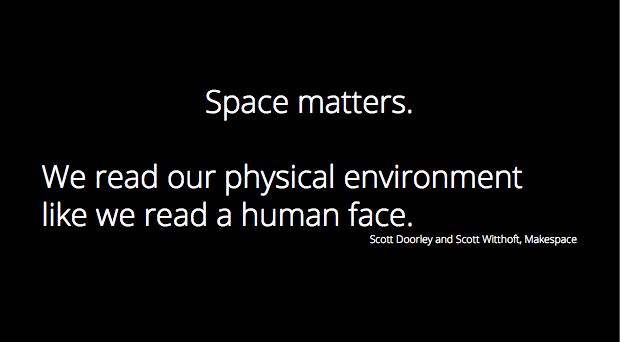
This is the question Rebecca Louise Hare, Design Specialist/Science Teacher/Learning Space Designer and overall awesome person challenged us with at CUE BOLD. A space, she explained, can’t be everything to everyone all the time. Prioritizing the function of the space is key.
Is it meant for collaborating? Physical Making? Digital Making? Reflecting? Showcasing? Working independently? Presenting? Receiving? Other? And no, you can’t just say yes. Think of how much time does it serve those purposes… and is there another space that could serve that purpose better?
Can we showcase student learning in the hallways? In the library? On a website or IG account? This frees our classroom walls for the process of learning instead of a museum for the product of learning.
Can students work independently outside of their assigned seat? Does it work on the floor? Under a desk? In the quad? On a bean bag chair?

When you prioritize the purpose of your space, the space can then support the purpose. If the kitchen is for cooking and socializing, then the inclusion of the island with bar stools and a large stove supports that purpose. The bed, the lawn, the makeup… the rest becomes clutter, distraction, barriers.
As we head into summer break, challenge yourself by asking: What do you want students to do in the space? What do students want to do in the space? And then design it to reflect that purpose.
Resources:
The Space: A Guide for Educators by Rebecca Louise Hare & Dr. Robert Dillon
Parts, Purpose, Complexities Thinking Routine
-
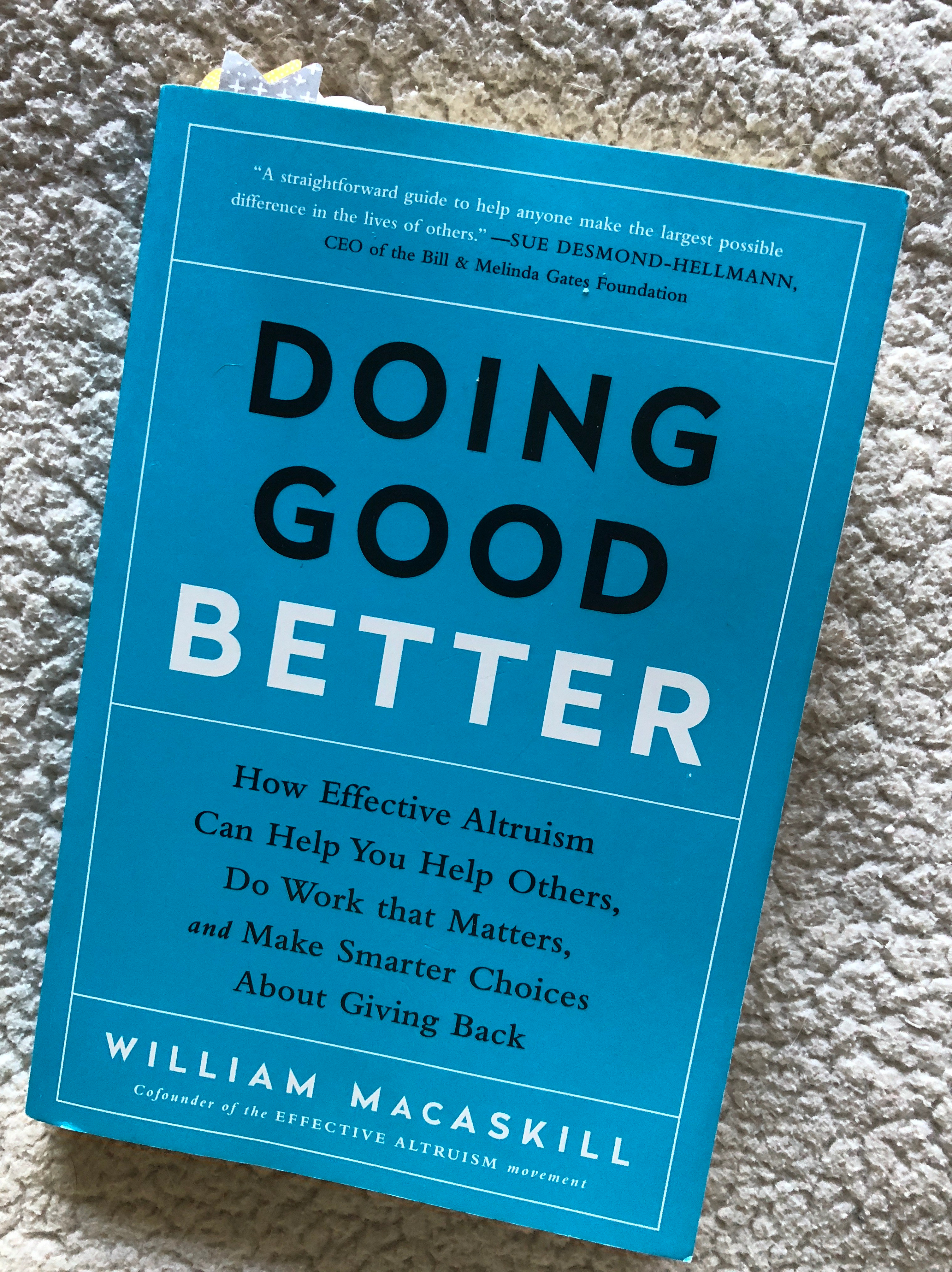
Is It Possible to Do Good Better?
 According to William Macaskill, it is. That’s the premise behind his book, Doing Good Better: How Effective Altruism Can Help You Help Others, Do Work That Matters, and Make Smarter Choices About Giving Back.
 Macaskill and colleagues developed effective altruism, which uses data and some snazzy principles to help people make a huge difference in the world. It’s about asking “How can I make the biggest difference I can?” and then using evidence and reasoning to find the answer. It’s not about more money, or volunteering more hours. It’s more about being impartial in analyzing the options to choose what’s best for the world. (Spoiler alert: many of the options that we choose aren’t the best ones!)
I picked up this book because of Design Thinking. Weird, maybe… but as we ask students to prototype solutions to complex problems, I’ve been grappling with what to do with those solutions. Are they solutions that warrant being pushed into the world? Have similar solutions already been tested? Should we tap into the passion students show towards specific subjects and encourage them to do something to make a difference, or redirect their energy to areas in which it is possible to truly make a difference? And hey, are we even tackling the right problems?
According to Macaskill, it’s not enough to do something. It needs to be the best thing, so that the thing done makes the difference it should make. When it comes to helping others, Macaskill says that “being unreflective often means being ineffective.” He shares multiple examples of programs that sound great on paper, like PlayPumps and Fair Trade but in actuality do little good for the people they intend to serve. In fact, some programs not only don’t do good, but they can cause harm, like Scared Straight, and boycotting sweat shops (seriously…!)
So what does this have to do with elementary students and design thinking?
If we are going to present students with opportunities to solve complex problems, and build in them a sense of agency that they can make a difference in the world, then isn’t it also our responsibility to make sure that they do good in a way that actually helps others? Shouldn’t we teach them how to identify work that matters? And how to make smart choices about ways to give back?
Although I’m not sure I agree with all of Macaskill’s premises, I do think this is an area which warrants a deeper dive. If we are going to teach advocacy, global citizenship, and cultural intelligence, then it is important that we also provide students with the tools needed to help them make smart decisions, just like we need to do with media literacy and fake news. We need to make sure that critical thinking stays prominent in this work.
We need to ask ourselves if we are doing good, or if we are doing good better.