Category: Design Thinking

  • The People You’ll Meet….

    The People You’ll Meet….

    Before I arrived at the SXSW EDU conference, I spent time looking through the conference app, marking sessions that correlated with goals I have for my department. Little did I realize just how much I was going to learn at this conference, and the bulk of it did not happen in those sessions. It happened in the personal connections I made. In the friendships I built.

    Those connections will fuel my soul and keep my mind churning with ideas and possibilities long after I forget the “how to” details of the sessions. They remind me why I am an educator; they share in my passions; they push my thinking; and they teach me through their actions and reflections. Can’t get that in a one hour session on learning environments!

    Next time you head to a conference, ask yourself, “What friendships will I form?” before you ask yourself, “What new things might I learn?”


  • Bashing into Walls to Change the World

    In the book Originals: How Non-Conformists Move the World, Adam Grant writes, “When we become curious about the dissatisfying defaults in our world, we begin to recognize that most of them have social origins: Rules and systems were created by people. And that awareness gives us the courage to contemplate how we can change them.”

    He explains that people blame the absence of creativity for the lack of originality in the world. (Be honest: Have you said recently, “Why can’t they come up with a new movie idea instead of just refashioning old ones?” I have…)

    Grant surmises that people think society would  be better off if only we could come up with some more novel ideas. “But in reality,” Grant explains, “the biggest barrier to originality is not idea generation—it’s idea selection…It’s widely assumed that there’s a tradeoff between quantity and quality—if you want to do better work, you have to do less of it—but this turns out to be false. In fact, when it comes to idea generation, quantity is the most predictable path to quality.” And when focusing solely on quality, “many people fail to achieve originality because they generate a few ideas and then obsess about refining them to perfection.”

    This reminded me of a Steve Jobs interview in which Jobs stated:

    5881
    “When you grow up you tend to get told that the world is the way it is and your life is just to live your life inside the world. Try not to bash into the walls too much. Try to have a nice family life, have fun, save a little money. That’s a very limited life. Life can be much broader once you discover one simple fact: Everything around you that you call life was made up by people that were no smarter than you. And you can change it, you can influence it… Once you learn that, you’ll never be the same again.”

    Creativity, originality, change… they all require stepping outside the societal norms and limitations placed on us. They require taking risks; ideating and iterating many, many, many times; and understanding that the capacity for creativity is in all of us, but maybe, just maybe, creativity requires work and a commitment to let all those ideas flow! Lots and lots of them. And of course, bashing into walls and living life outside the neat little world!

    So how do we provide the conditions for students to bash into the walls (okay, maybe not literally!)?How do we encourage the mass generation of ideas instead of obsessively refining the few? How do we provoke students to question, or even change, rules and systems?  In other words, how do we bash into the walls of a traditional, high-stakes educational system and empower students to become change agents (like the Marjory Stoneman Douglas students are trying to do!)?

    Educational systems, structures, and beliefs create enormous pressure on students to “get it right” (as determined by people no smarter than us) the first time. One assessment to measure if you learned the chapter content. One essay to determine if you met the writing standard benchmarks. One grade for each assignment. One SAT exam. Each of these with its own set of rules and systems to prove conformity to societal expectation.

    When students go against those rules and systems (again, as the Marjory Stoneman Douglas students are), adults get agitated and seek to put them back in their place. And yet, when students become adults and seek out jobs, the workforce bemoans their lack of originality and creative problem solving skills. 

    Our role as teachers and administrators should be, then, to bash into the traditional walls to provide students opportunities to:

    • Think and act like a designer
    • Solve real world problems
    • Connect with industry experts to experience the world of work from people living it, and not from a textbook
    • Use play as a way to learn
    • Learn from and with students, and not just teach to them 
    • Experience personalized learning that embraces strengths, passions, and ideas

    What walls are you bashing into? How about your students?  I’d love to hear about your classroom or school experiences.

    Sign up to receive an update when I post. Type your email address in the box and click the “Subscribe” button. My list is completely spam free, and you can opt out at any time.

  • From Prototype to Advocacy

    From Prototype to Advocacy

    6a00e5505caf4688330133ecfa78d3970b-800wi.jpgI’ve been mulling this question/idea around in my head for about a week now. Hoping my braintrust crew can help me out…

    As we provide design thinking opportunities out to students, I’m wondering how we capitalize on the empathy when the prototyping and feedback cycle ends.

    For example, the plight of the homeless has been a theme for a few classes of students throughout the district. Students watched an edited version of Tony the Movie, which follows Tony, a San Diego man who is trying to reverse his homelessness situation. After the movie, students had the unique opportunity of meeting both Tony and the movie’s director. They asked some important questions of Tony about how he access resources, what he most needs, and how being homeless feels.

    Students have responded to the experience in different ways. At one school, 4th grade students developed a needs statement around Tony needing to stay connected so as to access resources, and therefore, a way to keep his cell phone charged was critical. At another school site, 6th grade students are building tiny home prototypes for people in need, to include homeless, wounded veterans, and others.

    In both scenarios, the prototype will resemble a makerspace project – cardboard, glue, pipe cleaners, etc. The feedback loop will involve discussions around how well the prototype fit the needs statement, and did the elevator pitch clearly convey both the need and the method of addressing it.

    But then what?

    What about the students who truly connected with Tony and the struggles of homelessness? Their prototypes are not being manufactured, so what CAN they do? Do we just say, “Thanks for the great project” and then move on to our next Common Core standards-aligned lesson?

    How can we bring that empathy to life and move it from a cardboard prototype to an opportunity for advocacy?

    Some advocacy ideas I’ve been tossing around for students*:

    1. Write your local politicians, explaining the project and what was learned, followed by a request for call to action. (In this case, perhaps students could ask for safe places for people to sit and let their phones charge.)
    2. Share your learning and needs statement with three adults and ask them ways in which to get involved, or better yet, tell them how to get involved.
    3. Create a public outreach campaign for Open House night.
    4. Fundraise for a local charity that supports the cause learned about.
      *Our students are K-6 so the list should differ for older students.

    Including an advocacy option for students keeps the empathy focus of design thinking in front. It helps students see how ideas can become action, and how voice can create change.

    So what else could we add to the list? How are you supporting students to become advocates for change?

  • Crafting a New Story of Learning

    Crafting a New Story of Learning

    This was a fascinating read the other night…

    From: Making the World a Better Place Starts with a Really Good Story

    Kathleen: One of the things I saw in the organizations that I interviewed is that they prioritize storytelling, not only at the executive director or CEO level, but at every single level of the organization. Everyone within the organization can be a brand ambassador for the cause, whether it’s a staff member who happens to be at a cocktail party and comes across a donor, or whether it’s a beneficiary talking to a funder about the effectiveness of the work.

    Some of the organizations that I interviewed actually did storytelling practice in their staff meetings. IDEO.org does this storytelling roulette where they spin a wheel, and on the spot, a staff member has to tell a story about a project that they worked on. It’s that repetitive practice that really helps build storytelling skills.

    Nadine: One of the great benefits of doing that is that within the organization, it builds cohesion and alignment around the messaging and the brand. It’s really a powerful internal development tool, as well as an external development tool.

    How are you empowering both staff and students to tell the story of learning at your site? I just spent a day of professional learning with every teacher in our district. Based on an activity in Ron Ritchhart’s Creating Cultures of Thinking, we looked at the story of learning we were told growing up through beliefs, behaviors, expectations, etc. Phrases such as compliance, tracking, and worksheets kept rising up.

    Our district has already spent a year researching what education should look like for our students. We met with industry experts, read countless books, went to conferences across the country, and most importantly, talked to our stakeholders: students, parents, staff, and community.

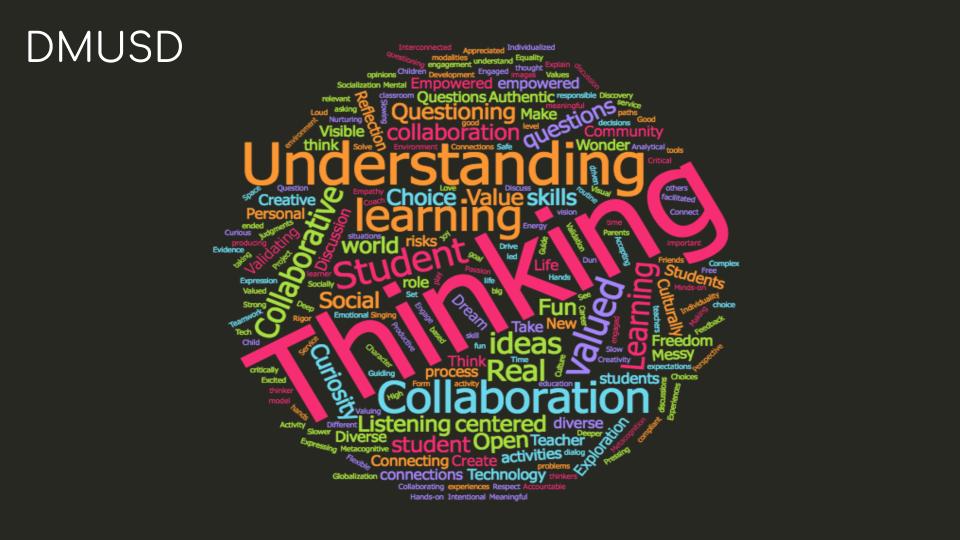
    With this information, as well as some video and article reads during our professional learning day, we began crafting a new story of education; one that values the unique geniuses of all students through strong instructional practices that promote student agency, collaboration, personalization, cultural intelligence, and design thinking. Our new story has much different phrases:

    Word Clouds from New Sticky Notes

    So how do we build a storytelling culture amongst all our stakeholders? That’s the next chapter we’re writing.

    How are you telling your story? Do you have a storytelling culture, or is a lone storyteller writing your book?

    Sign up to receive an update when I post. Type your email address in the box and click the “Subscribe” button. My list is completely spam free, and you can opt out at any time.


  • Ideas are Cheap, but Prototypes Cost: Learning Business Skills in a Makerspace

    Ideas are Cheap, but Prototypes Cost: Learning Business Skills in a Makerspace

    “Ideas are cheap. Execution is everything.” — Chris Sacca (on Shark Tank)

    Makerspaces are fun. I love seeing students discover new ideas, and new ways to represent those ideas, within a makerspace. There’s just something magical about turning twine, an egg carton, and a plastic spoon into a prototype for a prosthetic arm.

    But today I saw a twist on the makerspace concept. 5th grade students, ideating and designing prototypes for a Shark Tank product and pitch they were developing, had to strategically “purchase” makerspace supplies within the confines of a budget. Every pipe cleaner, every egg carton, had a cost associated, and project teams found out today that they have only $40 allocated to build the prototype. Need to hire an expert to drill a hole for you? There’s a cost. Want to try to do it yourself? Sure, but you’ll need to rent the drill. Buy 6 pipe cleaners but only need 3? Sorry, no refunds. Maybe another project team will buy your surplus materials, but chances are, they’ll want a reduced price.

    For some, this may seem like a stifling of the makerspace experience. But for these students, understanding the cost to build the prototype is important. Tamara, the school Library Tech, uses her experience as a former Product Manager to teach students how businesses develop, build, and market new products so that students can create a solid business plan to present to the Shark Tank panel. The panel, consisting of local business leaders in technology, real estate, and angel investing, are looking for products that not only engage the target user, but have a profit margin that will earn them money.

    “Schools are turning to makerspaces to facilitate activities that inspire confidence in young learners, and help them acquire entrepreneurial skills that are immediately applicable in the real world” (NMC Horizon Report: 2015 K-12 Edition, p. 39).

    “Schools are turning to makerspaces to facilitate activities that inspire confidence in young learners, and help them acquire entrepreneurial skills that are immediately applicable in the real world” (NMC Horizon Report: 2015 K-12 Edition, p. 39). These students are making so much more than a prototype in the makerspace; They are making their way into the future with the skills that matter most.

    image01-1483741945

  • Personalization Isn’t a Fancy Computer Program

    Personalization Isn’t a Fancy Computer Program

    Laura presented the idea of “personalization of learning,” meaning more in how does the teacher understand the student, build on their interests, and create learning opportunities for the student.  I can get behind this idea.

    The personalization of learning creates the opportunity for more depth and authenticity, whereas “personalized learning” seems to be more about knowing the “stuff”.                                                      – George Couros

    When George Couros mentioned me in his post, “Personalized Learning Vs Personalization,” I was honestly a bit surprised when I started to receive tweets and messages asking for more information, because I just assumed everyone saw it the same way as I did. And then, serendipitously, an article in my inbox called “A Confession and a Question on Personalized Learning” explained the problem with personalized learning, as it is constructed now.

    Larry Berger, CEO of Amplify, shared how computerized personalized learning programs are failing to live up to the promise. Not only have they not been able to map out a scope and sequence for learning, they don’t know how to measure truly where students are and what they need, and the library of lessons that are needed to teach students is only about 5% complete. But more important than all that, Berger writes is that:

    Just because the algorithms want a kid to learn the next thing doesn’t mean that a real kid actually wants to learn that thing.

    So we need to move beyond this engineering model. Once we do, we find that many more compelling and more realistic frontiers of personalized learning opening up.

    Which brings me to the question that I hope might kick off your conversation: “What did your best teachers and coaches do for you—without the benefit of maps, algorithms, or data—to personalize your learning?”

    In asking the question of what the best teachers and coaches do to personalize learning, we get at the heart of this topic. Personalization is, at its core, about relationships. It’s about knowing your students as unique human beings, and then finding ways to let them explore their sense of self through experiences that are not laid out, step by step, in a neat package by the teacher but rather require the students to find their own way to the finish line.

    An example:

    Over the past month, third graders at one of our schools have been studying the Kumeyaay Native Americans. An area of focus, placed by the teachers, was on culture and traditions. As the Kumeyaay adapted to outside influences, and disruptions to their way of life, they found ways to preserve their traditions for future generations. As the culmination to this unit, students participated in a weeklong Design Sprint.

    Objective: How might we understand the Kumeyaay journey of change over time and their desire to retain cultural customs, so as to better understand how to tell our own story in an ever-evolving time?

    To kick off the week, students heard stories from a Kamishibai storyteller. They discussed the elements of storytelling, and participated in an improv activity called “Pass the Gift” to explore how body gestures can be used to convey a story.


    From there, we asked students to think about an important tradition in their family. Using a chalk talk thinking routine, students wrote a tradition down on butcher paper. After conducting a gallery walk to see what everyone else wrote, students came up with categories for the different tradition types – topics ranged from dinner with the family to summer vacations to SuperBowl parties.

    And then the true personalization happened… students were told to decide on the best method to preserve the story of that tradition. They didn’t have to write an autobiography, with 5 paragraphs and a hook opener. They had to really think about what could not only best capture their story, but what would the user (their family) respond to best. The mediums chosen varied: movies, slideshows, stop-motion animation, painting, sculptures, comic strips, written narratives, and even a few Kamishibai story boxes!

    After students finished their projects, they shared them with 6th grade buddies to receive feedback. They’ll adjust the prototypes after break to prepare them for Open House. One teacher commented, after the Design Sprint ended, “The students shared their projects today with their sixth grade buddies and it was truly one of the most powerful moments we have ever witnessed in the classroom.”

    Personalization can take many forms. In this case, the artistic medium not only let students express themselves creatively, but it also provided a way for both the introvert and the extrovert, the verbal-linguistic and the logical-mathematical, the second language learner and the gifted child, to connect with the academic standards in a meaningful, relevant way.

    ** This is the first in a series of posts on Personalization of Learning. Sign up to receive an update when I post. Type your email address in the box and click the “Subscribe” button. My list is completely spam free, and you can opt out at any time.