Category: Design Thinking

  • Design Thinking: One Bite at a Time

    Design Thinking: One Bite at a Time

    Today, my Design Engineering team, along with two 6th grade teachers, had the pleasure of engaging in a Google Hangout with Ellen Deutscher, co-founder of #DTK12Chat, inventor of Design Dot cards, and just an overall awesome Design Thinker, teacher, and human being. The original intent of the call was to discuss Design Dots. If you haven’t yet seen Ellen’s Design Dots, it’s a deck of 50 cards with quick ideas to integrate design thinking into ELA instruction.

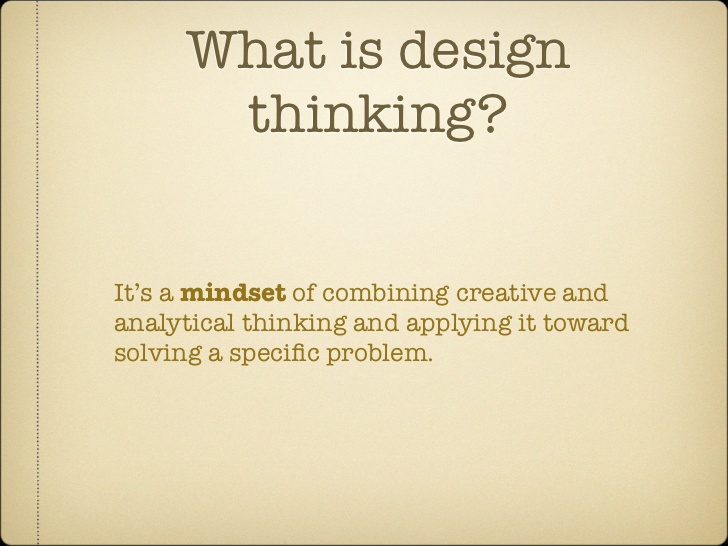
    What is design thinking?

    Quickly, the conversation became a rich conversation around how design thinking creates a mindset shift for students. When teachers build in students the core abilities needed to navigate the design thinking process, students not only develop a greater understanding of how to use design thinking processes to solve problems, but they also become more empathetic to the world around them. They begin to see needs in the world, and act as changemakers. But in order to make that thinking shift, teachers need to be intentional in using the language of design thinking in all they do, and not just during design thinking challenges. Key to this is realizing that design thinking does not have to be a start to finish project. It can happen in “little bites,” Ellen reminded us. Each element – empathy, define, ideate prototype, test – can stand on its own or be combined with the others, depending on the task at hand.

    Consider, during the course of a school day, the myriad of tasks students are completed. Now tweak them to reflect the design thinking approach. Can you ideate when writing an essay? What about when working to solve a math problem? When discussing story characters, can students build empathy for those characters? Can they define the problem the character is facing, and then develop a needs statement? How can students prototype during science labs? And test those prototypes? When the language becomes part of what teachers and students use throughout the day, students realize that Design Thinking is not just a project done once a year like a science fair. It’s a catalyst for change.

    When asked how to show parents the value in integrating design thinking with standards in the classroom, Ellen pointed us to Mary Cantwell, creator of DEEP Design Thinking. Mary, Ellen told us, had generated a list of the skills she observed students demonstrating through a design thinking experience.

    Not surprisingly, these skills match up with our district’s “Skills That Matter Most,” one of three key levers in our five year plan to ignite student genius by transforming the learning experience. And also not surprisingly, these skills are often listed by employers as being in high demand for the employees they hire.

    So how might we develop the design thinking mindset in today’s students so as to help them develop the skills that matter most for their future success? Well, for starters, we can do it one bite at a time.

    Sign up to receive an update when I post. Type your email address in the box and click the “Subscribe” button. My list is completely spam free, and you can opt out at any time.


  • Empathy: Are We Walking the Walk?

    Empathy: Are We Walking the Walk?

    This morning on Twitter, Sam Patterson posted:

    I responded, in the moment, with a quick tweet about the need for active listening and not just a passive head nod.

    But then it got me thinking…

    Why do we need to teach kids empathy? Research has shown that children develop empathy when about two years old. A two year old will see someone upset, and offer a teddy bear, or favorite blanket, to help console the person. Although the solution provided may not meet the needs of the upset person, for the two year old, it is a way to reach out and provide comfort.

    Dr. Martin Hoffman, who researched empathy in children, said that it isn’t until around age 7 that children begin to really be able to “walk in someone’s shoes” and provide a response that is more appropriate to the situation. because they are learning how to see a situation from someone else’s point of view.

    It’s in adolescence, Hoffman explains, that children can start thinking abstractly enough to understand the plight of others, such as homeless or or oppressed. Hoffman labels this stage comprehensive empathy and explains that it is at this point that children are first able to understand how the interplay of life’s experiences may color attitudes, feelings, and behaviors.

    Ask (most) any parent or educator and they will tell you that empathy is an important trait for children to possess. “Of course we want our kids to care for others. How silly of you to ask!” wouldn’t be an unheard of response. And yet, research conducted at Harvard University showed that, while 96 percent of parents say they want to raise ethical, caring children, and cite the development of moral character as “very important, if not essential,” 80 percent of the youths surveyed reported that their parents “are more concerned about achievement or happiness than caring for others.” Sadly, the percentages were no different when students were asked what topped teacher concerns. Surveyed students were three times as likely to agree as disagree with the statement “My parents are prouder if I get good grades in my class than if I’m a caring community member in class and school.”

    Why is there such a huge disconnect between the traits we think we value, and the values our children are actually being provided?

    Could it be because the messages we send are stronger than the words we say?

    When students see signs like the ones above that scream “I don’t care what your issues are, just do your work,” we are stripping the empathy away.

    When we force compliance  on meaningless assignments in our quest for higher test scores, we are stripping the empathy away.

    When we send students to the principal’s office without hearing “their side” of what happened, we are stripping the empathy away.

    And when we hear a student speak, but don’t listen to what they’re saying, we are stripping the empathy away.

    justice-scalia-quotes-on-religion-best-ideas-social-issues-international-day-for-compassion-and-empathy-only-go-so-farSo why do we need to teach students empathy? Because adults are the reason they are losing it in the first place.

    Need tips on how to build empathy? via Teaching empathy: Evidence-based tips . Have others? Please share them below.


    Sign up to receive an update when I post. Type your email address in the box and click the “Subscribe” button. My list is completely spam free, and you can opt out at any time.


  • Bringing the Invention Cycle to Design Thinking

    Imagination leads to creativity.
    Creativity leads to innovation.
    Innovation leads to entrepreneurship.
    ~ Tina Seelig

    Engaging in the Design Thinking process is a human-centered approach to creative problem solving. Regardless of what you call the stages of the process, or how you draw the progression, at its core is a belief that people can make the(ir) world a better place by engaging in divergent thinking practices. What is sometimes missing in the implementation of design thinking, especially in the classroom, is an understanding of how ideas develop and take shape. Enter Stanford University Professor Tina Seelig, who teaches a creativity course at Stanford, and her book Creativity Rules. 

    1_pVd4Ieg64ETU6a_xzR5lNASeelig’s book focuses on the four components of the Invention Cycle: imagination, creativity, innovation, and entrepreneurship. Imagination is envisioning things that do not exist. It requires engagement and the ability to envision alternatives. Creativity is applying imagination to address a challenge. Creativity requires motivation and experimentation to address a challenge. Innovation is applying creativity to generate unique solutions through focusing and reframing to generate unique solutions. And Entrepreneurship, which requires persistence and the ability to inspire others, is applying innovation, scaling ideas, and thereby inspiring others’ imagination.

    When considering the Invention Cycle, it’s important to understand how the four components build upon each other. As Seelig explains, imagination requires curiosity, engagement, and the ability to conceive of ideas in your mind. Creativity then fills a specific need and are manifest in the world. With creativity, new ideas only need to be new to the creator, and not the world. However, with innovation, the ideas are new to the world, not just the inventor. Therefore, the world must be looked at from a fresh perspective by challenging assumptions, reframing situations, and connecting ideas from disparate disciplines. Once the innovative idea is developed, it is entrepreneurship that brings the unique ideas to scale.

    Because Design Thinking is focused on problem solving, and not selling a new product, entrepreneurship is not called out as part of the process, although it does fit in the test/feedback stage. Spencer and Juliani noted in Launch that marketing skills help students learn how to share their work with an authentic audience. Building on that principle. then, entrepreneurial skills teach students how to go beyond simply sharing the work and actually bring an idea to fruition. Seelig explains:

    It’s a crime not to teach people to be entrepreneurial. We’re each responsible for building our own lives and for repairing the broader problems of the world. Skills related to innovation and entrepreneurship are the keys to seeing and seizing those opportunities. People should emerge from school with agency, feeling empowered to address the opportunities and challenges that await them.

    According to thought leaders, the advances in technology are moving us towards an  imagination economy. This economy is defined as one in which “intuitive and creative thinking create economic value, after logical and rational thinking has been outsourced to other economies.” Looking at the Invention Cycle as a transparent layer atop the Design Thinking process, it becomes even more evident that we do our students a huge disservice if we do not provide meaningful ways for them to develop their imaginative, creative, innovative, and entrepreneurial skills. Like all soft (but critical!) skills, these can be developed and are critical to students (and their teachers), regardless of their career paths.

    Sign up to receive an update when I post. Type your email address in the box and click the “Subscribe” button. My list is completely spam free, and you can opt out at any time.


  • Launching into Design Thinking

    I read Launch: Using Design Thinking to Boost Creativity and Bring Out the Maker in Every Student when it first came out, but at the time, it wasn’t as relevant to the work I was doing as Director of Educational Technology. In that role, I was not able to fully immerse myself in transforming classroom learning practices.  However, in my new role, Design Thinking plays a huge role in bringing our core principles of student agency, collaboration, personalization, and cultural intelligence to life. Therefore, I decided to crack the book open one more time and look for nuggets of wisdom I could share with teachers partaking in the revolution to making learning relevant, meaningful, and deep.

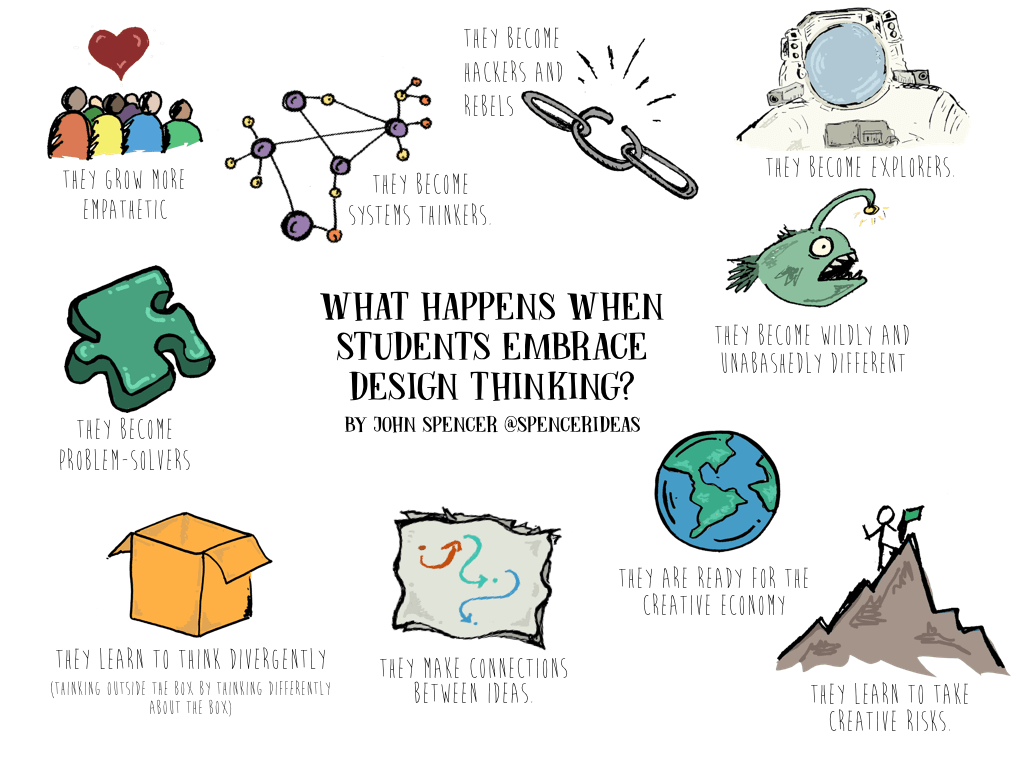
    when-students-embrace-design-thinking.001-1
    From “Getting Started with Design Thinking in the Classroom” blog post by John Spencer

    “Creativity is a process that requires structure. The word structure gets a bad rap as being part of some sort of rigid process that takes away from authentic and creative learning. That’s simply not the case” (p. 23).
    For teachers new to Design Thinking, they often jump to connecting it to makerspaces, which may then trigger images of students building cardboard arcades and toilet paper roll robots. For others, it triggers anxiety around loss of time management, or no academic instruction. But when design thinking is used with intention, structures such as thinking routines, time constraints, and feedback loops support students through the process.

    “Too many educators believe they lost their creativity – or that they were never creative in the first place. Maybe they stopped creating because they didn’t think they had the time, energy, or mental capacity for new ideas. We don’t buy it. Not creating is a choice – and a poor choice at that. And in truth, every time you come up with a new idea for a lesson, you are creating. Every time you think of a way to handle that super-challenging student, you are creating. Every time you collaborate with a colleague, design your classroom, set up the desks in a new way, or do something different – you are creating!” (p. 31)
    Honestly, I think this is the most important paragraph in the book. We often talk about the need to empower students with the soft skills needed for success, and creativity is one of those skills. But what we neglect to consider is that, for many teachers, creativity was stifled under No Child Left Behind, Program Improvement, and other high stakes accountability system. They lost their mojo, so to speak. So as we encourage them to open the doors to new experiences for students, we need to also remind them of the creative nature they already posses and find ways to nurture their innate abilities.

    “Creative classrooms are the ones where students are able to question answers as often as they answer questions” (p. 100). And along those lines, “You cannot empower students to be self-directed, responsible, critical-thinking people if they can’t ask their own questions. At that point, you’re teaching compliance rather than responsibility” (p. 106).
    In a previous district, we spent three years of instructional rounds looking for effective questioning strategies. This focus meant that a lot of our energy was spent watching for teacher moves that provided opportunities for multiple student voices; observing DOK levels of the questions asked; and watching for a variety of ways in which students respond to the questions. What was missing from this entire dialogue was the opportunity for students to feel empowered to ask their own questions, to dig into meaning that was relevant to them.

    Other items I appreciated in the book:

    John and AJ discuss how empathy is not always about a specific audience. Sometimes, industry designers base their work on awareness, which can involve empathy, but may also include “a personal awareness of a process, a system, or a phenomenon. [It] can be scientific or artistic, social or economic, human centered or systems centered” (p. 69). Opening empathy up to a broader context helps teachers and students better identify the purpose for engaging in the design thinking process.

    When I attended Harvard’s Project Zero last summer, I was fortunate to meet and learn from Edward Clapp, a Project Zero Project Director. Clapp discusses the biography of an idea, which John and AJ mention in their book as well. They quote Clapp:

    “What if instead of telling the biographies of individuals who are widely seen as creative geniuses, we tell the biography of the ideas that they are most known for? For example, what if instead of telling the biography of Albert Einstein, we told the biography of the Special Theory of Relativity? We would tell the biography of that idea, highlighting all the different players who have historically participated in the development of that idea, the different roles those individuals have played, and the different twists and turns that idea has taken as it has wended its way to the world” (p. 147-8).

    “Seven Reasons Why Kids Should Learn Marketing” is something I had not considered. Sure, we do elevator pitches with students and talk about audience awareness, but John and AJ write that students who learn marketing from a marketer’s perspective “grow as critical consumers while learning what it means to share their work with an authentic audience” (p.197). Their reasons why, which include learning about rejection and growing in creative confidence, also support the soft skill acquisition students need to succeed in the world.

    *****

    For the teacher who is dabbling in design thinking, or PBL, or genius hour, this book provides strategies and examples that will build teacher confidence in the process while engaging students in meaningful work. I appreciate the website connection which provides tangible projects, structures, and questions to guide teachers through design thinking. It’s a nice gateway before digging into the world of IDEO, Stanford d.school, and others.

    Learn more about the work we are doing with Design Thinking on our website: dt.delmarschools.org

    Sign up to receive an update when I post. Type your email address in the box and click the “Subscribe” button. My list is completely spam free, and you can opt out at any time.

  • What is your BIG opportunity for impact? #DesignCamp

    Today I had the pleasure of attending #DesignCamp. This event is a participant-driven deep dive into all things related to Design Thinking! The big levers towards deeper learning and equity for all students are: pedagogy, culture, leadership, and innovator methods/mindsets with the goal of spreading more goodness on the world (website). It was my first time attending this event, and definitely won’t be my last. Kaleb Rashad and Eric Chagala certainly know how to throw a party!

    The day started with some epic jams by Atlanta-based musician Chavis Flagg (Check him out – it won’t disappoint!). I’m sure the inclusion of Flagg at the start of the day was intentional, as music impacts our ability to connect with one another. According to music psychologist Stefan Koelsch, music “impacts brain circuits involved in empathy, trust, and cooperation” (article).  Flagg’s musical talents did a great job building empathy and cooperation amongst the attendees. Energy levels were high, smiles were big, and everyone seemed ready to embrace the day’s learning.

    IMG_9198After engaging our empathy, Billy Corcoran and Mike Strong (with a special remote guest appearance by Dan Ryder) defined the Design Thinking experience for us by taking the group through a quick-paced challenge to design a space suit for attendees of a rock concert on the moon. Many assume Design Thinking challenges will take days or weeks away from academic instruction, but this entire experience was less than an hour. And it did not require a huge makerspace. In fact, our prototype consisted of trash bags, cardboard, tape, and a piece of paper.
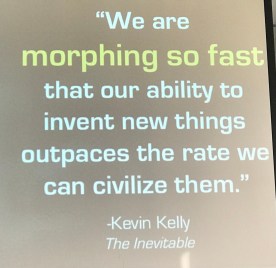
    Once our astronauts were safely launched on their voyage to the moon, it was time to dig deeper into the learning. The variety of sessions addressed many different facets of Design Thinking and deeper learner in the classroom.Having a large group of educators from our district, we were able to divide and conquer, gathering information and ideating on what all these new ideas meant for the work we are undertaking in our classrooms.

    IMG_9201Because I was speaking in the second session, I could only choose one, and so decided to spend my time with David Culberhouse, who always leaves me with more questions than answers! David shared the rapidly changing future with us, from Artificial Intelligence and the new gig economy to the skills this new work landscape demands. David challenged us to consider: 
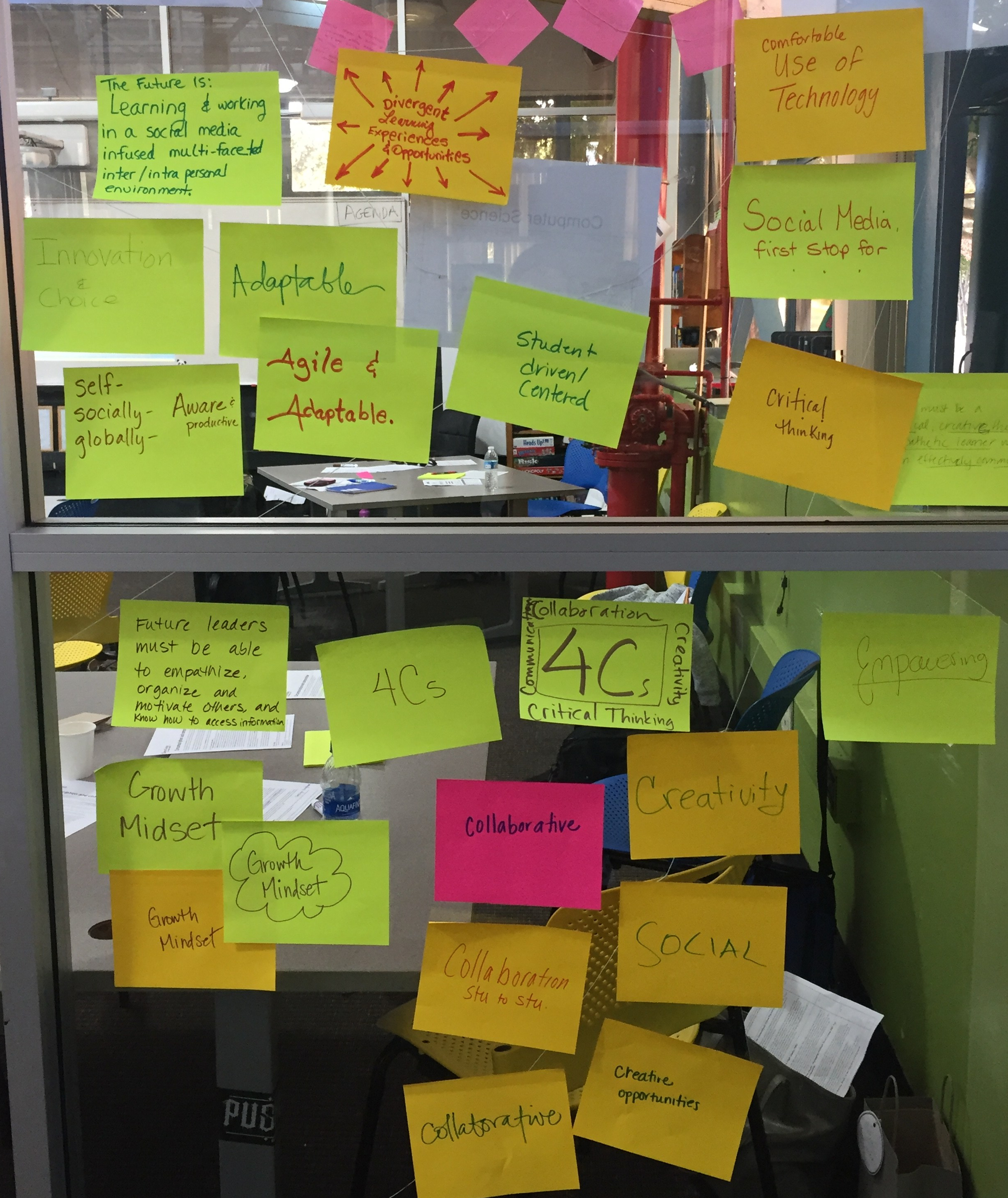
    – What is your BIG opportunity for impact?
    – Where can I have action?
    – Where can I make change?

    It was the perfect segue to the session I led with Paula and Sarah. In our session, we challenged participants to craft a new story of education, to question the systems, structures, and beliefs that have defined education for the past hundred years and embrace a new vision. We discussed the parts, purposes and complexities that reside in our current educational landscape, and dove into the ways in which design thinking can transform learning so that students develop student agency and cultural intelligence.

    IMG_9231
    After our sessions, I appreciated the fact that the day did not just end. Back together in the common space for some more music and sharing of learning. Sara Schairer, of Compassionit.com, briefed us on the prototype her group of participants developed to help promote the work her non-profit is doing to inspire compassionate actions and attitudes. One of the teachers from our group who participated in this design deep dive definitely heeded the call to action and began sharing her plans to spread the compassion to her students.
    Ending our day was a moment to reflect on the day, to consider what we had learned and what we were going to do with that learning. These quiet moments are so few and far between in our work. Often times, we attend trainings and then rush out at the end of the day so that we can get lesson plans ready for the next day. Having that opportunity to just think gave me a chance to consider ideas I want to test back at our district to make a BIG impact on our mission to ignite genius and empower students.
    Thanks to everyone who made today remarkable! It was truly mind-blowing!
  • Students’ Design Thinking Skills Sets Them Up for a Successful Future

    Yesterday I received this email from three 6th grade students:

    Dear Dr. Spencer,

                    As sixth grade students, we have been given the design challenge to enhance our school experience. There are problems ranging from balls left in the field to bathroom catastrophes. We thought that you would be a great person to interview because you are the Executive Director of Innovation and Design. 

    So today I happily set aside my desk work and traveled over to the school to talk to the students. I can honestly say, I’m not sure who learned more from our experience: them or me.

    As they had shared in the email, the students have been given the challenge of enhancing the school experience. In Del Mar, a K-6 district, our vision states that we are in “unrelenting pursuit of the extraordinary school experience” and now, so our these 6th grade students. Their teacher, who has been trained at both Nueva School’s Design Thinking Institute and Stanford’s d.school, is using her Quest elective class to provide the students with the skills and strategies necessary to utilize the design thinking process. Her focus is spot on. Jim Hackett, CEO of Ford, explains. “The old way was about disciplines,” Hackett told Fortune Magazine in September. “The new way will be about projects and understanding what people want.”

    During my conversation with the students, we discussed the school, and the needs I saw as rising to the top. But then the conversation shifted, and the students became intrigued more with my job, and the goal of our district to bring design thinking experiences to all students, and not just those lucky enough to have their teacher. One student then remarked, “What happens to us in middle school? They don’t do these things there, do they?” Although I wish I had a better answer for them, all I could say was “not yet…” They continued pressing me. “How will we handle the homework load in middle school? We have a reduced homework load now.”

    And so we started to analyze the skills that the students are receiving, and how those skills would translate to middle school (and life!) success. Homework load? No problem! Within these design thinking challenges, their teacher has taught them:

    • Backwards Planning: Just like homework, design thinking challenges have deadlines that must be met. But unlike assigned homework, backwards planning ensures students know how to prioritize their work load based on estimated work time, complexity of task, and due date.
    • Questioning: Design thinking requires students to define the problem that needs to be addressed. The questions they are formulating are complex, and get to the root of a problem so that they can better ideate and prototype solutions. This means they’ll have a better understanding of what information they need to complete their work. Furthermore, they’ll have the confidence to ask clarifying questions of their teachers.
    • Prioritization: When prototyping possible design thinking solutions, a lot of elements must come together. It can be easy to get distracted by wanting to make a prototype pretty, or add “just one more thing.” Learning how to prioritize actions based on a needs statement will also help them figure out if they should start their math homework due tomorrow before or after writing their English essay due next week.
    • Iteration: One of the most important concepts students learn in the design thinking process is that the iteration process is not a one time thing. Iterate, prototype, seek feedback, and do it again…and again… and maybe even again. Failure is not a cause for meltdown, but just an opportunity to iterate again. If you doubt me, just watch Audri and his Rube Goldberg machine process!


    Carole Bilson, President of the Design Management Institute, states, “There’s a lot of observation, listening and research as you are developing products and solutions.” Evelyn Huang, Director of Design Thinking and Strategy at Capital One Labs, explains that Design Thinking, a “human-centered methodology, coupled with a ‘fail fast’ attitude, allows us to quickly identify, build, and test our way to success. We spend less time planning, more time doing, and, above all else, challenge ourselves to see the world through the eyes of our customers every step of the way.”

    With skills like this being developed in our 6th graders , I don’t think the students will have any problems tackling the challenges they face in middle school next year. In fact, I venture to guess that these students will be redesigning the middle school experience in no time! And then high school. And soon, they’ll be solving problems we can’t yet fathom. Homework? Psh! No problem at all.