“If we want people to fully show up, to bring their whole selves including their unarmored, whole hearts—so that we can innovate, solve problems, and serve people—we have to be vigilant about creating a culture in which people feel safe, seen, heard, and respected.”
A while back I received an email from a 3rd grade teacher asking me to help her and the music teacher develop an integrated design thinking challenge for the class that would meet both ELA standards and music class objectives. During our meeting, we decided to focus on the topic of JOY.
How might we provide joy to our 5th grade buddies through an original music composition?
We outlined a plan, and I left the teachers to work their magic.
Today I met with the two teachers because they wanted to discuss how to help 3rd graders empathy map. As the classroom teacher recapped about the experiences thus far, I realized that something far more powerful than just design thinking had already taken place.
As part of the empathy and define process of this challenge, students developed a definition of joy, through their own experiences as well as by interviewing 5th grade students and their parents. The 3rd graders quickly noticed some trends arising in the responses received – many noted happiness; an absence of sadness; and feelings of peace.
When asked what brings people joy, parents shared moments like seeing family after a business trip, or hearing the laughter of their children.
But for one third grader, the answer was very different: not being hated.
Whoa…
What do you do with an answer like that? For this teacher, she tackled it head on. She asked the class, “Have you ever felt hated in this classroom?” Because she had created a safe place for them to share, a few did share moments when a peer situation made them feel less than loved…hated, even.
Reflecting on the situation, the teacher shared that, even if their musical projects don’t turn out as well as she wants them to, this project is a success because it opened her eyes to the depth of feelings these kiddos have, the complexities of their lives at such a young age, and her need to continue with social-emotional lessons.
That’s the thing about empathy… it can catch you when you least expect it. It doesn’t require an empathy map template or a Post-It. It requires an open heart and a receptive ear, and the capacity to be vulnerable so that you are open to the experiences of others.
I’m always grateful to the teachers that take these risks for our students, and even more grateful when they share their learning with me. It reminds me of how valuable our role is, and how important these authentic moments are to both students and adults.
…I may ramble in this post. It’s 1am. I’m tired! Have a head cold. But wanted to share my learnings…
🤪🤪
Do I really have to go home tomorrow?
It’s going to be hard to walk away from the synergy of woke educators at this conference, but I know that I have much work to do when I return to San Diego.
Not the work of answering emails and finishing tasks (although there is plenty of that as well), but the work of amplifying the conversations and ideas that have taken place here the past few days so that words don’t just stay words, but instead become actions.
David Hogg and Dan Rathers
I started today hearing the voice of the new generation, David Hogg of March For Our Lives, rethink advocacy in this new era. He shared how he had never truly understood what empathy was until he saw his 14 year old sister collapse under the weight of finding out that four of her friends died in the Marjory Stoneman Douglas shooting. As.a teenage boy full of hormones, he didn’t know what to do with those emotions, but he knew he didn’t want shooting to be just another news story with no change/impact.
Advocacy is born from passion, from desire, from need. So often in education we stifle that drive or relegate to an elective, after school, or GATE program. Education says it is preparing students for the world of work, but when a teenager can say that he never felt empathy until his senior year of high school, then what have we truly prepared them for? What kind of future doesn’t require empathy?
When pressed as to what prepared Hogg, and others like him, to be advocates, he credited experience with speech and debate classes; theater, TV production, and journalism. The very nature of these programs built the skills needed for activism. Hogg learned that it is not his place to speak for others, because he has not shared their experiences. But he can certainly elevate their voices, spotlight them.
When Hogg was asked what his advocacy work had accomplished, he paused before explaining, “We’ve accomplished a little in an area where nothing is expected so we’ve accomplished a lot.” This ability to see progress, to chart a path and stick with it, and to amplify voices through empathy… this is how schools should be preparing students not for the world of work, but for the world of life. The world they’re in now.
There was also a panel of three female teenage entrepreneurs sharing their stories today, and although they weren’t activists like David Hogg, they had a voice that was being amplified through their start-up companies and non-profit organizations. But it wasn’t an easy journey to become a teen entrepreneur.
Entrepreneurship is like a varsity sport, one of the women explained. “We’re working on it during ALL our spare time..thinking about it all the time. We need adult mentorship outside of the classroom to help us find our way.
But instead, many received truancy letters for taking time out of school to pursue their passion. “Attending an economic summit in Boston shouldn’t result in punishment at school!” Reminds me of conversations yesterday as to what learning is valued, and how antiquated our current learning value system is. How ironic that students are penalized for being successful outside the school walls.
Instead of punishing them, the young ladies asked for mentorship, for people to help them amplify their voice and their passions. People who would offer personal reciprocity by sharing their own struggles; helping alleviate self-doubt; and asking tough questions along the way. Sounds like they were asking for support with the soft skills, the skills that matter most.
One of the women explained, problem solving is just as important as reading and math. As entrepreneurs, they are learning how to fail and grow early. They’re using their creativity to think outside the box to create positive change for society.
And yet, these opportunities aren’t well integrated in elementary schools because the hard skills are pushed more than innovation. Only the gifted, the affluent, or the lucky get to participate. It doesn’t have to be this way. Some ideas shared were to run a pop up shop for a day as part of an entrepreneur project or to have students pick an inconvenience and design a solution.
The advice given to one of the entrepreneurs is just as applicable to all the educators in the audience: You need to take the first step before you’re even ready to take it. A small step is better than no step.
Amplifying voices should be happening all over our schools. “Libraries are like the quarterback [you never knew you had],” so why aren’t school and district leaders leveraging the power we have in our buildings? The library, in many schools, is the biggest classroom in the school. What if we reimagined the space as a systemic gateway to change?
In the 30 minute Reinvention: Designing Future Ready Libraries session, Carolyn Foote articulated that students deserve access to inviting, accessible, collaborative, flexible, tech-rich and literacy centered libraries that support academic and enriching experiences. I’d add that those spaces also support student passions. They elevate the voice of the students by providing them with the resources needed to find and nurture that voice.
#DTK12Chat Live!
Like every other day, today wasn’t just about the sessions. It was about the connections made between sessions. The best part of Wednesday at #SXSWEDU is actually the #dtk12chat that happens live from the Hilton lobby. There were so many inspiring stories shared about innovation, transformation, and creative change. More importantly, new friendships were forged, and old friends were embraced.
Dan Rathers, in the panel conversation with David Hoggs, shared the line from a Barbra Streisand song, “Hearts can inspire other hearts with their fire.” Well, I certainly plan on bringing a fire back to San Diego!
How many times have you found yourself trying over and over again to explain a problem, only to have the other person jump to solutions without quite hearing you? Reminds me of this Sesame Street routine.
What I love about Design Thinking is that the focus on empathy requires the designer to truly listen, observe, and immerse oneself into the problem through the lens of the user, and not the lens of the designer. It requires us to hear about the issue with the fly in the soup.
This hit home for me Saturday at #DesignCamp. I attended Ellen Deutscher’s (@Lndeutsch) “Nurturing Design Thinking Mindsets through Play and Improv” session. I told her I was attending because improv gives me anxiety and I needed to step outside my comfort zone.
Ellen is a wizard at leading people through collaborative experiences that build active listening and risk taking so I knew I was in good hands. At one point, after an activity, she asked if anyone wanted to share how that experience made them feel. She said, “Be mindful of your process. If you don’t like it, why force your students?”
How can a concept so seemingly simple not actually be so? Why do we, as educators, keep forcing processes on students that would make us cringe? Timed tests, novel selection by Lexile level, five-paragraph essays…
Perhaps it has to do with the fact that education tends to search for the middle ground, the average, and solve accordingly. Instead of being mindful of what makes us unique, it’s easier to solve for the middle.
The Air Force learned the flaw in this approach when they discovered that their cockpit, designed based on average measurements of hundreds of pilots, actually fit none of their pilots, resulting in many crashes … on one particularly rough day, 17 plane crashes!
Average doesn’t work in cockpits, and it doesn’t work in education. Randy Scherer (@RandellScherer) reiterated this in his “Design for Extreme Users” session. Randy explains how extreme users (or “radical people!”) lead us to “deep insights about why our designs sort-of, kind-of work.” When we set aside the concept of average, we can make a huge difference in the lives of students.
When we set aside the concept of average, we can be mindful of our processes. We can design education not for the average, but for every user. And when we do that, then we can truly take care of the fly in the soup.
“‘You can have all the right answers, but it doesn’t matter if you are answering the wrong question.’ The willingness to circle back and challenge the central question and continue to ask it in a better way – and potentially abandon the current exploration – that is the hallmark of Design Thinking.” – John K. Coyle in Design for Strengths
In education, there is a lot of talk about students discovering their passions, their strengths, their interests, and then building upon those through personalized learning opportunities. What does that truly look like? Although Coyle’s book is not specific to education, there are so many nuggets of wisdom that we can apply to our school culture.
“Skill gaps are easy – you work at them until you master them. Gravity problems – you accept them, quit solving for them, and then design around them.”
“Step Zero: Acceptance. You can’t solve a problem you are not willing to have.”
“Just because you ‘accept’ something does not mean you agree with it or submit that it is ‘OK.’ It simply means you accept that it is.”
“Most companies hire for diversity of talent, experience, and background – and then they waste it… more often than not, they ask each team member to do the same set of tasks in the very same way… they ignore the unique capabilities and contributions that individuals bring and, in so doing, waste all that unique talent they recruited in the first place.”
“The ‘one size fits all’ fair approach to work task distribution is a recipe for an unengaged team.”
“When all the team members have a reasonably good working knowledge of each other’s strengths, they will – on their own (with a nudge of encouragement from leadership) – start to self-organize for their strengths.”
In all honesty, I probably have Post-Its on every other page in this book and could have put so many quotes in this post. It’d be a great book study for teacher groups looking to better understand ways in which to develop personalized, strengths-based environments for both students and staff.
The other day I was co-presenting a session to educators that focused on why design thinking is needed in K-8 classrooms. We talked about the need for empathy, for designing a new future, for “soft” skill development, etc. You know how it goes… you sit and listen to a presenter talk about why their idea is going to revolutionize education, and you get all pumped up and ready to take on the world.
Then I led them through a brainstorming activity in which I asked them to quickly brainstorm all the WORST possible ways to introduce design thinking in their classroom. They stared at me. Surely I had misspoke. “No,” I clarified, “I don’t want your best thinking. I want your absolute WORST thinking. The most TERRIBLE ideas you can come up with…” and off they went.
The ideas they shared were eye-opening. Some were:
Present design thinking as a worksheet
Micro-manage every aspect of the design thinking process
Use a K-W-L at every stage of design thinking
Grade them on their final product
Provide no direction whatsoever and expect them to figure out what design thinking is
Make it a mandate
And so on… from those terrible ideas, we were able to springboard into great ideas because underneath every bad idea is a great idea just waiting to get out. It was a fun activity, yes, but a meaningful one as well.
Then today I read an article called “How You Can Get Better at Predicting the Future” Steven Johnson, author of Where Good Ideas Come From, discussed the importance of a premortem before making an important decision. Opposite of a postmortem, a premortem figures out what killed a person before the person actually dies. It has fantastic implications for the edu sector. In the premortem, you take your decision, or planned course of action, and describe how it proves to be a “catastrophic failure” in two years time. Why was the idea so terrible? How did it fail?
Johnson explains that this forces people to look at their decision from a different angle. Usually, we ask, “Do you foresee any issues with this idea/program/solution?” and people say, “No, looks good” and we move forward with the idea. But when you ask people, “Okay, invent the story of how this path ends up leading to disaster,” they see flaws they might not have seen otherwise.
How many school initiatives or even classroom lessons have been failures because we didn’t conduct a premortem? Even our best laid plans have room for improvement.
Next time I conduct my “most terrible idea” brainstorm, I think I’m going to switch it up and also ask them to brainstorm the catastrophic failure of their best plan so that the plan can become even better. Maybe then, we can eliminate some of our silver bullet solutions and dig deeper for a real edu revolution.
When you know your ‘why’ then your ‘what’ has more impact, because you’re working towards your purpose.
– Michael Jr.
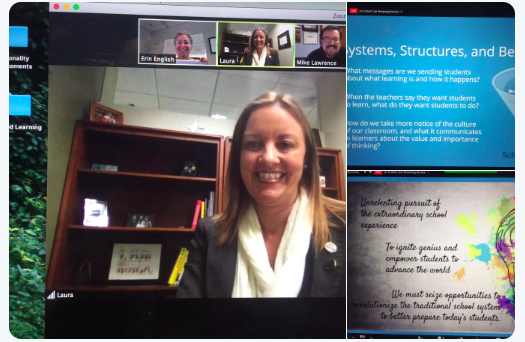
Today I was fortunate to present at the online #InnovateSD conference hosted by San Diego County Office of Education, thanks to an invitation extended to me by PowerSchool Senior Director of Educator Engagement Mike Lawrence.
At around 1 hour and 18 minutes of this YouTube video is my presentation.
Sorry – it won’t allow embedding
I’ve asked about the story of learning to over 300 educators over the past year, and regardless of age, background, or socioeconomic status, the answers were largely the same. The story of learning has been one largely comprised of compliance. Even those who shared about projects and experiential learning still shared a common message that you must do what you are told if you are to be labeled successful.
Many of our practices and our beliefs are so ingrained that they are institutionalized. After all, most educators have been in the school system since the age of four or five. It’s all many of us have ever known so it’s not a surprise that we don’t notice the messages we send through our systems, structures, and beliefs, or why we send them.
This video is about how Del Mar Union is pushing back on those systems, structures, and beliefs. It’s about the importance of providing students with the foundations and the experiences needed to think and to know their voice matters. It may be the story of Del Mar, but I am hopeful that it becomes the story of learning for all of us.