Author: Laura Spencer

  • Empathy is Always Worth the Time

    There are days when we all probably ask ourselves, “Is anyone actually listening?!?” Then I read tweets from teachers like this, and I realize the ripple effects from a pebble can travel much farther than seen from shore.
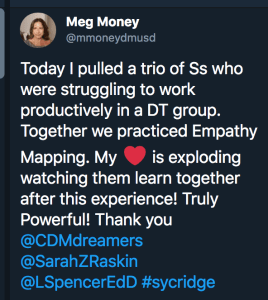
    A Tweet from Meg Money about using empathy mapping with her students

    Meg is one of those teachers I get excited to know and work with because she is willing to reflect on her practices as she continuously looks for connections that make a difference for students. After the above tweet, I asked her to blog this experience for others. Since she doesn’t have her own blog, I am giving her the space here to share. So this is Meg’s story in her own words…


    There’s a little saying that goes, “a stitch in time saves nine.”  
    Is Empathy Mapping worth the time?
    By: Meg Money, Sycamore Ridge 4th Grade teacher

    “As teachers, how do you want to invest your time?” Ron Ritchhart, Harvard’s Project Zero, asked a cohort of DMUSD teachers recently. This question has replayed in my mind time after time since.  Last week I was at a crossroads; time or making a difference? You see, our 4th grade class was in the thick of a Design Thinking challenge. All groups were collaborating ferociously and productively…all but one. But hey, it was my fault. I designed that group knowing that it had a 50-50 chance of working. This group of three included  kids who were bright and capable in their own right but different as day and night. Unfortunately I didn’t play my cards right, and now I had a group on my hands that had potential but was so far behind because productivity and collaboration were nonexistent.

    Now comes in the saying, “Timing is everything.” Fast forward two weeks to another training led by our very own DMUSD Design Team.  Paula (@CDMDreamers) and Sarah (@SarahZRaskin) led us through a Empathy Mapping exercise, and a light bulb went on. This is what my lagging group lacked… Empathy! However, this would take time; time a group was running out of.

    “How should I invest my time?” replayed one more time in my head. Yes, this is exactly what this trio of budding engineers deserved. They deserved to feel safe in a group and showcase their talents. Their assigned grouping shouldn’t be the barrier holding them back.

    I wasted no time and asked the group how they were feeling halfway through the research/prototyping phase. As you can imagine, they were frustrated and asked if they could just work alone. It was then I suggested that we come together and build empathy through the mapping exercise.

    What happened from there surpassed every expectation I’d anticipated. The kids were open, honest, polite and so insightful. They really didn’t need much prompting; they got it! They created NEED statements that immediately inspired them to hurry back to their learning. I watched in AWE as this group of young scholars immediately started approaching a difficult task with empathy and producing with the maturity of adults. I’m not going to lie, I had tears, goosebumps, and a swollen heart.

    So, was this worth the TIME? Oh, you have no idea. Just ask the group members.

    “Ms. Money, thank you for taking the time to do the mapping with us,” said one student.

    “This was the best day of the year,” another added with a hug.

    “Ms. Money, hurry, come see our idea!” shouted one from across the room.

    I will forever be reminded of this experience that truly confirmed that helping students find their potential and giving them a chance at success is absolutely worth the time. Empathy Mapping is now the frontrunner of my long list of “Must Explore and Practice” list. It is worth every second of TIME!

    Connect with Meg on Twitter at @mmoneydmusd

  • The Pyramid Scheme of Bloom and Maslow

    The Pyramid Scheme of Bloom and Maslow

    I’m not sure when I was introduced to the triangle guys… Bloom and his taxonomy, and Maslow and his hierarchy… but it was early on in my teaching career. I remember being told how important it was that students learn the basics before moving up the hierarchy of thinking. I also remember being told that it was equally important to ensure that higher level thinking opportunities were provided within my instructional approach.  And of course, it was also critical to ensure safety and belonging needs were met as well.

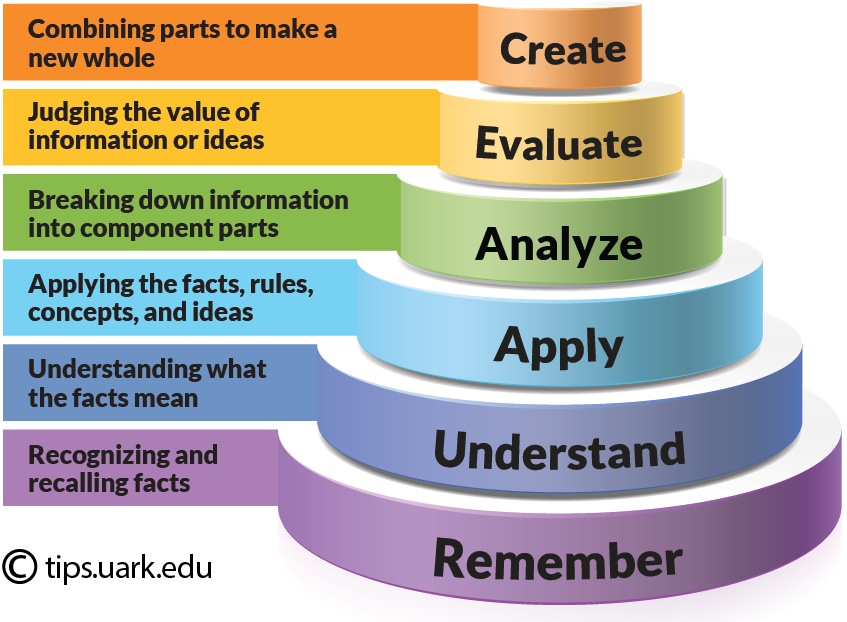
    Blooms_Taxonomy_pyramid_cake-style-use-with-permission

    I taught in a Program Improvement school during the No Child Left Behind accountability era. For those of you unfamiliar, it basically meant that failure to achieve proficiency within the timeline set forth by the federal government meant punishments. Punishments ranged from being publicly branded a failure to receiving corrective actions to being taken over (or “restructured”) by the state. For teachers, it meant doing whatever it took to raise test scores, even when not in the best interest of students.

    For the not proficient students, it meant teaching to the test. Drilling senseless information in the hopes that enough would stick to the move the needle to proficiency. For them, Bloom’s taxonomy wasn’t a triangle. It was a plateau of Remember with a sprinkling of Understand. Only proficient students were provided a ladder and some time to climb and explore. But even with those students, there was a problem.

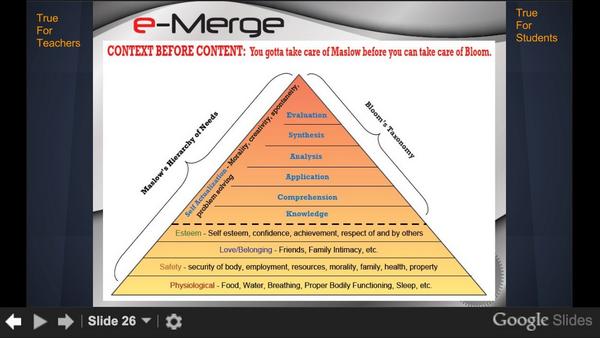
    The problem is that Bloom’s taxonomy isn’t actually a hierarchy of thinking… in fact, it was simply his theory of six learning objectives that he thought moved from lower to higher order thinking. It was not based on research in learning (see Making Thinking Visible chapter 1 by Ron Ritchhart, et al). All these years of teaching based on a triangle that has no grounding in what we know about cognitive processes… and now, to add to the confusing complexity, people are adding Maslow’s hierarchy to Bloom to send the message that students need Maslow before Bloom.

    B0E4xlWIcAEHOHl

    We need to move away from this pyramid altogether. Besides the primary two levels of physiological and safety needs, the rest of Maslow’s hierarchy does not happen in a classroom absent of cognitive development. A child will not establish a self-esteem if that child is not provided opportunities to learn and develop with his or her peers. A child is not going to feel a sense of belonging if his or her peers are engaging in complex thinking and discussion and s/he is not able to add to the richness of the conversation. Maslow, admitting that his earlier statements may have given “the false impression that a need must be satisfied 100 percent before the next need emerges,” explained that satisfaction of a needs is not an “all-or-none” phenomenon like we tend to act in education. Maslow also noted that the order of needs might adjust based on  individual unique needs. Fo example, some see self-esteem as more important than the need for love. For others, the need for creative fulfillment may supersede even the most basic needs. Therefore,  the old adage of “We must Maslow before we Bloom” doesn’t always stand firm.

    Another issue with this pyramid is that students can (and do!) analyze, synthesize and create as a way to form an understanding. Unfortunately, struggling students are often stuck in drill-and-kill mode without ever giving opportunities to engage in the higher order thinking that builds the thinking connections which truly create learning. I remember my daughter learning field hockey – she didn’t sit in a room learning every rule, every stick move, every penalty. She played. She learned. She tried out some moves and then reflected and adjusted based on her approximation of the standard. She watched others. This is how humans learn. Had she been forced to take timed tests on field hockey rules, she’d never have become the pretty good player she is today.

    When we move out of thinking of “only the proficient” can engage in complex thinking and give all students equitable opportunities to create, analyze, synthesize, etc., student learning and self-esteem will blow the top off both of those pyramids.

    Featured Image by 95C from Pixabay

  • Concierge Culture of Change

    Concierge Culture of Change

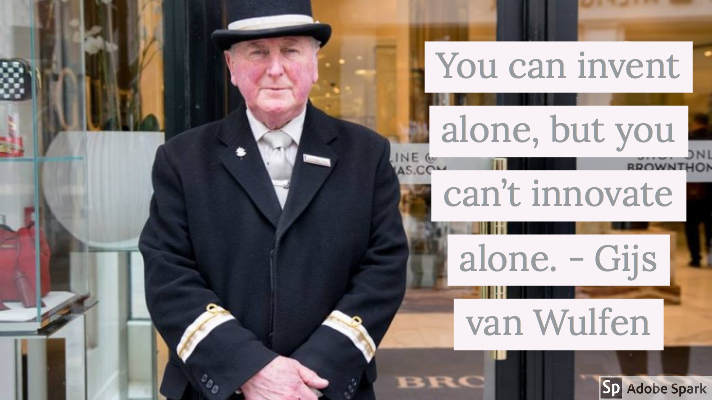
    Sometimes, we have to acknowledge that people have baggage before we can offer to take it off their hands. In shifting our educational culture, we need to see ourselves as the hotel concierge. When someone asks for help, they may not know what exactly they are seeking. It’s the job of the concierge to figure that out so that the guest has an extraordinary experience. Asking questions, discerning what the person likes and doesn’t like, and then brainstorming and providing different ideas to work towards a solution…. we can’t just assume everyone that comes to the desk needs a taxi cab or an extra towel.

    Likewise, we cant assume all our staff have the same understanding of the WHY or need the same professional learning when we’re making cultural shifts in our educational system. It takes time to dig in and figure out those latent needs, and then it takes a commitment to the person and the process to work towards the needed cultural shift.

    As we move forward, it will be important to keep those needs clear, and use them to set a path forward. Communication is going to keep everyone aware of all the pieces in motion and why those pieces are moving. Think of the concierge… when he recommends a restaurant for dinner, he doesn’t just give you the name. He writes it down, hands you a map and circles the location. Often, he’ll show you the best route to get there, and offer to make a reservation. This is how culture is shifted.

    If this post made you nod your head, or smile and think of a colleague… then share it! And subscribe to keep the posts coming!

  • Lucid Curiosity

    Lucid Curiosity

    I have a tendency to share articles, podcasts, books, movies, and anything else I consume with those around me. I have friends who tell me they keep folders in their email account full of my shares so they can hold on to them for later. And so I figured, why not share them with everyone. My goal, if I can keep it up, is a bi-weekly post with links to what has inspired thoughts from me. I figured the posts should have their own identity from the rest of my blog posts, so what to call it? And then, in a moment of lucidity, I thought…YEP. That’s it. Lucidity. So here we go…

    bing-han-223763-unsplash
    Curiosity has not killed this cat!   (Photo by Bing Han on Unsplash)

    Curiosity.

    Interestingly enough, although most companies say they value inquisitive minds, employees tend to feel stifled and conform to status quo instead of branching out with new ideas. In fact, a study found that curiosity drops 20% within six months on the job. Is it because the questions stop and the work production requirements increased? Maybe. But curiosity matters, and it has a huge positive impact on the workplace.

    There’s also an assumption that the creative jobs, the ones that hire curious minds, all require Bachelor degrees. Not true. Although blue collar jobs have declined, skilled-service good jobs are on the rise. The key is not so much in WHAT you learn, but more in the SKILLSETs developed while learning.

    So how do you encourage creative, curious minds? Jack Ma, co-founder of Alibaba, says you do NOT do it by being the top student at school. As he explained to his son, “being in the middle is fine, so long as your grades aren’t too bad. Only this kind of person [a middle-of-the-road student] has enough free time to learn other skills.” What other skills? Ma shared at the World Economic Forum that students need to learn that which machines cannot, such as teamwork, independent thinking, and caring for others.

    He’s not the only one to share this thinking. Minouche Shafik, Director of the London School of Economics, spoke at the World Economic Forum of the importance of “the soft skills, creative skills. Research skills, the ability to find information, synthesise it, make something of it.” Fabiola Gianotti, a particle physicist and the Director General of CERN, expanded on Shafik’s ideas: “We need to break the cultural silos. Too often people put science and the humanities, or science and the arts, in different silos. They are the highest expression of the curiosity and creativity of humanity.”

    So how do we ensure that we not just say we value curiosity and creativity, but actually practice what we preach? The latest Leadership + Design newsletter shared a few helpful tips:

    • Get out into the world outside of school and see how work is being done, why and by whom.
    • Move towards less compliancy and more possibility
    • Don’t just add, subtract

    cataddictsanony-mouse-give-it-to-me-straight-doc-its-curiosity-isnt-14968681Feeling curious now? This playlist created for CreativeMornings by DJ Jim Q may just put you in the mood to go explore.

    And hey, if this post made you smile, or think deeply for a moment, or just scratch your head and go HMM… then share it with a friend. Or two. And subscribe to keep the posts coming!


  • Beware of the person of one book.

    ben-white-197668-unsplash
    Photo by Ben White on Unsplash

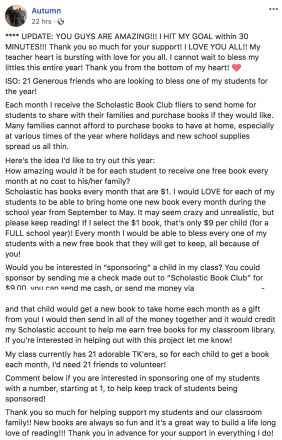
    During lunch today, I was skimming Facebook and came across a post from an awesome teacher friend Autumn with the following intro:

    ISO: 21 Generous friends who are looking to bless one of my students for the year!

    I was intrigued. I kept on reading…

    Screen Shot 2018-08-30 at 14.07.12Each month I receive the Scholastic Book Club fliers to send home for students to share with their families and purchase books if they would like. Many families cannot afford to purchase books to have at home, especially at various times of the year where holidays and new school supplies spread us all thin.

    Here’s the idea I’d like to try out this year:
    How amazing would it be for each student to receive one free book every month at no cost to his/her family?
    Scholastic has books every month that are $1. I would LOVE for each of my students to be able to bring home one new book every month during the school year from September to May. It may seem crazy and unrealistic, but please keep reading! If I select the $1 book, that’s only $9 per child (for a FULL school year)! Every month I would be able to bless every one of my students with a new free book that they will get to keep, all because of you!

    Before I could even finish reading the post, which provided all the logistics for getting involved, it was updated…

    **** UPDATE: YOU GUYS ARE AMAZING!!! I HIT MY GOAL within 30 MINUTES!!! Thank you so much for your support! I LOVE YOU ALL!! My teacher heart is bursting with love for you all. I cannot wait to bless my littles this entire year! Thank you from the bottom of my heart! 

    By the time I had finished my lunch, I noticed at least five other teachers had copied the post and were fully funded within minutes.  It was like an auction house selling a stack of Picasso originals for $9/each. People were greedily grabbing them all up. I felt lucky to finally catch an opening for a kinder class and signed up to be a book friend!

    What an awesome, simple way to work on closing the rich/poor reading achievement gap while promoting the value of reading.

    I wonder how else we can play with this generous idea..

    • What if it was set up like Secret Pals and the adults got a list of what the child was interested in, and the adult could pick out/order the book every month?
    • What if a FlipGrid was set up so adults could share their favorite books with the student so as to build a connection with a trusted adult?
    • What if we had volunteers to record themselves reading the books for children who don’t have a literate or English speaking parent at home?

    What other “what ifs” could we add?

    Have you implemented a program like this in your classroom? How’d it go? I’d love to hear from you.

    Blog post title is attributed to Thomas Aquinas.

    * Sharing is caring, so share some love with a ‘like’ and then share this blog post with a colleague.*

  • So You Want to Create a Flexible Learning Environment…

    So You Want to Create a Flexible Learning Environment…

    A colleague asked me for resources on flexible learning spaces. Her goal is for 6th students to use the Design Thinking mindset to redesign their own classroom. Because we know it’s not just about cool chairs and bright walls, it’s important that students and the teacher understand the WHY behind the decisions being made.

    Luckily, Twitter hashtag #learningspaces has a treasure trove of resources for teachers looking for a place to start. And attending CUE BOLD in May also provided me with access to amazing presenters and ideas around classroom environment.

    So here is the list of resources I curated for the students, in case it helps any of you:

    Tips for Designing Amazing Learning Spaces with Dr. Robert Dillon
    And here’s a visual for that YouTube video.

    Edutopia article showcasing some flexible K-8 classrooms.

    Video Series on the book The Space by Dr. Robert Dillon and Rebecca Hare

    This tweet may be good to spark a deeper conversation questioning why we need so many desks/chairs/etc in the room.

    12 Ways to Upgrade Your Classroom Design takes ideas from The Space and presents them in an easy to read blog post.

    Consider adding a Peace Corner to provide quiet spaces for reflection and emotional centering.

    Designing Brain Friendly Spaces by Dr. Robert Dillon is a short article with some targeted questions to ask while considering how space is used.

    CUE BOLD has made all the presentation slides available for those wanting to learn more. There are quite a few on learning spaces that are worth checking out. Look for Rebecca Hare, Michael Morrison, and Michelle Ho & Danielle Roja for relevant links.

    And of course, as you consider all this, please keep in mind that Pinterest is awesome for beautiful wedding decor, scrumptious recipes, and creative Outfits of the Day, but Pinterest-designed classrooms don’t always meet the needs of the learners (and they’re expensive to create!). My original blog post on that topic is still one of my most popular ones.

    Please let me know in the comments what else should be added to this list.


    And hey, if this post made you smile, or think deeply for a moment, or just scratch your head and go HMM… then share it with a friend. Or two. And subscribe to keep the posts coming!