Marzano deserves our anger. But at this point, what he really deserves is to be ignored.
— Read on teacherhabits.com/marzano/
Sometimes it’s best just to share the words of others without adding any commentary. Enjoy the read.
Marzano deserves our anger. But at this point, what he really deserves is to be ignored.
— Read on teacherhabits.com/marzano/
Sometimes it’s best just to share the words of others without adding any commentary. Enjoy the read.
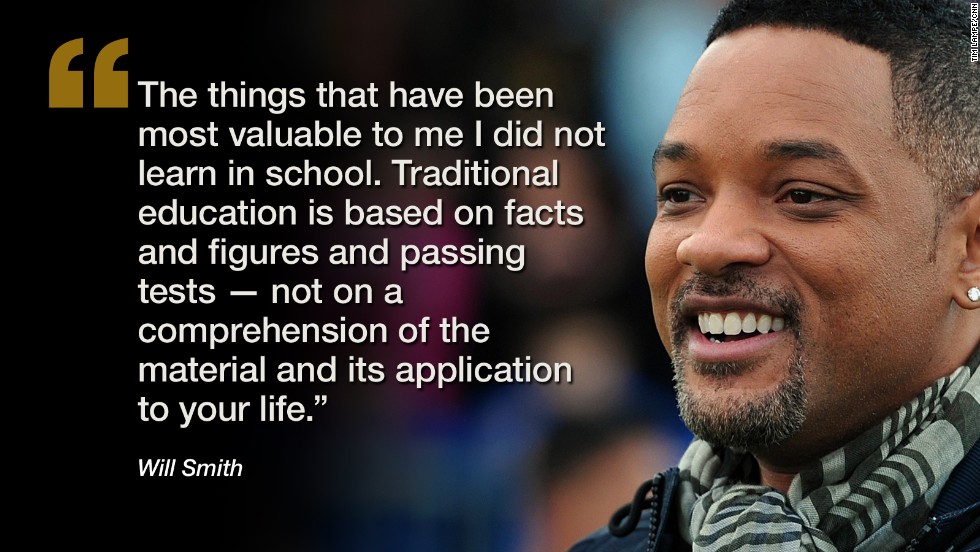
Being as my role includes the words “innovation” and “design,” I often talk to parents about shifts in educational practice, and why they are happening. Our district is elementary only, so some parents naturally worry about what will happen to their children after they leave an innovative elementary experience.
The question usually goes something like this:
Are my children going to be prepared for a traditional ______
(middle school, high school, college) experience?
It made me think about my own children, and what I prepared them for, and how I prepared them. I knew there’d be a time when both my girls would have their hearts broken by a love interest. But never did I think to myself, “Perhaps I should break their heart fnow so they are prepared for this moment.”
Instead, I focus on building confidence and independence in my daughters. I model resilience by being open about my own disappointing life experiences. I share books, articles, movies, and songs with positive life messages. And above all else, I encourage open dialogue with them so they see me as a source of support, and not fear.
I didn’t need to break their hearts to prepare them for heartbreak. They have each experienced the woes of teenage angst, and unreturned love, and came out a stronger, more determined woman.
Likewise, I don’t feel children need to be prepared for traditional school experiences by mimicking those experiences. Instead, children should be taught the skills they will need to thrive and find success regardless of the situation in which they are placed. If they learn critical problem finding and solving skills; how to collaborate with a team, even if the team is less than ideal; ways to empathize with others; and how to engage in creative thought and process they will be equipped with the skills to not only get them through the outdated, err traditional, school experience, but they’ll also have the skills to be successful in life.
I suggest we help parents instead pose the question:
Are my children going to be equipped with skills needed for a successful life,
regardless of their _____ (middle school, high school, college) experience?
I have five degrees. Five! An Associate degree, a Bachelor’s degree with a double major, a Master of Arts degree, a Master of Science degree, and a Doctorate in Education. I love school.
And yet, even with all those fancy certificates, my boyfriend is smarter than me. He’s a welder. No fancy college degrees. But he can build and create and fix and imagine in ways my brain can’t comprehend.

Case in point: We bought a Jeep. A ’68 Jeep that hadn’t been loved in a very long time. It had been parked in a field for 15 years, stripped of its elements and left abandoned to nature. No seats. No pedals. No steering assembly. All wiring stripped and sitting in a pile in the cab. Rusty nuts and bolts that belong somewhere filled a coffee can.
And yet he is rebuilding it. There’s no manual for this. No YouTube video series that connects all the dots. He has to figure it out. He IS figuring it out. Sometimes with parts that are there. Sometimes with new parts he is purchasing. And sometimes with parts he fabs up on his own. Watching him work mesmerizes me. His ability to see in three dimensions, and to understand the interdependency of systems and how they contribute to the overall form and function, is a form of genius I don’t possess.
I share all this with you not just because I am insanely proud of his skills (although I am!), but because I think it’s important to remember that there is not one best way to learn. As much as I love school and books and conversations about school and books, John would shrivel up in that environment.
Our experiences often have a greater impact on us than degrees ever will!
— Jonathan Spike (@Mr_JSpike)
When I started play teaching my dolls and neighborhood friends at age six, I knew everything and dispensed my knowledge to them through worksheets I drew, and books I read, and homework I made them complete (my poor friends!). When I started actual teaching twenty years later, not much had changed. I still made worksheets for my students, and read books with (and to) them, and assigned homework. Over the years, I learned and adapted to a 1:1 environment, and brought in Genius Hour and Project Based Learning. But sadly, and I am not proud to admit this, I controlled much of the learning structure in my room.
But our role as teachers is changing. We need to be cognizant of the needs of our learners. All our learners. Not just the ones that are compliant. Not just the ones that are college bound. Not just the ones that look like and sound like we do.
And part of that change is the realization that the best way to support a learner may simply be to get out of his/her way and let the learning figure itself out, like it does for John.
***
If you like Jeeps, or just watching things come to life, feel free to follow along via Instagram @wabisabi68jeep as we get this thing desert ready!

To culminate the school year, my Innovation and Design team published a blog post reflecting on all that we accomplished, and more importantly, all that we LEARNED, this past school year.
It’s crazy to think we’ve only been working together for one school year, and yet in that time, we co-planned with classroom teachers to create 65 design thinking units. There were other design thinking opportunities provided to students that we weren’t directly involved in, too.
Below is an excerpt from that reflection. I share it here because I think the learnings are universal to many. You can view the original blog post as well, which also includes a fun infographic.
*****
When people think and act like a designer, they must be able to see not just what is, but what might be (Berger, Cad Monkeys). The design thinking opportunities teachers facilitated for students this year truly exposed students to what might be by helping students discover their inner genius, and then empowering students to use that genius to advance the world. We watched in awe as students demonstrated sincere empathy and felt a call to action within, and outside of, design thinking experiences. We felt joy when watching the faces of teachers as they saw their students demonstrate their passion for learning. And we enjoyed seeing those proud parents listen to their children present their prototype solutions at packed exhibitions!
And we learned a lot, too! We learned…
– how important it is to always start with why and to know the priorities. When people understand the why and have an opportunity to be a voice in building the how and what, there is a greater success in change efforts.
– that every site and teacher, just like every student, has unique qualities requiring a customized approach to integrate design thinking experiences.
– connecting with industry experts to not only dive deeper into the content standards and relevant application to careers today, but to provide high-quality feedback on student thinking, exponentially increases student learning. And that expeditionary partnerships with local organizations is truly a game changer that leads to extraordinary experiences for students!
– a constant feedback loop is important from all stakeholders. Feedback, or better yet, feedforward, is an art form, and we are all working towards being master artists.
– our beliefs and experiences inform our actions. It is critical to give people an opportunity to experience something new for themselves so that they are empowered to contribute to leading change initiatives.

Today I was honored to give a speech at a 6th grade promotion ceremony.
I will admit, I was scared to give a speech. I mean, I give presentations all the time. I consider myself really good at it (like, really!). But a speech? I don’t do speeches. So I struggled for about a week to come up with something to say. Luckily, I was speaking at a school that had embraced design thinking this year. In fact, that was what I was asked to speak to… easy, right?
So after procrastinating for a week, I finally wrote it yesterday. I’ll admit to finding inspiration in the pages of Cad Monkeys by Warren Berger. (Thanks, Warren!) I decided to share it here, as I think there are a couple decent nuggets inside.
*****
Good morning everyone and welcome to today’s event. I’m honored to have been invited to speak on what I know is a very special day for both the students and families here today. My name is Dr. Laura Spencer. I am the Executive Director of Innovation and Design for the Del Mar Union School District. Basically, I have the coolest job in the district because my role is to work with your awesome teachers, as well as students like yourselves, to create opportunities that ignite the personal, inner genius of students and empower them to advance our world.
This year, as part of District Design 2022, 6th graders started using the principles of Design Thinking to find ways to make a difference in their classroom, on their campus, and in the world. Design Thinking is a human-centered approach to solving complex problems. It uses empathy and creativity to find innovative solutions.
In fact, this entire promotion ceremony is the result of a design thinking challenge to rethink how promotion can better meet the needs of the people here. Let’s give our students a hand for all their hard work organizing this special day…
To the 6th graders, I challenge you to think and act like a designer always. Designers must be able to see not just what is, but what might be. It’s about looking for opportunities to make positive change. To advance our world. And the best part is that you don’t have to wait for adulthood to get started. You can start making positive change today. Find opportunities throughout middle and high school. And don’t stop there. Keep using your inner genius to advance the world!
Think with empathy. Don’t presume to know what’s going on in someone else’s head. Get to know people. Understand them. Discover what makes them unique. Learn about their challenges. In doing so, you’ll also learn more about yourself.
When you practice empathy, you’ll find problems in need of solutions. We’ve got large problems and challenges in the world, but there are answers, too. They’re all around you. Don’t be afraid to look. It doesn’t matter how old you are.
Remember, your first idea is not always the best idea. Brainstorm! Wild and crazy ideas are sometimes the ones that take flight. Just think, when the adults here were kids, we were told to never get in a car with a stranger. Stranger danger was real. Now we use Uber or Lyft on our phone to ask strangers in cars to pick us up and bring us places. So never be afraid to chase after that crazy idea! (But hey, don’t get in cars with strangers!!)
And remember, prototypes are meant to be rough at first. You won’t always get things right the first time. In fact, you’ll probably get it wrong more often than you’ll get it right, so keep building and seeking out feedback. Doesn’t matter if it’s a crazy complex math problem or a video game you’re designing. Keep refining that prototype until you get it figured out. Ask for help.
Above all else, be human-centered in all you do.
So congratulations to the almost 7th graders, congratulations to the families, and finally, congrats to the teachers and everyone else who supported our students along their journey.
I’ll leave you with this final quote, from a great author with whom I imagine you are all familiar, by the name of Dr. Seuss.
“You have brains in your head. You have feet in your shoes. You can steer yourself in any direction you choose. You’re on your own. And you know what you know. You are the guy who’ll decide where to go.”
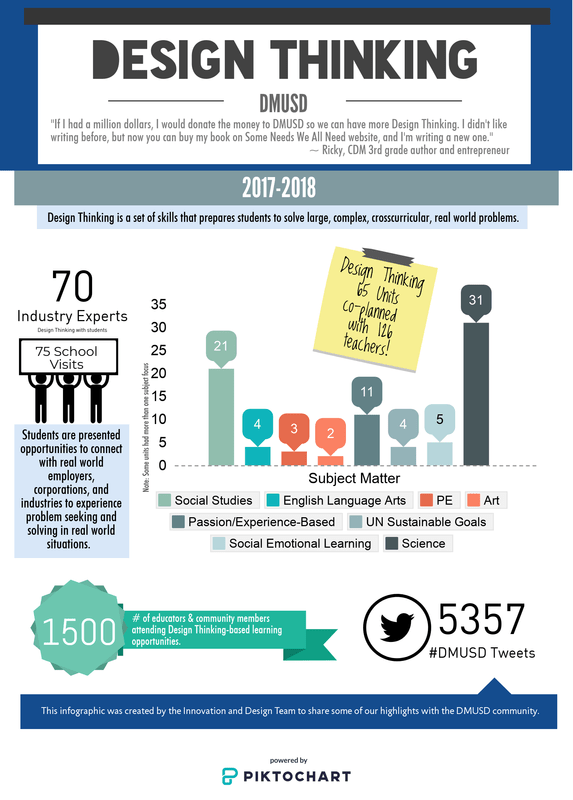
In August, Dr. McClurg challenged all of us to begin a journey from the tame to the wild, and as evidenced by some of the data Sarah, Paula, and I put together about our year, the DMUSD staff did just that. This year for us has been a monumental year of learning, creativity, and celebration, which would not have been possible if not for the amazing staff we were fortunate to work with throughout this school year.
When people think and act like a designer, they must be able to see not just what is, but what might be. The design thinking opportunities teachers facilitated for students this year truly exposed students to what might be by helping students discover their inner genius, and then empowering students to use that genius to advance the world. We watched in awe as students demonstrated sincere empathy and felt a call to action within, and outside of, design thinking experiences. We felt joy when watching the faces of teachers as they saw their students demonstrate their passion for learning. And we enjoyed seeing those proud parents listen to their children present their prototype solutions at packed exhibitions!
And we learned a lot, too! We learned…
– how important it is to always start with why and to know the priorities. When people understand the why and have an opportunity to be a voice in building the how and what, there is a greater success in change efforts.
– that every site and teacher, just like every student, has unique qualities requiring a customized approach to integrate design thinking experiences.
– connecting with industry experts to not only dive deeper into the content standards and relevant application to careers today, but to provide high-quality feedback on student thinking, exponentially increases student learning. And that expeditionary partnerships with local organizations is truly a game changer that leads to extraordinary experiences for students!
– a constant feedback loop is important from all stakeholders. Feedback, or better yet, feedforward, is an art form, and we are all working towards being master artists.
– our beliefs and experiences inform our actions. It is critical to give people an opportunity to experience something new for themselves so that they are empowered to contribute to leading change initiatives.
We have some hopes and plans moving forward to the 2018-19 school year. Besides continuing to support the momentum for implementing design thinking experiences in the classroom, we are looking to increase opportunities for expeditionary partnerships and industry expert connections. We’re building design thinking-ish mini-experiences that teachers can use within a lesson, as well as redesigning some of our planning tools to be more user-friendly.
We are thankful to each and every staff member and student of DMUSD for the opportunity to serve you, and look forward to continuing in our unrelenting pursuit to create the extraordinary school experience for all students.
 Laura K Spencer, Ed.D.