Author: Laura Spencer

  • Eat a Good Breakfast and Get Plenty of Sleep!

    Eat a Good Breakfast and Get Plenty of Sleep!

    (Warning: This may cause you to disagree with me, and that’s okay! Share your comments below)

    fd495738d893a765ffa40edd2fcec112
    Found on Testing Motivation Pinterest Page.

    Don’t lie…

    When you read that title, what immediately jumped in to your head? If you’re an educator, I’d bet fifty bucks that state testing, or some other high stakes accountability assessment, leapt into your mind.

    Why?

    Why do we harp on students to eat a good breakfast and get plenty of sleep during testing season? (Is it truly a season???)

    Why do we leave students notes of encouragement on their desks during testing?

    Why do we ask parents to make sure students are at school on time, and that appointments be scheduled before or after school on testing days?

    Maybe the better question is …

    Why don’t we do this every day?


    … What messages are we sending about our values when we roll out the compassion ticker tape parade one time a year? And when that parade just happens to coincide with the test upon which schools are judged? Do we value the student or the test score?

    All those awesome desk notes and hallway banners and granola snack packs I have seen on Twitter and Facebook this past month are fabulous. They truly are. So let’s make sure they don’t just happen during state testing.

    Let’s make sure students know that EVERY SINGLE DAY they matter! Because they do. (And so do you, awesome teachers!)


  • Is It Possible to Do Good Better?

    Is It Possible to Do Good Better?

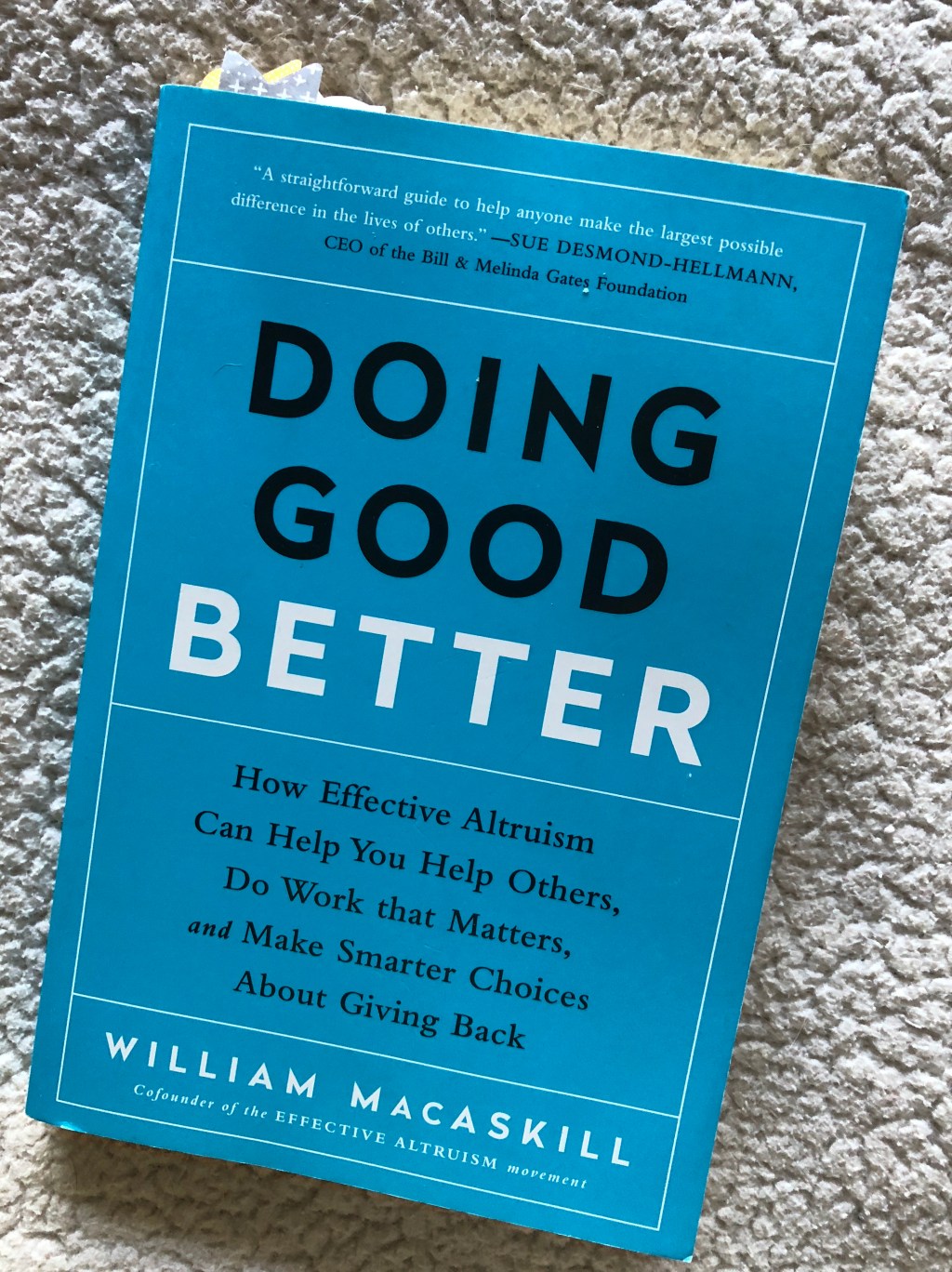
    Doing Good Better bookAccording to William Macaskill, it is. That’s the premise behind his book, Doing Good Better: How Effective Altruism Can Help You Help Others, Do Work That Matters, and Make Smarter Choices About Giving Back. 

    Macaskill and colleagues developed effective altruism, which uses data and some snazzy principles to help people make a huge difference in the world. It’s about asking “How can I make the biggest difference I can?” and then using evidence and reasoning to find the answer. It’s not about more money, or volunteering more hours. It’s more about being impartial in analyzing the options to choose what’s best for the world. (Spoiler alert: many of the options that we choose aren’t the best ones!)

    I picked up this book because of Design Thinking. Weird, maybe… but as we ask students to prototype solutions to complex problems, I’ve been grappling with what to do with those solutions. Are they solutions that warrant being pushed into the world? Have similar solutions already been tested? Should we tap into the passion students show towards specific subjects and encourage them to do something to make a difference, or redirect their energy to areas in which it is possible to truly make a difference? And hey, are we even tackling the right problems?

    According to Macaskill, it’s not enough to do something. It needs to be the best thing, so that the thing done makes the difference it should make. When it comes to helping others, Macaskill says that “being unreflective often means being ineffective.” He shares multiple examples of programs that sound great on paper, like PlayPumps  and Fair Trade but in actuality do little good for the people they intend to serve. In fact, some programs not only don’t do good, but they can cause harm, like Scared Straight, and boycotting sweat shops (seriously…!)

    So what does this have to do with elementary students and design thinking?

    If we are going to present students with opportunities to solve complex problems, and build in them a sense of agency that they can make a difference in the world, then isn’t it also our responsibility to make sure that they do good in a way that actually helps others? Shouldn’t we teach them how to identify work that matters? And how to make smart choices about ways to give back?

    Although I’m not sure I agree with all of Macaskill’s premises, I do think this is an area which warrants a deeper dive. If we are going to teach advocacy, global citizenship, and cultural intelligence, then it is important that we also provide students with the tools needed to help them make smart decisions, just like we need to do with media literacy and fake news. We need to make sure that critical thinking stays prominent in this work.

    We need to ask ourselves if we are doing good, or if we are doing good better.


  • There’s More to Her Than Meets the Eye

    There’s More to Her Than Meets the Eye

    When school dress codes focus the majority of their attention on what girls should not be allowed to wear, it sends a message.

    A powerful message.

    A message that girls are the problem. Their bodies are distracting to boys. And that boys shouldn’t have to be responsible for curtailing their sexist behavior.

    This needs to stop.

    It breeds harassment. And misogyny. And a blame the victim culture.

    Proud of my daughter for standing up for her rights. For her body. For her voice.

    Take a few minutes and read her post. Words of support always loved:

    There’s More to Me Than Meets the Eye

  • I Have Fallen in Love with Cad Monkeys, Dinosaur Babies, and T-Shaped People!

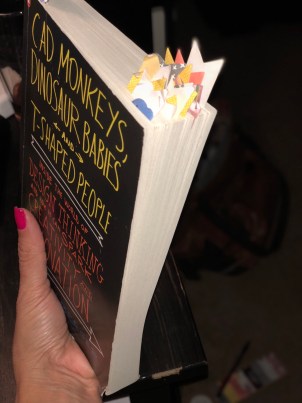
    Well, not literally! But I did thoroughly enjoy the book Cad Monkeys. Dinosaur Babies, and T-Shaped People: Inside the World of Design Thinking and How it Can Spark Creativity and Innovation by Warren Berger (That title is quite a mouthful!!). If you don’t believe me, consider the fact that I used up almost all of my super cute Target bin book tabs in this one book!

    Book tabs on my book

    I truly don’t even know where to start to describe all I learned from Berger. His deep dive into the world of design, and designers, read like a novel – fascinating characters, interesting plot developments, and a universal theme to do the right thing.

    You know what? I’m just going to share some of my tabbed inspirations and see where it goes:

    * It can be difficult to step back and look at one’s life with a fresh eye, but this is part of what design can teach us: how to view things sideways, how to reframe, rearrange, experiment, refine, and – maybe most important of all – how to ask “the stupid questions” that challenge assumptions about the way things have been done in the past.

    * Jumping the fence…attempting to make the leap from the realm of known achievability (what we know is possible) to the much larger surrounding space (what we don’t know how to do yet).

    * Everything a business does matters; that every action communicates a message to the world and also has consequences on some level.

    * Jim Hackett, CEO of Steelcase: “There is an over celebration of getting things done” and not enough patience for “thinking as part of doing.”

    * Dean Kamen: “We have to do whatever it takes to get ideas out there into the world. Otherwise, you’re just doing science fair projects.”

    * Mark Noonan: “Instead of just asking a question, you have to take ownership of it.”

    * Bruce Mau: Process enables experimentation. “It’s like a safety net.” People tend to feel more comfortable experimenting with new ideas and venturing onto unfamiliar turf when they carry with them an established method of working and solving problems. It means that even if they don’t quite know what they’re doing, they always know what to do.”

    This book is like the Lorax, in that it speaks for design. And even though it’s about design, these quotes also speak to the heart of education. They speak to the work we must do to ensure student learning experiences are relevant to the world they inhabit today, and the future world problems they will be inheriting.

    I leave them here, then, without my commentary so that they can speak to you as well. Tell me, what do you hear?

  • Countdowns Suck. Yes, I said it.

    71xhwxJpRsL._SY606_

    I wanted to write earlier…I really did. So many blog posts have been ruminating in my brain the past few weeks.

    But I’ve had a major life event happen. And I needed time to process. And that meant taking a break from my blog.

    So what happened? My oldest daughter, Alexandra, enlisted in the U.S. Navy. In fact, she leaves for basic training in 21 days. 30200 minutes.

    I’m so insanely proud of her. Having served in the U.S. Army myself, I know how scary it can be to give control of your life over to the government in the name of freedom. But she did it, and not only did she do it, but she was chosen to participate in the cryptology program, which is the same program in which my dad served during the Vietnam War.

    So if I am so proud, why haven’t I blogged? Because I am also scared to death! I vacillate between proud momma and “Oh my gosh… how will I survive eight weeks without talking to her, without seeing her, without knowing she is okay?”

    The days are counting down until she leaves… 21 days… 30175 minutes since I started writing this blog post. 21 days until her exciting new life begins and my angst-ridden new life begins.

    Makes me wonder how many of our students have similar angst with those “Countdown to Summer Vacation” signs that are found in so many classrooms these days. If a child’s summer is spent traveling to Hawaii, that countdown is amazing. If that summer is spent babysitting younger siblings or wondering if there is enough food for lunch and dinner, those numbers are pretty darn scary.

    Sign up to receive an update when I post. Type your email address in the box and click the “Subscribe” button. My list is completely spam free, and you can opt out at any time


  • A Rubric is Not an Authentic Audience

    A Rubric is Not an Authentic Audience

    If students have only experienced a rubric as an audience to their writing, we have failed them miserably.

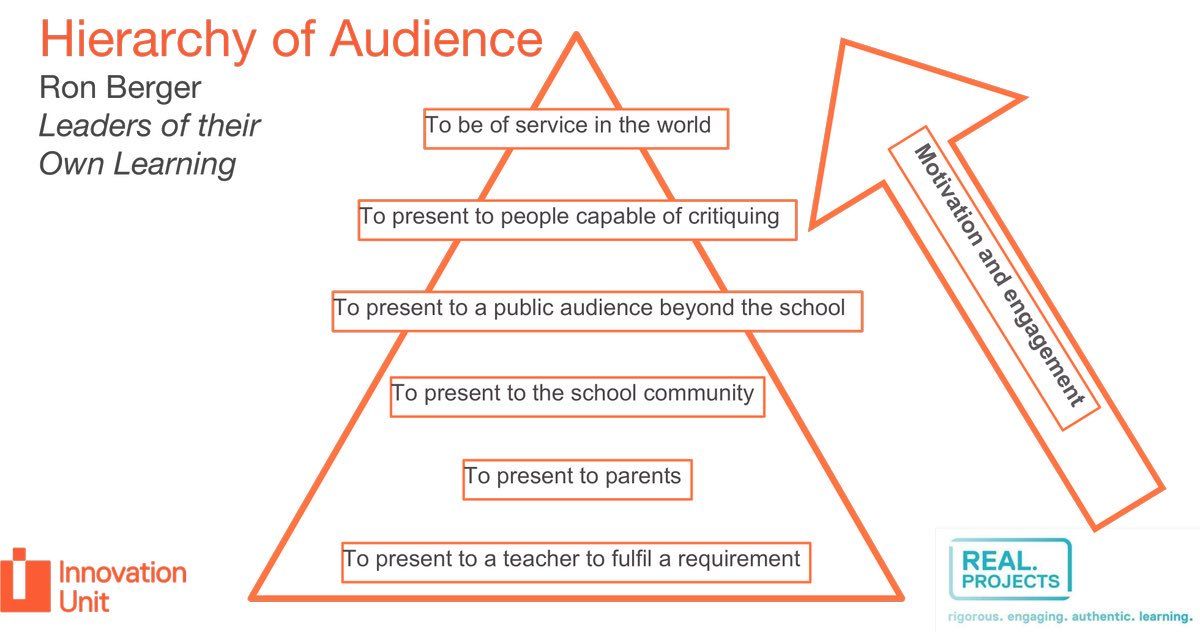
    Ron Berger, known for his work with Expeditionary Learning Outward Bound school network, Harvard Project Zero, and the Carnegie Foundation for the Advancement of Teaching, created a Hierarchy of Audience graphic to show how valuable authentic audiences are. He explains:  “When we finish school and enter the world of work, we are asked to create work of value — scientific reports, business plans, websites, books, architectural blueprints, graphic artwork, investment proposals, medical devices and software applications. This work is created over weeks or months with team consultation, collaboration and critique, and it goes through multiple revisions.”

    hierarchy of audience

    So how can we create opportunities for students to stretch beyond the rubric?

    Our 6th graders are about to embark on a collaborative project with an international corporation to solve an actual problem the corporation is facing. They will be required to convey their proposals using business communications methods such as those Berger listed. Their audience will be the engineers, corporate executives, and marketing teams of the corporation.

    Third graders, embarking on a classroom fundraising project, developed business plans and presented proposals based on a craft they wanted to sell at Open House. They had to identify their customer, develop a cost analysis, and a marketing plan.

    My 16 year old daughter, wanting to share a message of female empowerment with others her age, started a blog… which ironically receives more viewers than me on many days!

    Rubrics have their place as a formative assessment tool. But let’s not make it the destination. Our students have much more to contribute to the world than can be conveyed on a 4 point rubric!