Year: 2019

  • Don’t Wait for the Postmortem to See if You’re Sick

    Don’t Wait for the Postmortem to See if You’re Sick

    β€œEducators have long complained that end-of-year, β€œsummative” assessments are not useful because the results are not available until fall when their students have moved on to the next grade.”

    (Is this the end of end-of-year testing? Education Dive)

    Okay… I’m not a high stakes (I mean “end-of-year”) testing fan either, but …

    Summative assessments are like a postmortem. It gives you feedback after the fact. And although it can be disaggregated by student, the data isn’t really about each child. It’s about the system. Did the system educate this group, and these sub-groups, of students to the predetermined appropriate level dictated by some guy in a suit in an office building somewhere? If not, then the system needs to evaluate its methods and make adjustments. If it did, then other systems ask for the silver bullet solution to apply to their own system.

    It was never set up to be anything different or better than that. It’s not about Martin. It’s about 356 Martins in grade 6, 70 of which are “low-socioeconomic” Martins, 95 of which are “two or more races” Martins, and 64 of which are “English Learner” Martins.

    If you’re waiting for a postmortem to decide if you need to cut back on the greasy foods, you’re doing it wrong.

    Get Your Check-Ups

    If you want useful data to make instructional adjustments, you have to go to the doc for routine check-ups, aka formative assessments. You need blood work, your heart listened to, and maybe a good ol’ knock on the knees to check those reflexes!

    Relying on state accountability test data to make modifications is too late – you’re already in the morgue.

    In successful learning environments, whether they be a formal classroom or a behind-the-wheel driving lesson, learning is assessed multiple times a day, and adjustments made as needed by the teacher. Madeline Hunter included Checking for Understanding, Guided Practice, and Individual Practice as critical elements of good teaching because they inform the teacher as to appropriate next steps. Formative assessment is not about a multiple choice test given on Tuesdays, but rather an ongoing practice to determine if the instruction is having its intended outcome.

    (Hey, doctors say they “practice” medicine… coincidence?)

    State tests will never replace this teacher function. Nor should they try.

    Now, if only we could reduce the testing window and give teachers more TIME to analyze and discuss their formative and summative assessment data with peers throughout the year.

    Now THAT would make a difference!

  • Function and Agency

    Function and Agency

    I spent a year digging deeply into the concept of student agency with teacher teams. We tried to define what agency looked like for a particular grade level, and then how to use that definition to create a classroom culture that provided opportunities for students to develop and exhibit agency.

    Lately, as I work on creating learning experiences for virtual learners, I’ve been thinking a lot about the agency work. How do students who aren’t in a classroom develop and exhibit agency? Do they have to already have agency in order to be a successful virtual learner? Is this a chicken or the egg debate?

    Executive Function

    The other day I stumbled upon a webinar by Sucheta Kamath, founder and CEO of EXQ, called The Back-to-school Brain: Developing Executive Function Skills to Shape a Successful School Year. Kamath dove into the importance of Executive Function skills for students. According to Kamath, executive function is the ability
    to serve the self (goals),
    done by oneself,
    by managing self
    …and if one can’t, it’s the ability ask for help, by oneself.

    In other words, if an idea is originated by a parent or teacher, than it is the parent or teacher’s executive functioning skills getting worked, and not the student.

    This isn’t far off from the definition of student agency. One definition I like states that “Agency refers to the power to make choices. Students with agency are those who feel a high level of responsibility and ownership for their own learning (source).” In order to have that high level of responsibility and ownership, students would need to have executive functioning.

    So then…if a teacher is setting up a classroom to provide opportunities for students to develop and exhibit agency, then how much of that opportunity is based on the teacher’s executive functioning skills and agency and how much of it is building the child’s skills? In other words, if the teacher says, “I’m creating this writer’s workshop to build agency” then has the responsibility and ownership been placed on the teacher instead of the student?

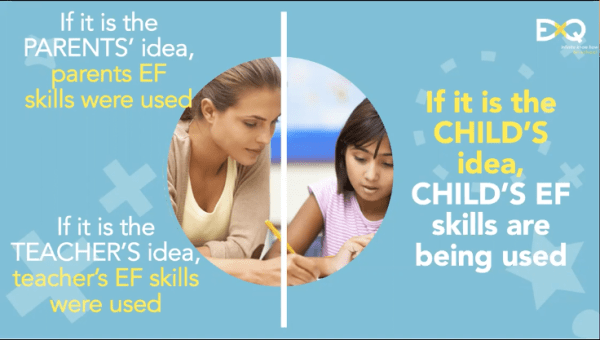
    Slide with female adult helping young female student.
States: If it's the parent's idea, parents EF skills were used. If it's the teacher's idea, teacher's EF skills were used. If it is the child's idea, child's EF skills are being used.
    Slide from Kamath’s presentation. EF = Executive Function

    This becomes an important question when considering two important executive functioning skills – to adapt and to shift flexibly. Throughout a school day, students are expected to transition multiple times through a variety of different transition types:

    • leisure to leisure – from lunch to free play, or during station rotation with fun experiences
    • work to leisure – finishing up an assignment before recess or the end of the school day
    • leisure to work – coming back to class after recess, or lunch, or an assembly
    • work to work – shifting from math instruction to science instruction

    Disengaging from one experience and then reengaging with a different experience is exhausting, especially when it is a work to work adjustment. Before students can take ownership of learning, they must successfully navigate these transitions.

    Kamath recommended that teachers ensure the expectations match the level of skill readiness. It may be unrealistic for a kindergartner to know how to put away math and pull out writing without direction, but it is not unrealistic for a middle school student. So before judging a child for failure to exhibit agency, it may be necessary to provide help in executive functioning,

    A tip from Kamath: Use timers to warn about upcoming transitions (not just when time is up!), as well as provide visual reminders. Have different timer sounds for different transition types.

    Function Before Agency

    So if executive functioning skills must stem from the student’s self management, and self-management is required in order to exhibit responsibility and ownership, which are demonstrations of agency, then it stands to reason that students need to have age-appropriate executive functioning in order to demonstrate agency in learning.

    Our Role as Educators

    Helping students discover their sense of purpose, and then assisting them in using their executive functioning skills to set them on a course to achieve that purpose, will create a personal drive to learn, and thus lead them to take agency, or ownership and responsibility, of that learning.

  • Talking to Colleagues about Talking to Strangers

    Talking to Colleagues about Talking to Strangers

    My daughter Alex gets a quirky partial smile on her face when she’s highly anxious or nervous. I worried that this would work against her when she was in Navy Boot Camp.

    Today’s blog explains why…

    When Mike Lawrence invited me to his next #HookEd virtual book club talk, I jumped at the opportunity. The book selected was Talking to Strangers: What We Should Know about the People We Don’t Know by Malcolm Gladwell.

    Usually, I would read the book so that my post-it tabs could be put to good use, but I’m glad I chose the audiobook this time. Gladwell, when quoting others throughout the book, included the original audio, so in many ways, the audiobook felt like a really long podcast, in which multiple people were invited to speak. It helped make sense of the dense topic he was wading through.

    About the Book

    But I have to admit, I didn’t love this book. I’m not even sure I really liked it. I did, however, enjoy the book talk, especially when we discussed the “allusion of asymmetric insight.” As the book explains, asymmetrical insight is:

    The conviction that we know others better than they know usβ€”and that we may have insights about them they lack (but not vice versa)β€”leads us to talk when we would do well to listen and to be less patient than we ought to be when others express the conviction that they are the ones who are being misunderstood or judged unfairly.

    To illustrate this point, the book shares a simple experiment in which people are given words in which some letters are replaced with a blank. Participants fill in the blanks to form words. When people analyze the word bank of others, they tend to draw conclusions. For example, if most of the words are glum, they might assume the person is depressed, or negative. And yet, when looking at their own set of words, people often state that there is no correlation to their personality, and that the words are just random.

    Mike asked each of the book club participants to also complete the word list. A couple participants even asked a few others to complete it as well. And just like in the book, we all ascribed no meaning to our own list, but could easily find connections in others.

    Mike had a good insight into this – he said that, as humans, our brain is constantly looking to solve patterns and find meaning where maybe meaning doesn’t exist. I wonder if it’s a remnant of our cave days… staying alive by judging situations and people quickly.

    Human Transparency

    Which may explain another problem Gladwell brought up – that of human transparency. Gladwell says that we tend to have a β€œdefault to [an assumption of] truth,” meaning we think we know or can read other people’s intentions, good or bad. We base much of this on facial expressions. After all, how hard can it be to recognize anger or fear on someone else’s face?

    Turns out it is pretty dang hard. Mismatches between expressions and intentions are common. And if you think all anger looks the same, then the Trobiander tribe in Papau New Guinea will convince you otherwise. To them, a gasping face is a face of anger and threats, and not fear.

    And when the perceived facial expression doesn’t align with the emotion we expect to be present, it creates a mismatch. And mismatches can lead to incorrect assumptions about the person in front of us. This can be something as simple as, “That person is always in a bad mood” to a life altering guilty verdict because the defendant doesn’t appear remorseful.

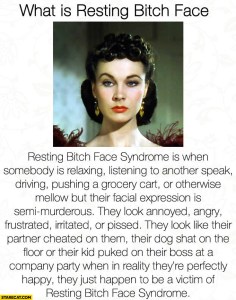
    I have been a victim of facial mismatching. RBF, anyone?

    A photo of a woman with a perceived scowl, with the headline "What is Resting Bitch Face"

    So why am I bothering to write about this?

    I was talking to a colleague the other day who said that she had been perceived as a less dedicated teacher

    How many times do we, as educators, make assumptions about our students, or their families, (or each other?) that are either based on an allusion of asymmetric insight or a facial-emotional mismatch?

    Ever think a parent must not be invested in a child’s education since that parent never shows up to school events, award assemblies, or sign homework logs?

    I’ve missed many of my daughters’ events because, as an educator, I had to be at events at the same time as they had theirs.

    Ever suspect that a child (or spouse…lol) is lying since s/he is avoiding eye contact when questioned about a situation?

    I get anxiety when confronted and look away so I can focus on controlling my own emotions before responding.

    Ever assume the class understood your lecture because they are all nodding their heads as you speak?

    So many times I’ve been off-task or bored and will nod so as to avoid being discovered.

    Ever think a student doesn’t care about the failing grade because they smirk when you bring up the topic?

    I circle back to the opening, and my daughter Alex with her quirky smirk…

    Know Better, Do Better

    Here’s the thing – so much of what we know, or presume to know, is based on assumption. I’ve made a lot of (probably incorrect) assumptions about my students and colleagues and community throughout my career.

    Perhaps, then, Gladwell’s book had an impact on me, even though I wasn’t a huge fan.

    Gladwell writes: β€œThe thing we want to learn about a stranger is fragile. If we tread carelessly it will crumple under our feet… The right way to talk to strangers is with caution and humility.”

    Or as we say in design thinking, empathy. 😌

  • Boxes Aren’t For Thinking

    Boxes Aren’t For Thinking

    How do you innovate from inside the box?

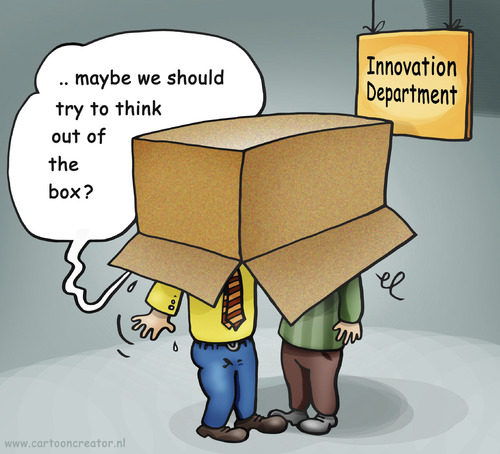
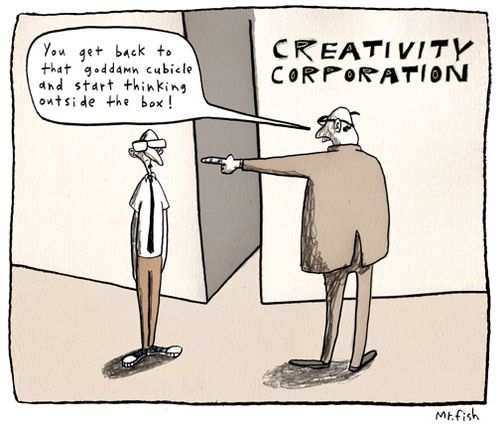
    “Think outside the box” is probably one of the most overused statements. No matter what the situation, or problem, inevitably someone will say, “We need to think outside the box.”

    The problem with thinking outside the box is that leadership often wants to create a box to contain the thinking outside the box. In other words, think outside the box, but only insofar as the thinking stays within the organization’s predetermined box.

    Today I had a meeting scheduled with a director at the San Diego Zoo to discuss an upcoming zoo-sponsored hackathon, and potential connections with K-12 education. In lieu of the traditional phone call introduction and conversation, we decided to meet at the zoo. And since it was a beautiful day, our meeting was a walk and talk around the zoo instead of inside the administration building.

    Without the confines of the box, we found our conversation expanding beyond the original topic of discussion. Discussions of elephant emotions and giraffe spot patterns sparked conversations about augmented reality and wildlife conservation. We were able to dream big about ways to build student advocacy in to zoo fieldtrips while talking UX design and hackathons.

    I walked away from the meeting with ideas and energy to pursue those ideas.

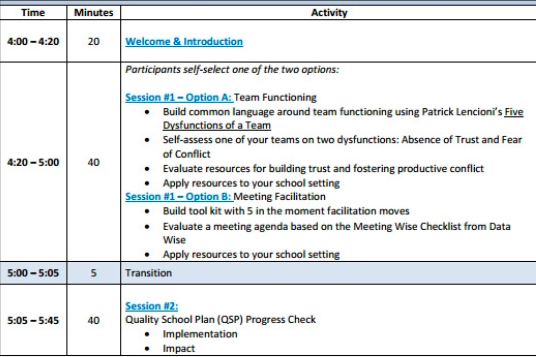
    This freedom of time and space to connect with others, to engage in meaningful dialogue, and to reflect on possibilities is not often provided for educators. The box confines, and the box dictates, what should be thought about and when. Look at any PLC or meeting agenda and you’ll probably see something like this:

    We want teachers to be innovative. We want schools to be transformative. But we don’t provide opportunities for that because we control the interactions. Topics are outlined, times are allotted, and thinking stays inside the box.

    It used to be that teachers could go to conferences as a way to think outside the box (although in reality, they were just thinking inside a different box… but it was still outside their own box, so that was cool).

    But now I’m seeing more and more districts and schools self-hosting their own professional development “mini-conferences” which are, effectively, keeping people in the box.

    One of my favorite design thinking exercises is a premortem experience, in which you write about what could go wrong with a proposed solution.

    Looking from a premortem lens, ask yourself, what would happen if we took the box away? What’s the worst that could happen if we asked teachers to go for a walk in the park with a colleague and talk? Or to visit a local business (or zoo) and walk and talk with someone there? If we removed the box, even for an hour, what might come of it?

    Honestly, I can’t picture the world ending. But what I can picture are people being exposed to new ideas and information, and considering the implications for their teaching and learning.

    If we want classroom learning to be relevant, and we want teachers to provide real-world connections, it can’t be done inside the box.

    We need to build opportunities for educators to think freely, to wander open spaces, to connect with people they don’t get to connect with, and to think without agendized topics and time constraints, so that we can truly start to think outside the box about education.

  • How May I Be of Service

    How May I Be of Service

    As some of you know, I took a career break this summer. My first break from working since I was 14 1/2 years old. It was both terrifying and exhilarating. One of the by-products of that break was being able to connect with people I previously felt too busy to connect with, and provide them with any expertise, crazy ideas, or just goofiness they desired.

    I spent time in classrooms co-teaching or observing lessons with teacher friends, as well as dispensing tech support and professional trainings for clerical (aka classified in edu world) staff. I also volunteered as a Designer-in-Residence at UCSD, and have been enjoying stretching my brain in the world of academia. In fact, yesterday I sat in a room full of computer science students and listened to Professor Ravi Chugh talk about “Bi-Directional Programming with Direct Manipulation.” I may even be able to fool you into thinking I understood the talk if I throw out acronyms like PL and GUI and terms like output-directed programming πŸ˜›.

    The Curse of Averageness, or is it?

    This opportunity to expand and immerse reinforced a concept I read recently in Mark Manson’s book, The Subtle Art of Not Giving a #@%!: A Counterintuitive Approach to Living a Good Life. Mark writes:

    Most of us are pretty average at most things we do. Even if you’re exceptional at one thing, chances are you’re average or below average at most other things.

    Mark Manson

    Assuming that’s true, then it would make sense to seek out those who may be exceptional in an area in which we are average (or below, gasp!) and improve our own skillset. But the fact of the matter is, we don’t. Instead, we internally judge ourselves for not being up to par because society (aka the media) focuses on the exceptional only, not the average. The best of the best… and the worst of the worst. It sells. Can’t deny it.

    It’s crazy. We all have something to offer. Sure, we may not be extraordinary, but we have something dang nabbit! I may never be able to create a PL to GUI bi-directional platform for programmers, but I can certainly help streamline your Gmail madness, or recover a lost password for your (okay my) grandpa’s bank account. And I can certainly ramble on and on about the talks I have listened to, or books I read, in an attempt to provide a nugget of inspiration for someone else. It’s not extraordinary, but it’s me. It’s what I have to offer.

    So How May I Be Of Service to You?

    So here it is… I started two new ventures to share my averageness with the world, and I hope it brings you some extraordinary value.

    YouTube – I have no desire to be a YouTube star, as you’ll see by the low-fidelity quality of my videos. But I am starting to post some tech tips on there. These are tips that illicited “oohs” and “ahhs” when I shared them at a recent professional development. Short, relevant, and (hopefully) applicable.

    Podcast – Again, no desire to be a podcast star, but sometimes I have ideas, and I share them with people and then I think, that’s too much energy to try to write in my blog. And then, poof, it’s gone. So after chatting with Paula last night about hackathons and entrepreneurs, I grabbed my phone and recorded my thoughts. And so here’s the first episode. I don’t know how often I’ll post these, but I will. And who knows – maybe you’ll be in the next one. Again, super low fidelity. In fact, episode 1 was recorded in my car sitting in traffic (hands-free of course).

    I hope that these ventures in sharing encourage others to share their little bit of above average with others. After all, it’s the community that helps us grow.

    And since you’re here, and reading this, do me a favor…leave a comment. Let me know what you’re thinking… what’s your above-averageness that you can share with others? What do you wish I would share with you?

    And then, subscribe. Subscribe to this blog, or the YouTube, or the podcast, or all of it. Because those subscriptions show love, and value, and make me feel like maybe being average is a pretty cool feeling to have.

  • Teens Doing Whatever It Takes to Draw Attention to Human Trafficking

    Teens Doing Whatever It Takes to Draw Attention to Human Trafficking

    Yesterday I watched as teens came together to use their design thinking and entrepreneurial skills to tackle the subject of human trafficking, which is prevalent in San Diego. They came up with innovative ideas to increase awareness and inspire action.

    The day kicked off with a motivational talk by WIT Founder, Sarah Hernholm. She stressed to them how important their voice is to solving big issues in our society. “You’re so much more than your school, your GPA, your AP course load… what matters are your ideas.”

    Sarah and Don sharing with teens about the issue of human trafficking.

    To provide more context as to how important the issue of human trafficking is to San Diego teens, Don from Saved in America shared with the group how 3,000 teens from San Diego alone were lost within the past year. He shared signs of distress to look for in friends who may be involved in unhealthy relationships, as well. When asked why teens don’t know more about this epidemic, Don responded that it’s a hard conversation for adults to start with teens. One of the teen participants responded, “Just because it’s a hard conversation doesn’t mean we shouldn’t have it.” Another added on, “Teens have to be at the table for issues impacting teens.”

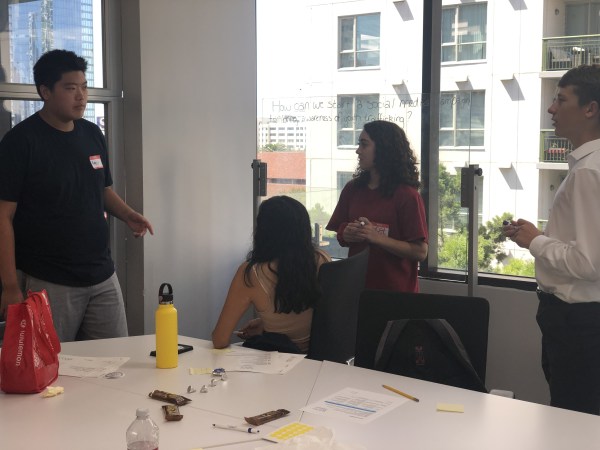
    Brainstorming ways to encourage teens to avoid unhealthy relationships.

    And at the table they were!

    Don’s talk lit a fire in the teens. Split into smaller groups, they brainstormed solutions to:
    – Ensure teens know the Human Trafficking Hotline Phone Number
    – Provide education to teens on healthy vs unhealthy relationships
    – Encourage parents to engage in conversations about human trafficking with their teen
    – Use social media to increase awareness of human trafficking amongst teens

    Sorting ideas on how to encourage parents to engage in conversations with their teens about human trafficking and unhealthy relationships.

    Design Thinking the Challenge Presented

    Empathizing. Defining. Ideating. Prototyping. Testing and Refining. Teens spent six hours developing their proposed solution to one of the problems. Unlike past WIT Hackathons, this year the teens did not have an adult coach assigned to them. Instead they were trusted to use the design thinking process on their own, seek out feedback or assistance when needed, and most importantly, have their voices heard.

    Students had not met prior to the day, but by the end, they were family.

    A Bias Towards Action

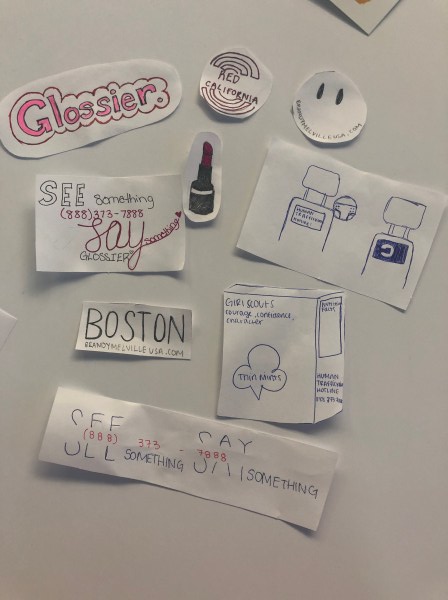
    It was an honor to coach them, and a thrill to listen to their pitches. Two groups tapped in to the power of Instagram to get their message out to peers. One group connected with local and national businesses to ask that the hotline be printed on their product packaging. We had a group developing curriculum for middle and high school teachers, and another group developing signage for public transportation stops and gas stations.

    Hotline Heroes is partnering with local and national companies to add the hotline to product packaging.

    Each proposal was unique, and their pitches were on point. Just like Shark Tank, students tackled all the key components of a pitch: Why, How, What, Target Market, Competition, Unique Selling Proposition, and Financials. They were scored on how well they met the challenge; their ability to address all the components; their presentation skills; the feasibility of their solution; and their adherence to the time allocation.

    This video uses a snack analogy to discuss healthy vs unhealthy relationships

    Change Agents

    Although three groups won a monetary award, the reality is that all of the teens were winners. They came together, used empathy to tackle a tough issue, and spread the word about an issue that affects their lives. These kids are world changers!

    If you haven’t heard of WIT, check it out. Hackathons and college credit courses are available for all San Diego County high school students. It’s also available in Austin, TX and New York City. And hey, if it’s not in your town (yet), reach out to Sarah and make it happen!