Year: 2017

  • Stop Talking About Summer Vacation!

    Stop Talking About Summer Vacation!

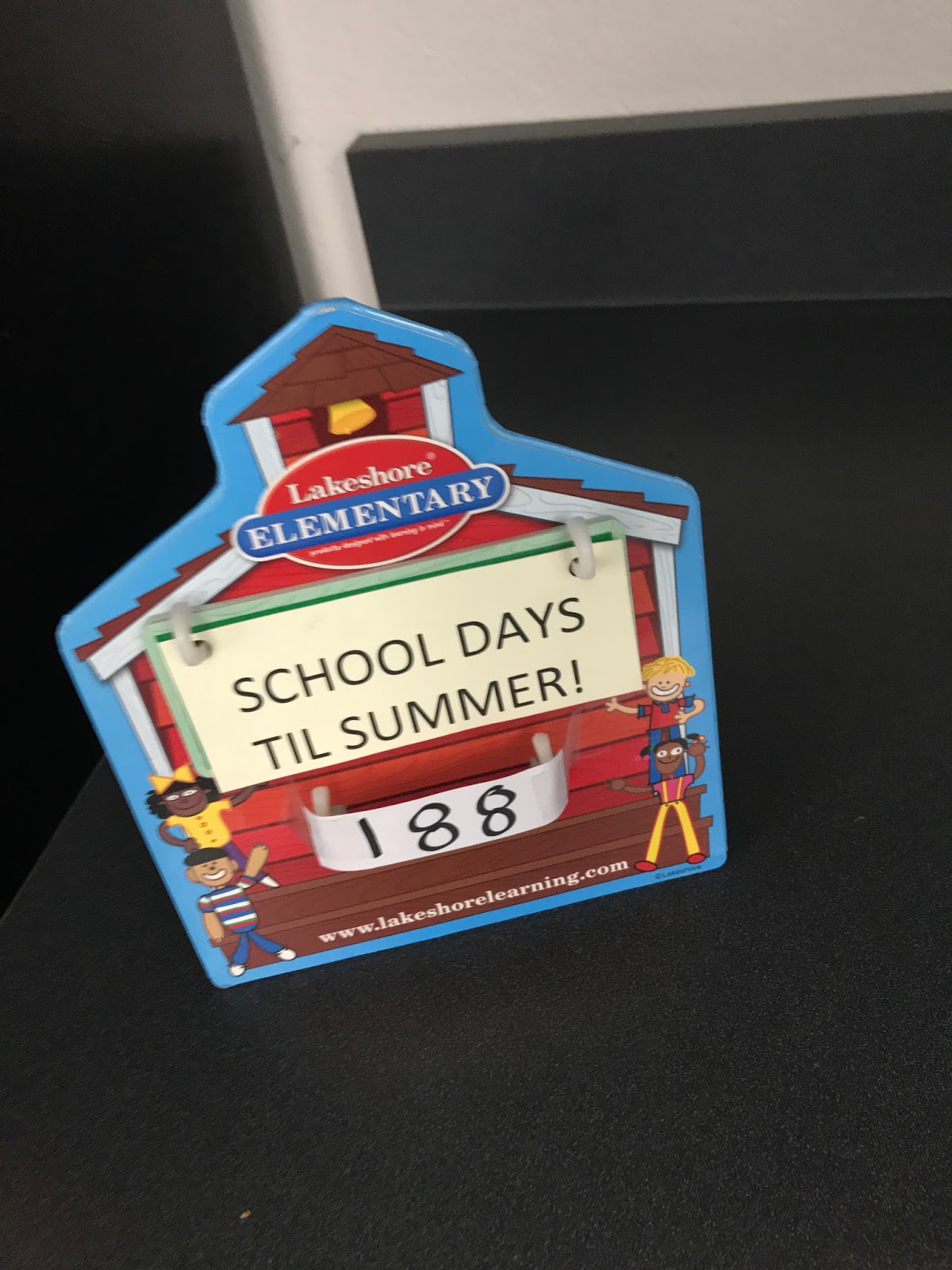
    School Days Til Summer

    Write about your summer vacation.

    How many of you wrote on that topic, or something very similar, when you were in school? How many of you wrote about it many, many times? Honestly, I can’t remember a first day of school that did not include a summer vacation activity.

    Now take a moment and ask yourself, what does this focus on summer vacation say about the culture of learning at your school, or in your classroom? More specifically:

    How does this make students feel who don’t have awesome summer stories to share? What about those who depend on school for basic safety and needs like the free lunch program?

    Where is the joy of learning if everyone is counting down to leave school?

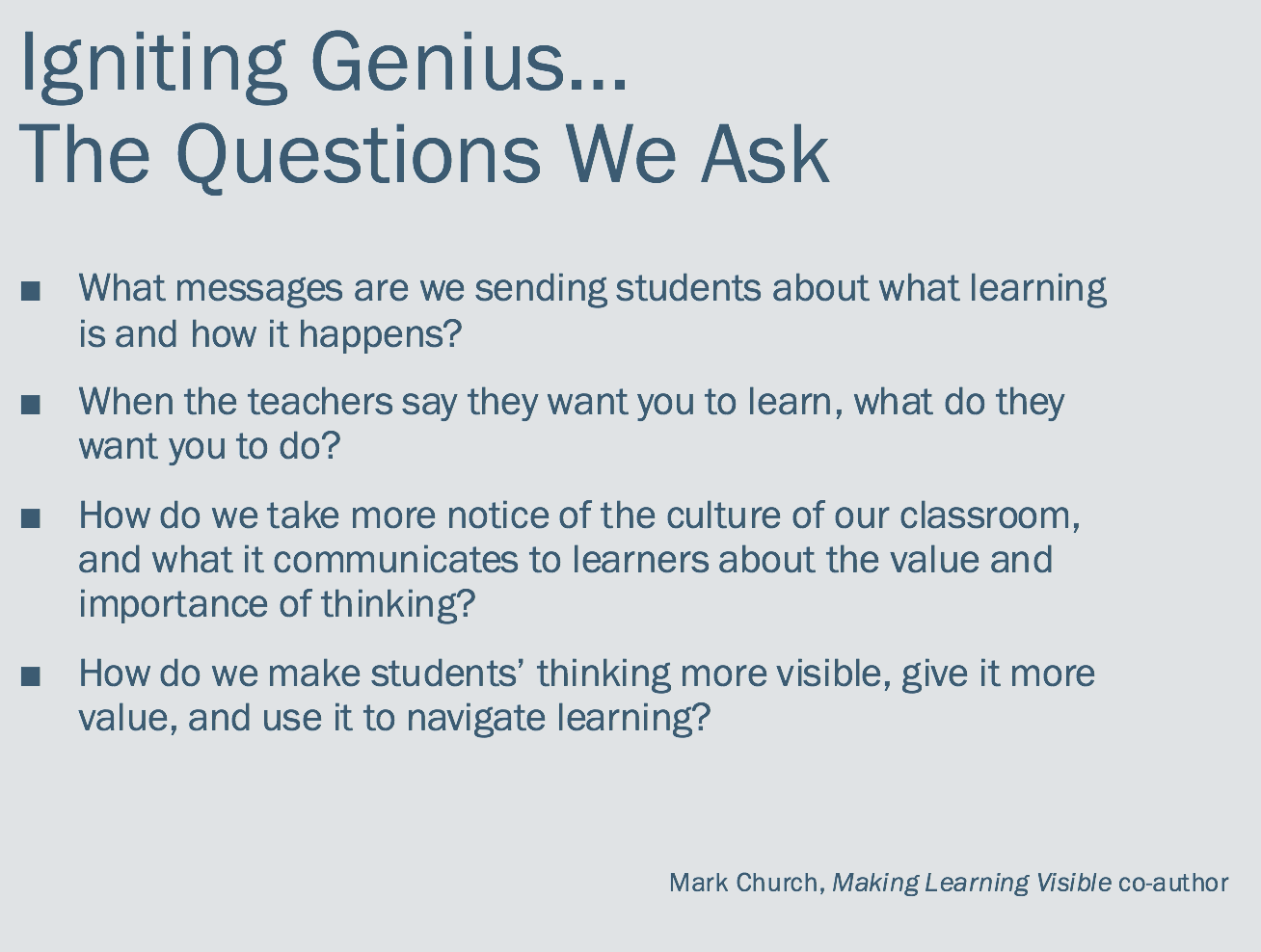
    Mark Church, co-author of Making Learning Visible, presented at Harvard’s Project Zero four questions we must consider when looking at the learning transcript. These questions are critical if we are to empower all students to reach their genius potential.
    As Ron Ritchhart, author of Creating Cultures of Thinking and Making Learning Visible explains, students grow into the intellectual life around them (Project Zero break-out session). If the intellectual life is reduced to a “how many days until summer?”mentality, then is it any surprise teachers need to remind students that they release the students, and not the bell?
    Let’s flip the transcript… I suggest Lakeshore Learning create a sign that says “X Days of Awesome Learning Have Taken Place This Year.” Let’s show students that we value them, we value learning, and we value the time we get to spend with them igniting their genius.
  • Don’t Eclipse True Learning Opportunities

    Don’t Eclipse True Learning Opportunities

    Unless you live under a rock, you probably heard about the solar eclipse that happened today.  Across the country people were standing outside with their ISO-certified glasses, or their pinhole cameras, or just looking at the shadows poking through the trees. Strangers became friendly outside office buildings as they showed off their homemade tools and warned each other about the dangers of staring at the sun. Children held their paper glasses tightly to their face, while gleefully pointing at the event as it unfolded in the sky.

    And yet, there were also plenty of students kept inside today. Many schools, fearful of becoming schools for the blind, kept students locked behind the safety of their classroom walls, resorting to NASA live feeds to simulate the experience.

    I’m not sure why, in public education, there is this fear of providing students with experiences. I spent the past ten years of my career promoting digital citizenship as an important curriculum component for all students. However, it seems a bit bizarre to teach digital citizenship without giving students an opportunity to practice being good digital citizens. We give the students the rules, like not talking to strangers and protecting personal identity. We warn them about college recruiters watching their every move. We tell them that the footprint is FOREVER … all while blocking every social media channel in existence. At the end of the course, we congratulate the students for being good digital citizens, even though they have not shown us any application of their good citizen skills beyond completing a worksheet, or drawing a poster of the rules. It’s like teaching a semester class on football, and then awarding a student as MVP without the class ever playing the game.

    Today was an awesome day for students to BE scientists, to LIVE science. And every day is an awesome day for students to be good digital citizens. We just need to give them the chance. We need to pop these bubbles we place students in so they can experience the “real world” we keep talking about. The world that is happening right outside our walls.

  • Creating Wonderspaces

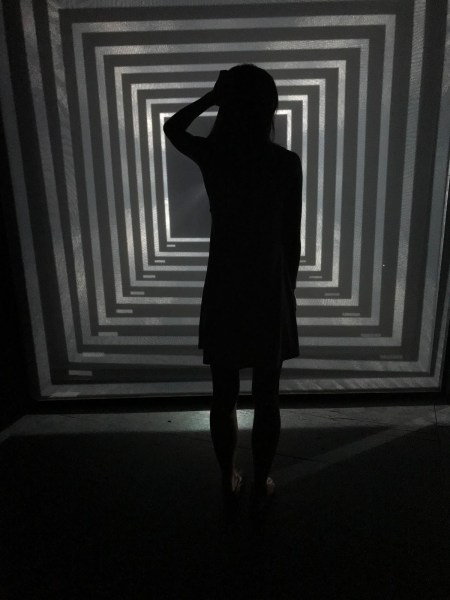
    On Sunday, my daughter and I attended the Wonderspaces exhibit in San Diego. It is described on their website as “a pop-up museum of extraordinary experiences.” Each of these experiences was given their own space in which to reside so that each piece could speak its own voice, without the presence of the others.

    As we explored the 16 unique experiences, Jordan and I experienced a range of emotional reactions to the art. In some, we were completely awestruck. In others, we were perplexed. At others, raw with emotions. And in some, we felt playful. “The Last Word,” consisting of hundreds of pieces of rolled up paper, allowed participants to leave their “last word” to someone… a way to “recapture what was never uttered” (website).  This opportunity to peer into the soul of others silenced my mind, and opened my heart to the emotional plight of others. Contrary to that silence, “On a Human Scale” invites the participant to play the piano surrounded by video screens of human faces. However, this is no ordinary piano. In lieu of strings creating sounds, each key is connected to a human voice… truly, no matter what you play, the result is beautiful.

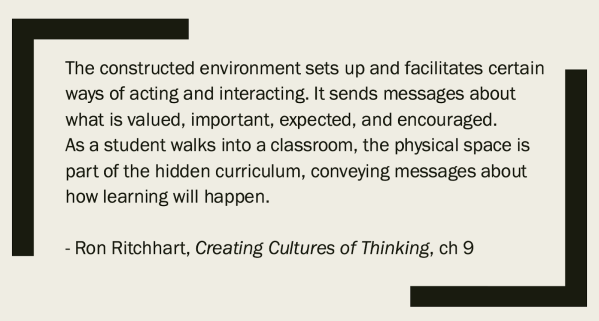
    Sir Ken Robinson stated that “If you want to shift culture, it’s two things: its habit and its habitats – the habits of mind, and the physical environment in which people operate” (2010). Each of these exhibits was setting out to shift the culture, through both mind and environment. Which makes me ask the question, why aren’t schools creating wonderspaces? Ron Ritchhart, in Creating Cultures of Thinking, explains:

    So what do we value in our classrooms? Judging by the rows of desks I still see in many schools across the nation, we value individual, quiet, one-directional transfer of knowledge. If learning is a creative and imaginative process, like we say it is, then isn’t it our moral imperative to bulldoze the industrial era culture and bring in wonderspaces? What would that look like for you? Your students? Dream big and share your ideas below.

  • Art of Creating Awe

    Art of Creating Awe

    “When we’re sort of infused with either enthusiasm or awe or fondness or whatever, it changes and alters our perception of things. It changes what we see. It changes what we remember.” 
    – Rob Legato, movie effects creator from his Ted Talk “The Art of Creating Awe

    School Board meeting introduction
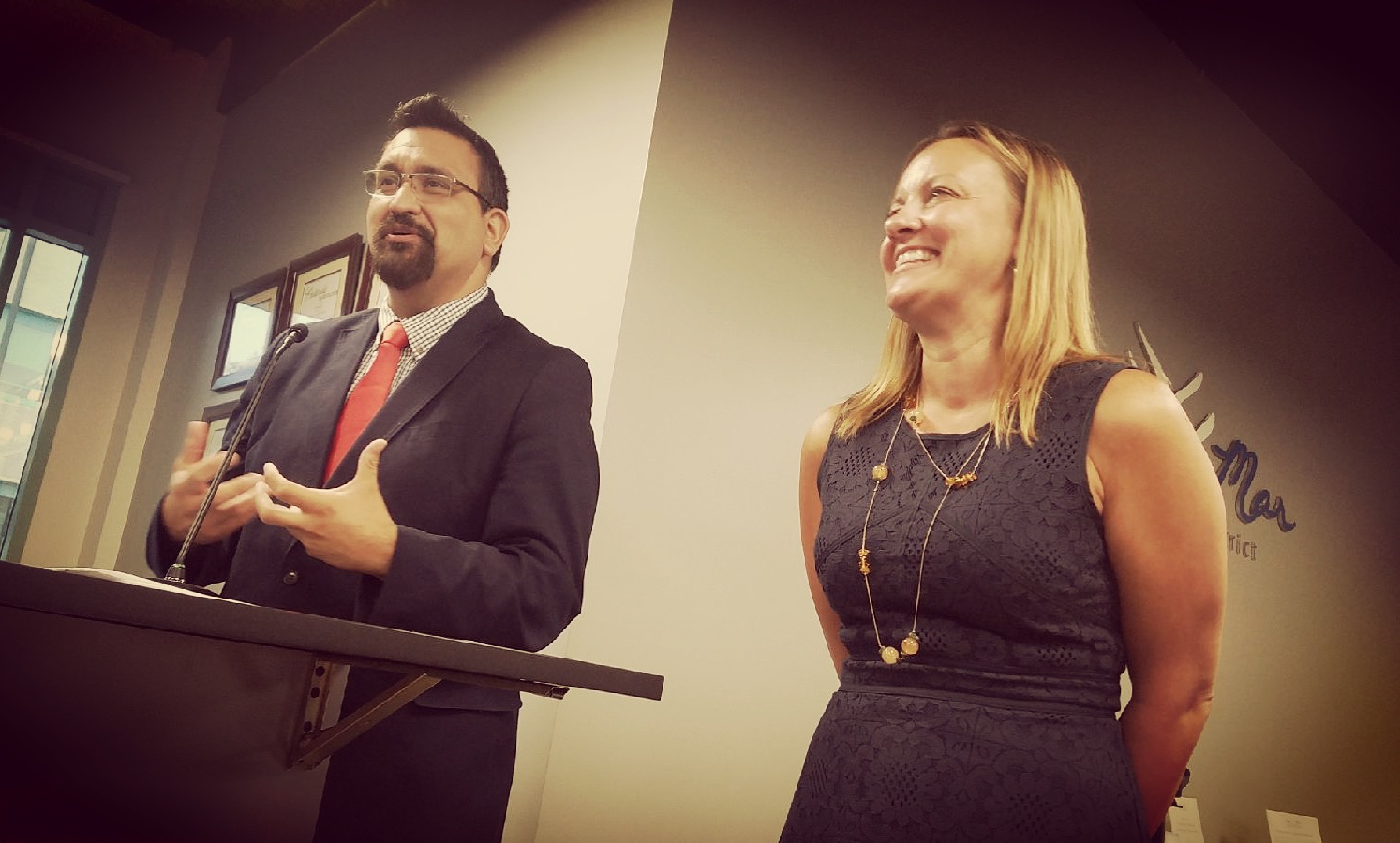
    Being introduced to the School Board
    Last week I started a new job. No longer in Educational or Information Technology, I am now the Executive Director of Innovation and Design for a K-6 school district. Leaving my former position, and district, was not a decision that I took lightly. And yet, it was an easy decision to make. Why? Because this new district is in pursuit of awe… of wow… of creating wonder and joy for students. It was evident in their five year plan published on their website. It was evident in the weekly videos produced showcasing students engaged in learning. It was evident in the questions they asked me during the interview process. It was evident in every conversation I had with employees, colleagues around the county, and community members. And it was even evident in the description for the job being offered.
    So often, in education, we get bogged down in the bureaucracy crap… test scores, union contracts, budget cuts, uninvolved parents… and heaped on that are the jargon of the day crap, like “teach with fidelity” and “21st century skills” and “1:1.” We lose sight of the fact that we do all this for those doe-eyed precious hearts smiling at us from their desks. We forget to bring the awe into what we do.
    Awe can’t be found in any of those items I listed. It’s not found in a standards-based report card or in a data team meeting. It’s found when we play, when we dream, when we listen, and when we lead with our hearts. That’s what I have found in this new role. The opportunity to listen to my heart, and provide for students the opportunities they deserve, they desire, and they expect from us. 
    I’m excited for this new journey. And excited to bring life back to this blog to share my awe journey.