Year: 2017

  • Be More Dog!

    My daughter wrote a blog post about her observations and experiences while serving as the Social Media Director for SDCUE conference. In her post, she reflected on the lack of “teachers eager to keep learning and the ones who wanted to keep up with the new technologies” when she was in school just a couple years ago. She questioned why teachers are “stuck in their ways” and why there aren’t more teachers like the ones at SDCUE who want to keep on learning.


    Maybe it’s because those “stuck” (her word, not mine) teachers need to be more dog. You see, dogs are amazed by EVERYthing. A snack is amazing. The UPS driver is amazing. Even a chewed up ball that smells like mud and lost its shape is amazing. They live for the moment, and they aren’t afraid to fail.

    So how can we build the confidence and excitement of our teachers that have not yet channeled their inner dog? What chew toy, adventure, or treat will make them as excited as a dog? Do teachers need more time to connect with teachers that are already being more dog? Do they need more professional development on how to be a dog? Are teachers being asked to be more dog while living in a cat house? How do we fix this?

    Culture. We talk about it in terms of the behaviors of a group, such as school culture. But when you look at its Latin root, it means growing, or cultivation. We grow a culture based on our behaviors and beliefs. In education, bogged down by bureaucracy and budget shortfalls and high stakes testing and (whatever else you want to insert here) we have cultivated a culture of … cats. Of people who are tired of chasing the laser light around the room. It’s up to all of us to change that culture. To create more opportunities to be dog. After all, if we aren’t feeling awesome about what we’re doing, how is a student to ever feel awesome learning with us?

    If we could all just encourage each other to find moments of dog, we’ll work towards creating the experiences Alex kept searching and hoping for when she was in school. We can all chase the ball. Chew the toy. Grab the stick. We can all be more dog.

    Read more about the Be More Dog campaign (2013) and all the ways they inspired people to drop their cat-like ways and embrace the dog inside.


  • Yes, and: The Power of an Idea

    Yes, and: The Power of an Idea

    Kobi Yamada wrote a fabulous book called What Do You Do With an Idea? In the book, the main character finds an idea. He takes it with him everywhere. When he first shares it with others, they scoff at it. Luckily, the boy does not listen to the naysayers and instead nurtures the idea.  In the end, the idea takes form and … well … read it and find out.

    I read this book yesterday to a 4th grade class. I had not met the students before, but they seemed pretty excited to have me there. At the end of the book read, we discussed the plot, and why people may not have supported the boy and his idea.

    After the discussion, I led them through an improv activity called “Yes, but.” In “Yes, but” one person of a pair shares an idea. In this case, the idea was what the student wanted to do over the weekend. The other person’s job is to react to the idea with a “yes, but” statement. For example:

    Student 1: I think it’d be cool to go to the zoo this weekend

    Student 2: Yes, but it’s so hilly that you will get tired.

    Student 1: Oh. Well, maybe I can go to the beach instead.

    Student 2: Yea, but it’s supposed to rain on Saturday.

    As you can see, it can be discouraging to have every idea turned down by others. (And honestly, who hasn’t encountered these people in our own lives?) After debriefing how disheartening that conversation was, we flipped the script. Now, the second person’s job was to add a “Yes, and” statement to the idea.

    Student 1: I think it’d be cool to go to the zoo this weekend.

    Student 2: Yes, and you can check out the new panda exhibit.

    Student 1: Ooh yea! And I can take a picture of the plants they eat to show our science teacher.

    Student 2: Yes, and you can probably buy a book on pandas to share with the class.

    Now the idea is growing and taking shape. The students shared how it made them feel to have their idea encouraged instead of stymied. I left them with the call to action to focus on being idea encouragers instead of naysayers.

    This activity is a great lead in to any design thinking project or empathy building activity. All ages, adults and children, deserve the opportunity to have their ideas heard. Who knows which of those ideas just might change the world!

    Article: Yes, And… 5 More Lessons in Improv-ing Collaboration and Creativity from Second City

  • Inspired to Ditch Activities and Design Experiences

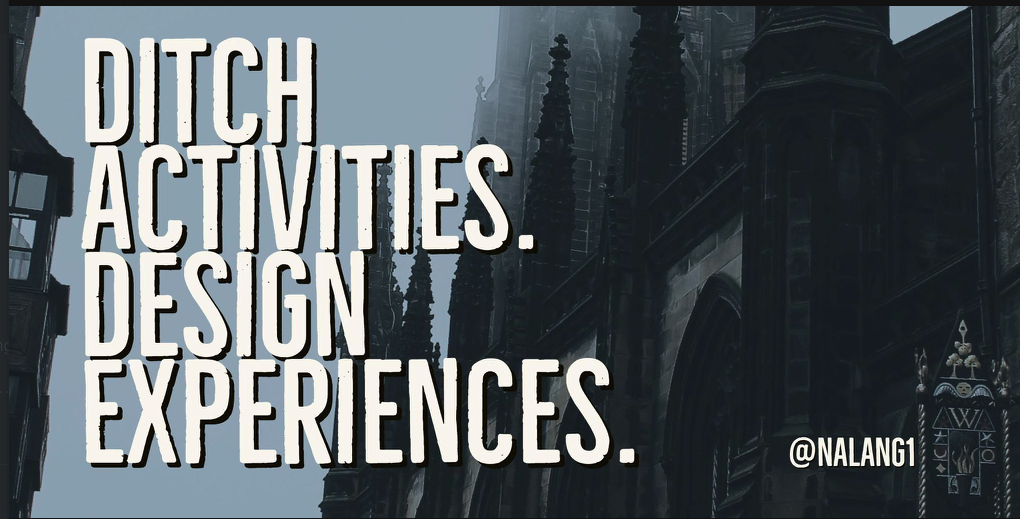
    Dr. Nathan Lang, an Ed Leader and Innovator, shared this graphic on his Twitter (@NALANG1) the the other day. In four words, it simplifies much of what we are working to achieve through Design Thinking in my school district.

    When I was in school, I completed a lot of projects. I created clothing worn by a Native American tribe; I recreated a topographical map of California with salt dough; and I built a California Mission with sugar cubes. Most of us have similar memories from our school days. However, none of these projects truly prepared me for the challenges of life. Yes, I learned to work nicely with others, and clean up after myself. I even learned that, if I procrastinated long enough, my mom would work on my projects after I went to sleep. But the piece that was missing was that these projects were just projects. They were defined for me by my teacher, and were meant to teach a specific content standard. What each of these projects was missing was the creation of an experience.

    In Design Thinking, we want students to learn how to solve problems and truly make a difference in their community. We want them to develop empathy for others, and then use that empathy to see the world through a different lens. We want students to grapple with solutions that aren’t black and white, wrong or right. Mostly, we want students to experience the world, and then make that world a better place…for themselves, their peers, their community, and hopefully, the world.

    This is the work of Design Thinking in classrooms. To design experiences that ignite student genius and empower them to change the world. Without it, they’re just projects.

  • Teacher Ed Tech Ambassadors: Keep the Focus on Students

    Last month there was quite a lively conversation about an article titled “Silicon Valley Courts Brand-Name Teacher, Raising Ethics Issues.” A lot of educators were upset about the seeming “attack” on teachers this article contained, as it seemed to question the reason teachers become ed tech brand ambassadors.

    It’s important for teachers to have access to the tools they need to teach well, and sometimes these ambassador programs provide that. Over my educational career, I have been branded by a few ed tech companies. For example, I was a Microsoft Innovative Educator and a Tech4Learning Innovative Educator. Both titles were earned based on evidence of higher level learning taking place with those tools in the classroom. I didn’t have to keep using their tool to maintain my title, or prove that I was using the tool for a certain percentage of my day.
    However, I was also a titled educator for another ed tech company, and in order to maintain my title and digital badge, I had to continue showing use of the tool through blogs and posts to their website. After a year, I elected to delete the digital badge from my signature and instead focus on what I knew to be the best for my students and the learning experiences they required. Their requirement of unfaltering brand loyalty was a red flag. Even though they sent me a tshirt, then a sweatshirt, and a coffee mug, and an Amazon gift card, none of those perks provided better learning for my students. And when the brand requires X amount of lessons or use over a period of time, that puts the product over the needs of students.
    I taught in one of the first nationally-recognized 1:1 programs and there were many days when I felt the best tool was one that didn’t require a battery. We were an English class. We needed to read, and discuss, and think, and process. But I got a lot of flak for that from the program director… a lot! Because the program and the publicity and the money being brought in to the district was more important than my understanding of student needs… that’s a slippery slope. And one that we, as educators, need to keep in mind when we agree to become a brand ambassador.
  • Enough.

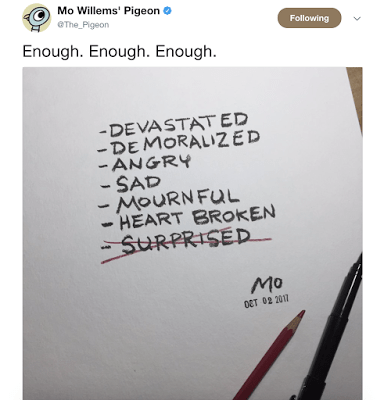
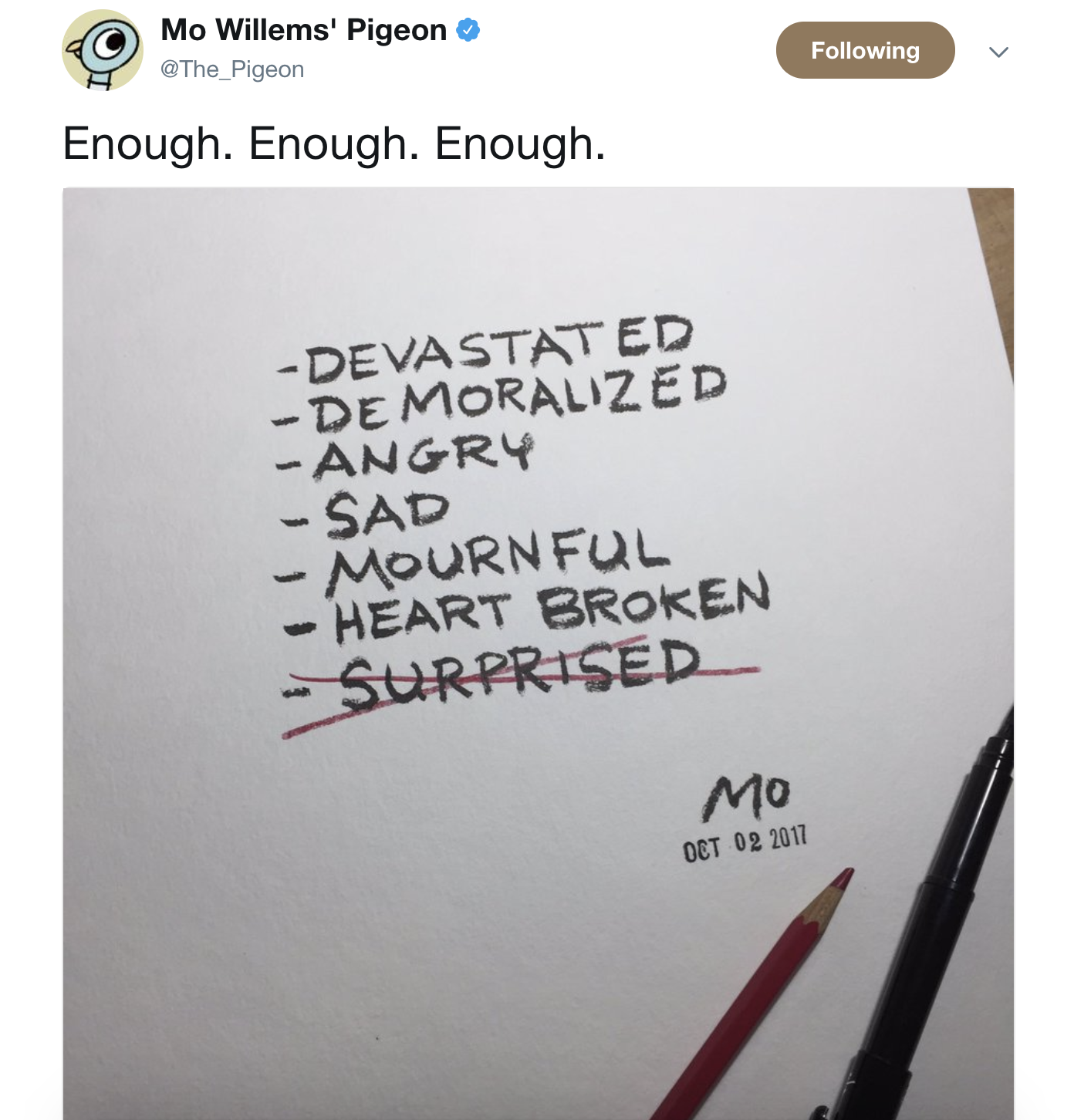
    Enough.

    Love thy neighbor as yourself. – Mark 12:31
    I woke up today to horrible news on my iPhone. Over 500 injured, and over 50 killed in the largest mass shooting in modern U.S. history.
    It’s unfathomable that this happened. And it’s unfathomable that it has happened before. And that it will happen again.
    I wish I had words of wisdom about how to change the culture of our society. But all I can say is, hug your babies. Tell your students that you care about them…and truly mean it. Look at a homeless person as a human, and not as a dreg. Call your mom and tell her you’re grateful for doing her best in raising you. Whatever you do, exude love.
  • The Punctuation in Your Classroom

    The Punctuation in Your Classroom

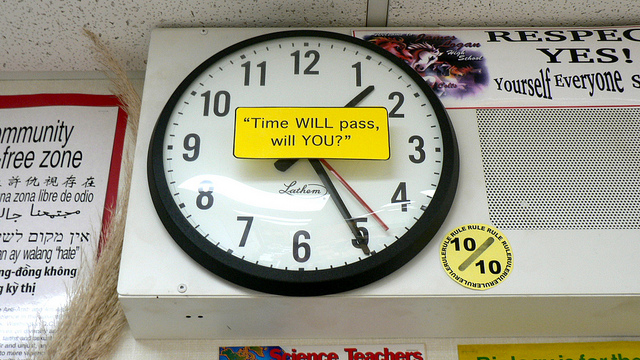
    Photo Source: Flickr, Eric E Castro 

    I learned the other day that ending a text message with a period can be interpreted as insincere. Such a simple, innocuous dot now carries more hidden messages than it was ever intended to convey. Likewise, the messages we think we’re sending in our classrooms may not be the messages received by students. Consider these… Time WILL pass, will YOU? Does this imply a nurturing, supportive environment that believes ALL students deserve every opportunity to be successful? I’m not so sure.

    Students not paying attention in class? Lock up devices. Does this show trust? Relationship building? I wonder if the teacher’s device is locked up during meetings as well. Or how about this sign I saw in a classroom:  “Work hard in silence. Let success be your noise.” A companion sign read, “The way to get started is to quit talking and begin doing.” Does this mean we don’t value collaboration? Team work? I wonder how Edison and Einstein would have fared had they been forced to work in silence. When I attended Project Zero at Harvard University, I went through an exercise called Parts – Purposes – Complexities.  

    The simplified steps are: Choose an object or system and ask:

    • What are its parts? What are its various pieces or components?
    • What are its purposes? What are the purposes for each of these parts?
    • What are its complexities? How is it complicated in its parts and purposes, the relationship between the two, or in other ways?

    This helps us (and students) slow down and make careful, detailed observations. This is done by looking beyond the obvious features of an object or system to stimulate curiosity and raise questions. When we did this at Project Zero, we were asked to list EVERY SINGLE ITEM in our classroom, and then to question its purpose and its complexity. So many a-ha moments happened from this activity as people really started to question each and every object, and why it was there. They began to see the messages, the periods at the end of the sentences.

    So as you look around your classroom, ask yourself, what messages are you sending? What punctuation is on those messages?