Year: 2017

  • The Waiting is as Important as the Doing

    Book cover of Grayson by Lynne CoxA few days ago, I publicly declared that I was reclaiming my love of reading in 2018, and to do that, I would be trying to read a book(ish) a week. The first step in this journey was dusting off my library card and making a trip to the stacks. Such fun to roam the aisles and pick up books I wouldn’t otherwise select!

    For my first official book read, I chose Grayson by Lynne Cox. It’s a short memoir from Cox, an American long-distance open-water swimmer. The story centers on her experience swimming with a baby gray whale who had gotten separated from his mother. Cox’s bond with the whale while attempting to reconnect him with his mother is touching.

    A few passages and my connections to them:

    Sometimes it's the process of doing that makes things clear.

    Sometimes the answers we find while searching are better or more creative than anything we could ever have imagined before.” When introducing new technology tools to teachers, there is often this desire to fully understand the tool before introducing it to students. But in doing so, we strip students of the opportunity to explore and create their own experience, their own learning.

    In our district, we are at the beginning of a five year plan called District Design 2022. Our vision, the unrelenting pursuit of the extraordinary school experience, is so that we can ignite genius and empower students to advance the world. It can be hard to remember that this quest won’t happen tomorrow, or next month, or even next year. It’s a five year plan, and even that may be ambitious. And even though we have yearly objectives, and ideas of what students need to become empowered, it will require humility and a lot of introspection to find the answers within the struggles.

    The struggle can be made even more complicated by the fact that not everyone understands why we are swimming against the tide. Our plan is ambitious, and it can be hard for some to justify the WHY for radical change when our district is already performing in the top 1% of the state on standardized testing.

    Cox realizes that the only way to help the baby whale is to set aside her own needs, and think, and behave, like a whale. There are moments of doubt, especially when she finds herself a mile from shore in the cold Pacific waters with no mother whale in sight. At times, the baby dives deep in to the ocean, and remains unseen for 10-15 minutes at a time. It’s during these times, Cox surmises, that the baby is getting away from the surface level distractions to listen for the calls of the mother.

    It’s in one of these moments that Cox reflects:

    Wait as long as you need to. The waiting is as important as the doing: it’s the time you spend training and the rest in between; it’s the reading and the thinking about what you’ve read; it’s the written words, what is said, what is left unsaid, the space between the thoughts on the page, that makes the story, and it’s the space between the notes, the intervals between fast and slow, that makes the music. It’s the love of being together, the spacing, the tension of being apart, that brings you back together.

    The waiting is as important as the doing…  So many times I have pushed ahead because I see the destination and I am eager to get there. I may not have given teachers time to move beyond the surface distractions and dive deep. But it’s these moments, this space between the thoughts, that builds capacity, builds commitment, moves the vision to reality.

    Thanks Lynne Cox for writing this gem of a book. I look forward to the next book on my list.

    Have one you want to add to my list? Please add it on my blog post titled “The Next Chapter”.

  • Learning to Drive

    Jordan in her carMy daughter got her driver’s permit, and now the state of California has entrusted me to teach her the rules of the road. (I truly think they should make adults pass a test showing that we are qualified for this important role!)

    When she first started driving, she was extremely nervous and unsure of herself. Who wouldn’t be? Her knowledge of how to handle a 4,000 pound vehicle was limited to the reading she had completed in an online permit class and two hours behind the wheel with a certified instructor.

    Our first time driving was around and around (and around and around) a parking lot at the local community college. It was a Saturday, and the lot was remarkably empty. There she learned how her car responded to steering and brakes. She practiced coming to a complete stop and signaling her intentions. When she was confident, we drove around the campus a few times so that she could practice adjusting speed and navigating turns. And then it was time to hit the streets.

    Not even a block away from campus, driving through a quiet neighborhood, a BMW appeared behind us. Impatient with my daughter’s driving, he immediately started tailgating her and honking his horn. Her anxiety rose exponentially, and I could see every bit of confidence drained from her face. As soon as was possible, she pulled off the road. He honked as he passed, and she refused to keep driving.

    A few weeks later, I ordered a magnetic bumper sticker from Amazon that read, “Please Be Patient Student Driver” . As she continued to learn how to drive, there were plenty of opportunities for people to be angry or frustrated with her. Her ability to maintain a consistent speed was sketchy, and she was painfully slow coming out of a turn. But remarkably, nobody honked at her. Nobody tailgated or cut her off.  They gave her space to learn. They slowed down and let her over when she signaled. And they smiled when they drove by. I’m sure they were just as eager to get to their destination as the BMW driver, but they didn’t show it. And her driving improved. And continues to improve.
    It makes me wonder, what signs would our students wear if they could design their own? Would they ask for more patience because of a rough night at home? Would their sign acknowledge a struggle with reading? Or ask for more encouragement during independent work time? Our students may not be wearing signs, but we do know that they all need our patience and support and love as they learn to navigate their own roads.

    Sign up to receive an update when I post. Type your email address in the box and click the “Subscribe” button. My list is completely spam free, and you can opt out at any time.

  • The Next Chapter

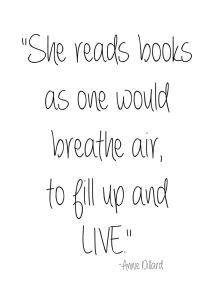
    The other day, my boyfriend told me he didn’t know what to buy me for Christmas, because I don’t have any hobbies. It made me stop and reflect because I always considered reading a hobby of mine. When I was little, my mom would punish me by sending me outside to play because I just wanted to read. I remember refusing to leave my room for days at a time because I was wrapped up in the Witching Hour series by Anne Rice, and then Imajica by Clive Barker and oh, the joy of holing up with every Neil Gaiman book! I remember crying during Harry Potter, and rooting for love to win in Jane Eyre, and adding quote after quote to my quote journals while reading Kierkegaard and Camus and Sartre and Hesse. My professional spirit grew with Daniel Pink, Sir Ken Robinson, Pat Lencioni, and Simon Sinek. I have always been in love with the ideas in books.
    I think that, somehow, as my career progressed and the daily demands increased, I got so wrapped up in “I have to read this”  to stay current or to sound smart that I stopped enjoying the love of reading just for the sake of loving reading. Sure, I’ve read, but I wasn’t becoming part of the books. They were something I needed to do before going to bed.  It had become a hole I didn’t realize I had.

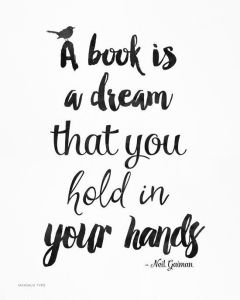
    A book is a dream that you hold in your hands.

    And then today, I read a blog post called “100 Books” by Joe Mullikin. Joe describes his resolution to read 100 books in 2017 and the impact it had on him. One of the elements I appreciated in Joe’s blog is that his list of books was not just a list of professional books, but included thought-provoking fictional books as well. His list made me miss books – miss the way they fill my soul, fill my brain, and push me to think beyond myself.

    So I am committing to recapturing my love of reading in 2018. A book(ish) a week. A blend of fiction and professional learning. And I need your help. Please leave a comment with the one (or two) books that have shaped you as an individual. The book that made you sad when the end came. The book you wish you could buy for everyone you know.

    As I read, I’ll share with you my thoughts and titles. Hopefully my journey will inspire the work I do, the life I lead, and the children I raise.

    Let’s do this!

  • Finals = Lots of Homework = Stress = Sickness = Death, therefore Finals are Death

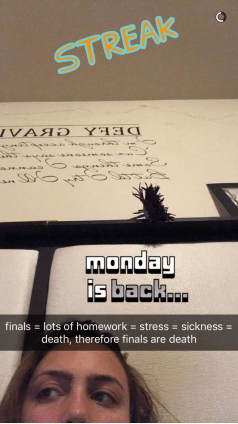
    My youngest daughter is a high school sophomore. She’s the type of student most teachers love – completes her work, answers the questions, conscientious about her grades. Compliant. And a perfectionist who demands more from herself than the world demands of her.

    Finals = lots of homework = stress = sickness = death, therefore finals are deathSo when she sends me snapchats like this one, it breaks my heart. This is not what education is supposed to be about, is it? Later that evening, while suffering a mild mental breakdown, she texted me. (Granted, I was only one room away, but the idea of walking away from her studies was too stressful for her.)
    How come teachers assign so much homework right before our finals as if they don’t know our other teachers are doing the same exact thing. It’s as if they think we are some miracle workers that don’t need sleep or socializing.

    My mental health is deteriorating and I feel PHYSICALLY sick just because of this overwhelming amount of work and hard test where they expect you to remember everything from August 15 which I doubt they could even remember clearly but they think is easy bc they’ve spent years upon years studying it.

    How is this fair to the students?

    Please explain this to me.

    Problem is, kiddo, I can’t explain it to you.

    In “Assessing Our Children to Death,” Steve Nelson, author of First Do No Harm: Progressive Education in a Time of Existential Risk explains:

    “There is a nearly perfect inverse correlation between the emphasis on metrics and the quality of learning in schools. More metrics mean less powerful learning. As reliance on this data (and the scores it measures) goes up, the real quality of learning experiences goes down. Children are real, flesh and blood, funny, eccentric, imaginative, irreverent, loving and sensitive human beings, not data points for arcane studies of “outcomes.

    Yes, Jordan, you are definitely all of those things, and more!

    Robert Marzano, Debra Pickering, and Jay McTighe (quite a powerhouse of educational experts, by the way!), in Assessing Student Outcomes,  describe conventional assessments, such as Jordan’s final exams, as being narrow in focus since they only capture one moment in time. They explain that these assessment types are “generally incapable of revealing in any comprehensive way what students know and can do. Moreover, the conditions of such tests are often highly controlled. Students complete the work within inflexible time limits and have restricted access to resources and limited opportunities to make revisions. These kinds of tests also sacrifice authenticity, since they differ markedly from the ways in which people apply knowledge in the world outside of school. Despite these limitations, the results of such one-time measures are frequently used to make significant decisions, such as whether a student should be admitted to or excluded from special programs and what final grade a student will receive in a class.”

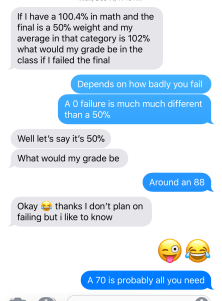
    Oh yes, grades. That would explain this text I received from Jordan:

    A text from Jordan asking how a weighted final will impact her math grade

    Well Jordan, all I can say is, hang in there! Last I checked, finals did not literally kill anyone. And as the saying goes, what doesn’t kill you makes you stronger… or at least gets you a good grade in your class!


    Sign up to receive one update when I post. Type your email address in the box and click the “Subscribe” button. My list is completely spam free, and you can opt out at any time.

  • Holidays Are For Families, Not Homework

    Today’s memory on my Facebook feed was an article I shared a few years ago. Since winter break is coming up, it’s a good time to share it again.

    The Tyranny of Homework: 20 Reasons Why You Shouldn’t Assign Homework Over The Holidays

    No time to read a long article? Here’s the Cliffs Notes version:

    Stop assigning homework over vacations, and let students enjoy time with family and friends. And while they are enjoying time with family and friends, you do the same.

    The packets, the grading, the reading logs – those aren’t building lifelong memories, but baking cookies together, or going for a bike ride with friends, does.

    moreyouknow

  • Career Pathways at All Grades

    Career Pathways at All Grades

    On Wednesday, I had the privilege of attending the OC Career Pathways Showcase at the Marconi Automotive Museum. Who can turn down an opportunity to see vintage vehicles, talk to brilliant students, and listen to top executives from SpaceX and Virgin Orbit? Not me!

    I have to admit – the programs these students had access to, both in high school and community college (and a couple junior highs) was amazing. I kept thinking, “What would my adult life had looked like if I had been exposed to these hands-on STEM programs when I was 14 years old?” Students displayed projects completed in the areas of engineering; computer science; biotechnology; fabrication; robotics; and more. One student told me he had almost completed his private pilot’s license. Another discussed designing a robotic, prosthetic arm for a peer. Community College partners displayed their pathways to degrees and technical certificates within those fields, and their internship opportunities for the students present.

    During this showcase, Gwynne Shotwell, COO and President of SpaceX, along with Tim Buzza, Vice President of Launch for Virgin Orbit, discussed their career pathways. Gwynne stressed the importance of project-based learning so that students “apply what they learn” and Tim shared the moment he switched from being concerned more about his grades in college to focusing on mastering the content being taught. When a student asked them both about how they deal with failure, Gwynne pointed out that people tend to learn more from failure than success, because it requires adaptation and another attempt. Tim expanded on that, reminding students that “failure means you put yourself out there more than most people would” and should not be a sign of defeat.

    In this entire conversation, however, I realized that one voice was missing, and that was the voice of the elementary student. If we are to truly prepare students for the opportunities these students are accessing, we need to start from day one in kindergarten. Here’s why:

    Linda Gottfredson (2002) describes how career choice in young people develops through a process of circumscription and compromise. During circumscription, which begins at ages 3-5, students rule out unacceptable options based on their perceived fit with the child’s self-concept. Between ages 3-5, children understand that adults have roles in the world, and that they, too, will one day have a role. By age 8, children start to assign job roles to particular sexes. If a job doesn’t align with their gender, it becomes unacceptable. By age 13, children have seen more job types and start to categorize them by income, education level, lifestyle, etc. in addition to sex type. They may exclude jobs that require a lot of education because they don’t have college role models in their family, or they may portray a job as being too much manual labor. Starting at age 14, children begin the conscious process of choosing jobs that align with their interests and perceived abilities.

    After excluding so many options during the circumscription stage, children then being compromising, which involves “sacrificing roles they see as more compatible with their self-concept in favour of those that are perceived to be more easily accessible” (Winter, nd). Their lack of knowledge about the job, their abilities, and the future of the field begins to compromise their career choices.

    Crazy to think this huge life decision… picking a career … starts to flesh itself out before a child even enters school. And for most, the decision is molded with no active modeling or involvement by adults until high school, if the child is lucky enough to have a pathway option, or upon graduation, when facing the daunting prospect of self reliance.

    So what can we do to open those doors that students may be subconsciously closing at such an early age? How do we bring elementary education to the table with secondary and post-secondary education so that these amazing experiences aren’t limited to only some students? In our district, we’re bridging that divide through design thinking challenges that include industry experts; field trips that focus on the world of work community; and time for students to explore passion projects and Genius Hour. I’m hopeful that we’ll soon incorporate Gallop strengths-finder tools and local mentorships as well, both with community industry leaders and high school pathways programs. What are you doing?

    Article References:

    Circumscription and Compromise by The Careers Group

    Gottfredson, L.S. (2002). Gottfredson’s theory of circumscription, compromise, and self creation. In D. Brown (Ed.), Career Choice and
    Development (4th ed.). San Francisco: Jossey-Bass, pp. 85–148.