My youngest daughter is a high school sophomore. She’s the type of student most teachers love – completes her work, answers the questions, conscientious about her grades. Compliant. And a perfectionist who demands more from herself than the world demands of her.
 So when she sends me snapchats like this one, it breaks my heart. This is not what education is supposed to be about, is it? Later that evening, while suffering a mild mental breakdown, she texted me. (Granted, I was only one room away, but the idea of walking away from her studies was too stressful for her.)
How come teachers assign so much homework right before our finals as if they don’t know our other teachers are doing the same exact thing. It’s as if they think we are some miracle workers that don’t need sleep or socializing.
My mental health is deteriorating and I feel PHYSICALLY sick just because of this overwhelming amount of work and hard test where they expect you to remember everything from August 15 which I doubt they could even remember clearly but they think is easy bc they’ve spent years upon years studying it.
How is this fair to the students?
Please explain this to me.
Problem is, kiddo, I can’t explain it to you.
In “Assessing Our Children to Death,” Steve Nelson, author of First Do No Harm: Progressive Education in a Time of Existential Risk explains:
“There is a nearly perfect inverse correlation between the emphasis on metrics and the quality of learning in schools. More metrics mean less powerful learning. As reliance on this data (and the scores it measures) goes up, the real quality of learning experiences goes down. Children are real, flesh and blood, funny, eccentric, imaginative, irreverent, loving and sensitive human beings, not data points for arcane studies of “outcomes.”
Yes, Jordan, you are definitely all of those things, and more!
Robert Marzano, Debra Pickering, and Jay McTighe (quite a powerhouse of educational experts, by the way!), in Assessing Student Outcomes, describe conventional assessments, such as Jordan’s final exams, as being narrow in focus since they only capture one moment in time. They explain that these assessment types are “generally incapable of revealing in any comprehensive way what students know and can do. Moreover, the conditions of such tests are often highly controlled. Students complete the work within inflexible time limits and have restricted access to resources and limited opportunities to make revisions. These kinds of tests also sacrifice authenticity, since they differ markedly from the ways in which people apply knowledge in the world outside of school. Despite these limitations, the results of such one-time measures are frequently used to make significant decisions, such as whether a student should be admitted to or excluded from special programs and what final grade a student will receive in a class.”
Oh yes, grades. That would explain this text I received from Jordan:
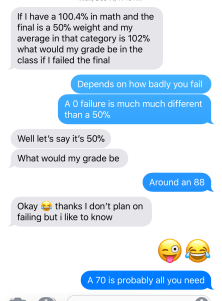
Well Jordan, all I can say is, hang in there! Last I checked, finals did not literally kill anyone. And as the saying goes, what doesn’t kill you makes you stronger… or at least gets you a good grade in your class!
Sign up to receive one update when I post. Type your email address in the box and click the “Subscribe” button. My list is completely spam free, and you can opt out at any time.


 Laura K Spencer, Ed.D.