Category: Book Reads

  • Bringing the Invention Cycle to Design Thinking

    Imagination leads to creativity.
    Creativity leads to innovation.
    Innovation leads to entrepreneurship.
    ~ Tina Seelig

    Engaging in the Design Thinking process is a human-centered approach to creative problem solving. Regardless of what you call the stages of the process, or how you draw the progression, at its core is a belief that people can make the(ir) world a better place by engaging in divergent thinking practices. What is sometimes missing in the implementation of design thinking, especially in the classroom, is an understanding of how ideas develop and take shape. Enter Stanford University Professor Tina Seelig, who teaches a creativity course at Stanford, and her book Creativity Rules. 

    1_pVd4Ieg64ETU6a_xzR5lNASeelig’s book focuses on the four components of the Invention Cycle: imagination, creativity, innovation, and entrepreneurship. Imagination is envisioning things that do not exist. It requires engagement and the ability to envision alternatives. Creativity is applying imagination to address a challenge. Creativity requires motivation and experimentation to address a challenge. Innovation is applying creativity to generate unique solutions through focusing and reframing to generate unique solutions. And Entrepreneurship, which requires persistence and the ability to inspire others, is applying innovation, scaling ideas, and thereby inspiring others’ imagination.

    When considering the Invention Cycle, it’s important to understand how the four components build upon each other. As Seelig explains, imagination requires curiosity, engagement, and the ability to conceive of ideas in your mind. Creativity then fills a specific need and are manifest in the world. With creativity, new ideas only need to be new to the creator, and not the world. However, with innovation, the ideas are new to the world, not just the inventor. Therefore, the world must be looked at from a fresh perspective by challenging assumptions, reframing situations, and connecting ideas from disparate disciplines. Once the innovative idea is developed, it is entrepreneurship that brings the unique ideas to scale.

    Because Design Thinking is focused on problem solving, and not selling a new product, entrepreneurship is not called out as part of the process, although it does fit in the test/feedback stage. Spencer and Juliani noted in Launch that marketing skills help students learn how to share their work with an authentic audience. Building on that principle. then, entrepreneurial skills teach students how to go beyond simply sharing the work and actually bring an idea to fruition. Seelig explains:

    It’s a crime not to teach people to be entrepreneurial. We’re each responsible for building our own lives and for repairing the broader problems of the world. Skills related to innovation and entrepreneurship are the keys to seeing and seizing those opportunities. People should emerge from school with agency, feeling empowered to address the opportunities and challenges that await them.

    According to thought leaders, the advances in technology are moving us towards an  imagination economy. This economy is defined as one in which “intuitive and creative thinking create economic value, after logical and rational thinking has been outsourced to other economies.” Looking at the Invention Cycle as a transparent layer atop the Design Thinking process, it becomes even more evident that we do our students a huge disservice if we do not provide meaningful ways for them to develop their imaginative, creative, innovative, and entrepreneurial skills. Like all soft (but critical!) skills, these can be developed and are critical to students (and their teachers), regardless of their career paths.

    Sign up to receive an update when I post. Type your email address in the box and click the “Subscribe” button. My list is completely spam free, and you can opt out at any time.


  • Launching into Design Thinking

    I read Launch: Using Design Thinking to Boost Creativity and Bring Out the Maker in Every Student when it first came out, but at the time, it wasn’t as relevant to the work I was doing as Director of Educational Technology. In that role, I was not able to fully immerse myself in transforming classroom learning practices.  However, in my new role, Design Thinking plays a huge role in bringing our core principles of student agency, collaboration, personalization, and cultural intelligence to life. Therefore, I decided to crack the book open one more time and look for nuggets of wisdom I could share with teachers partaking in the revolution to making learning relevant, meaningful, and deep.
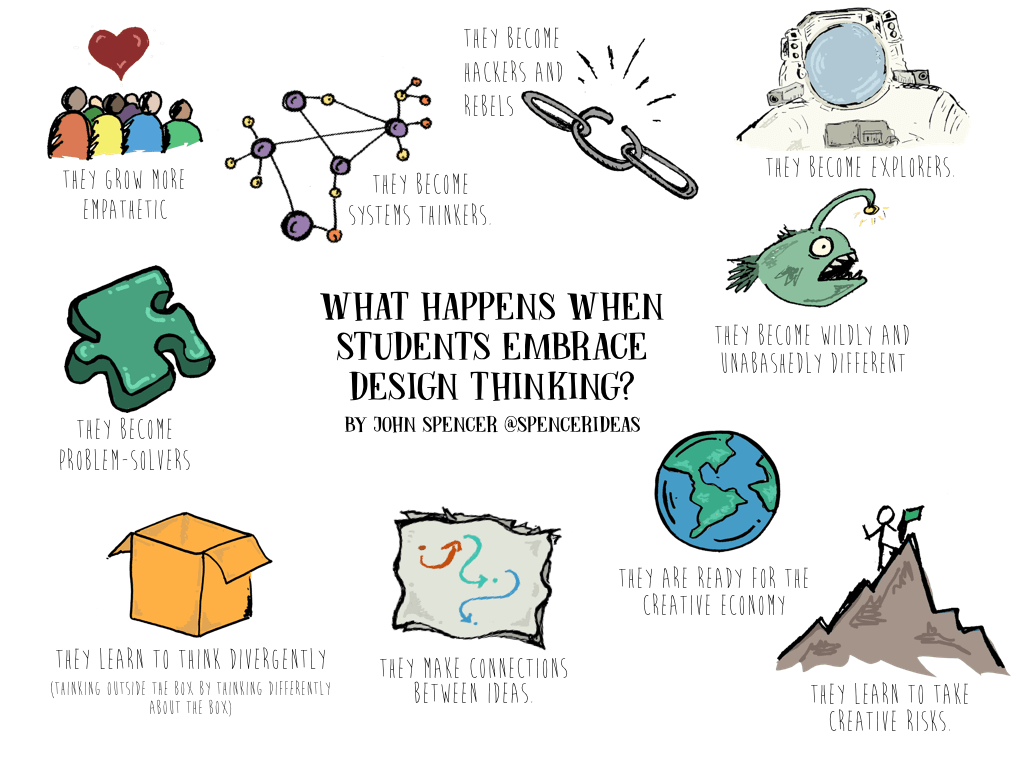
    when-students-embrace-design-thinking.001-1
    From “Getting Started with Design Thinking in the Classroom” blog post by John Spencer

    “Creativity is a process that requires structure. The word structure gets a bad rap as being part of some sort of rigid process that takes away from authentic and creative learning. That’s simply not the case” (p. 23).
    For teachers new to Design Thinking, they often jump to connecting it to makerspaces, which may then trigger images of students building cardboard arcades and toilet paper roll robots. For others, it triggers anxiety around loss of time management, or no academic instruction. But when design thinking is used with intention, structures such as thinking routines, time constraints, and feedback loops support students through the process.

    “Too many educators believe they lost their creativity – or that they were never creative in the first place. Maybe they stopped creating because they didn’t think they had the time, energy, or mental capacity for new ideas. We don’t buy it. Not creating is a choice – and a poor choice at that. And in truth, every time you come up with a new idea for a lesson, you are creating. Every time you think of a way to handle that super-challenging student, you are creating. Every time you collaborate with a colleague, design your classroom, set up the desks in a new way, or do something different – you are creating!” (p. 31)
    Honestly, I think this is the most important paragraph in the book. We often talk about the need to empower students with the soft skills needed for success, and creativity is one of those skills. But what we neglect to consider is that, for many teachers, creativity was stifled under No Child Left Behind, Program Improvement, and other high stakes accountability system. They lost their mojo, so to speak. So as we encourage them to open the doors to new experiences for students, we need to also remind them of the creative nature they already posses and find ways to nurture their innate abilities.

    “Creative classrooms are the ones where students are able to question answers as often as they answer questions” (p. 100). And along those lines, “You cannot empower students to be self-directed, responsible, critical-thinking people if they can’t ask their own questions. At that point, you’re teaching compliance rather than responsibility” (p. 106).
    In a previous district, we spent three years of instructional rounds looking for effective questioning strategies. This focus meant that a lot of our energy was spent watching for teacher moves that provided opportunities for multiple student voices; observing DOK levels of the questions asked; and watching for a variety of ways in which students respond to the questions. What was missing from this entire dialogue was the opportunity for students to feel empowered to ask their own questions, to dig into meaning that was relevant to them.

    Other items I appreciated in the book:

    John and AJ discuss how empathy is not always about a specific audience. Sometimes, industry designers base their work on awareness, which can involve empathy, but may also include “a personal awareness of a process, a system, or a phenomenon. [It] can be scientific or artistic, social or economic, human centered or systems centered” (p. 69). Opening empathy up to a broader context helps teachers and students better identify the purpose for engaging in the design thinking process.

    When I attended Harvard’s Project Zero last summer, I was fortunate to meet and learn from Edward Clapp, a Project Zero Project Director. Clapp discusses the biography of an idea, which John and AJ mention in their book as well. They quote Clapp:

    “What if instead of telling the biographies of individuals who are widely seen as creative geniuses, we tell the biography of the ideas that they are most known for? For example, what if instead of telling the biography of Albert Einstein, we told the biography of the Special Theory of Relativity? We would tell the biography of that idea, highlighting all the different players who have historically participated in the development of that idea, the different roles those individuals have played, and the different twists and turns that idea has taken as it has wended its way to the world” (p. 147-8).

    “Seven Reasons Why Kids Should Learn Marketing” is something I had not considered. Sure, we do elevator pitches with students and talk about audience awareness, but John and AJ write that students who learn marketing from a marketer’s perspective “grow as critical consumers while learning what it means to share their work with an authentic audience” (p.197). Their reasons why, which include learning about rejection and growing in creative confidence, also support the soft skill acquisition students need to succeed in the world.

    *****

    For the teacher who is dabbling in design thinking, or PBL, or genius hour, this book provides strategies and examples that will build teacher confidence in the process while engaging students in meaningful work. I appreciate the website connection which provides tangible projects, structures, and questions to guide teachers through design thinking. It’s a nice gateway before digging into the world of IDEO, Stanford d.school, and others.

    Learn more about the work we are doing with Design Thinking on our website: dt.delmarschools.org

    Sign up to receive an update when I post. Type your email address in the box and click the “Subscribe” button. My list is completely spam free, and you can opt out at any time.

  • The Antidote: Happiness for People Who Can’t Stand Positive Thinking

    The Antidote book jacketI have to admit, part of the reason I picked up this book at the library was to joke with my daughter. One of the things she will tell you about me is that I am anything but overly peppy or bubbly. It’s not that I am negative, or a “Debbie Downer.” I consider myself more of a realist who likes to look at all potential outcomes of a situation. So when I saw this book displayed on the bookshelf, I thought it’d be a great kick off to my 2018 reading list.

    And it truly was. Burkeman, a journalist and author, sets out in this book to explore the negative path to happiness. Motivational seminars and self-help positive affirmation books can actually lead to less happiness. Through his research of various psychologists, philosophers, and religions “…it pointed to an alternative approach, a ‘negative path’ to happiness, that entailed taking a radically different stance towards those things that most of us spend our lives trying to avoid. It involved learning to enjoy uncertainty, embracing insecurity, stopping trying to think positively, becoming familiar with failure, even learning to value death. In short, all these people seemed to agree that in order to be truly happy, we might actually need to be willing to experience more negative emotions—or, at the very least to learn to stop running quite so hard from them.”

    You know, maybe I should just let this video explain it:

    Some specific quotes that jumped out at me:

    “The effort to feel happy is often precisely the thing that makes us miserable. And that it is our constant efforts to eliminate the negative – insecurity, uncertainty, failure, or sadness – that is what causes us to feel so insecure, anxious, uncertain, or unhappy.”

    “Confronting the worst-case scenario saps it of much of its anxiety-inducing power. Happiness reached via positive thinking can be fleeting and brittle, negative visualization generates a vastly more dependable calm.”

    “Reassurance can actually exacerbate anxiety: when you reassure your friend that the worst-case scenario he fears probably won’t occur, you inadvertently reinforce his belief that it would be catastrophic if it did. You are tightening the coil of his anxiety, not loosening it. All to often, the Stoics point out, things will not turn out for the best.”

    “A person who has resolved to ‘think positive’ must constantly scan his or her mind for negative thoughts – there’s no other way that the mind could ever gauge its success at the operation – yet that scanning will draw attention to the presence of negative thoughts.”

    “But sometimes you simply can’t make yourself feel like acting. And in those situations, motivational advice risks making things worse, by surreptitiously strengthening your belief that you need to feel motivated before you act. By encouraging an attachment to a particular emotional state, it actually inserts an additional hurdle between you and your goal. The subtext is that if you can’t make yourself feel excited and pleased about getting down to work, then you can’t get down to work.”

    “Ceaseless optimism about the future only makes for a greater shock when things go wrong; by fighting to maintain only positive beliefs about the future, the positive thinker ends up being less prepared, and more acutely distressed, when things eventually happen that he can’t persuade himself to believe are good.”

    What it means to me

    IMG_8773.jpgI just keep thinking about the anxiety levels of my daughter leading in to her high school final exams. She was a miserable human being. I saw more tears in a 7 day span than I had probably seen the past year. And I wonder if it’s because our current society focuses so much on positive thinking and goals and “you can do it.” Her fear of not doing “it” was crippling her. Had she been exposed to negative thinking, she would have been able to see that the worst-case scenario (failing the test) would have resulted in maybe a B in a class. And truly, in the grander scheme of things, is that B worth the anxiety she put herself through? (She passed, by the way, and maintained her straight A record…)

    Are we teaching students resilience? Are we teaching them how to cope with failure? Or are we just piling on the gold stars for everything they do? Embracing a growth mindset does not mean ceaseless optimism. It means wiping the dirt off our knees when we fall and looking for a plan B… or C.. or maybe even a Plan W.  But does it also mean asking students to consider what’s the worst that could happen if it doesn’t work out? Are we helping students to see that their life is NOW or are we always talking to them about “one day” and “in [next grade/school/etc] you’ll need to know this…” When we talk about goal setting, how do we frame it? “There’s a real benefit to finding ways to loosen our grip as goal driven people. When you look at successful entrepreneurs…you find they don’t follow this stereotype.” Instead, Burkeman says, we should remain ready to adapt where we are heading and embrace the uncertainty that scares us.

    Maybe that should be added to my one word 2018… can I commit to uncertainty? What are your thoughts on this?

    A full review of the book via The Antidote by Oliver Burkeman – review | Books | The Guardian

    Sign up to receive an update when I post. Type your email address in the box and click the “Subscribe” button. My list is completely spam free, and you can opt out at any time.

  • Commit to read more books

    booksAs you may have read, my one word for 2018 is COMMIT. One of my commitments is to read more. So it was only fitting that Daniel Pink would include an article about how to read more in his most recent Pink newsletter. (I sware he included it just for me!)

    Five steps to read more books:

    1. Download books to your smartphone
      I downloaded the Libby app to my phone, which allows me to check out eBooks from my local library. Figure that it will be a nice way to add an extra book to my bedside stack and give me something to do during all those waiting times, such as at the doctor, the Costco gas line, or waiting for a meeting to start. I also downloaded Read This Next, which suggests books to read based on authors you like. I haven’t played with it yet, but it looks promising. And of course, I have Audible for my commute to/from work.
    2. Set a daily reading goal
      It’s hard for me to set a goal beyond just reading every day. I don’t like page or chapter counts, as I feel it stifles my brain. So for now, let’s just say the goal is to read every day.
    3. Read before bed every night
      ZZZZZ…. no, seriously, this is my reading time. Now I just need to do a better job of putting down the phone earlier so I can get more reading time in before the eyelids close on me.
    4. Keep a stack of tempting books on hand
      I don’t know any educators for which this is an issue. Part of my purpose for the reading goal this year was to get that stack a bit lower. I feel like I add five for every one I read! I do, however, want to add more fiction to the pile so that I have a plethora of choices.
    5. Read aloud
      I’m perplexed. I don’t know how this will increase my book reads. First of all, no one wants to hear me. And if I am reading at bedtime, I may have a pretty grumpy boyfriend in the morning! How about an under my breath muttering?Any other tips you’d add to the list?

    via How to read more books — Quartz

  • The Waiting is as Important as the Doing

    Book cover of Grayson by Lynne CoxA few days ago, I publicly declared that I was reclaiming my love of reading in 2018, and to do that, I would be trying to read a book(ish) a week. The first step in this journey was dusting off my library card and making a trip to the stacks. Such fun to roam the aisles and pick up books I wouldn’t otherwise select!

    For my first official book read, I chose Grayson by Lynne Cox. It’s a short memoir from Cox, an American long-distance open-water swimmer. The story centers on her experience swimming with a baby gray whale who had gotten separated from his mother. Cox’s bond with the whale while attempting to reconnect him with his mother is touching.

    A few passages and my connections to them:

    Sometimes it's the process of doing that makes things clear.

    Sometimes the answers we find while searching are better or more creative than anything we could ever have imagined before.” When introducing new technology tools to teachers, there is often this desire to fully understand the tool before introducing it to students. But in doing so, we strip students of the opportunity to explore and create their own experience, their own learning.

    In our district, we are at the beginning of a five year plan called District Design 2022. Our vision, the unrelenting pursuit of the extraordinary school experience, is so that we can ignite genius and empower students to advance the world. It can be hard to remember that this quest won’t happen tomorrow, or next month, or even next year. It’s a five year plan, and even that may be ambitious. And even though we have yearly objectives, and ideas of what students need to become empowered, it will require humility and a lot of introspection to find the answers within the struggles.

    The struggle can be made even more complicated by the fact that not everyone understands why we are swimming against the tide. Our plan is ambitious, and it can be hard for some to justify the WHY for radical change when our district is already performing in the top 1% of the state on standardized testing.

    Cox realizes that the only way to help the baby whale is to set aside her own needs, and think, and behave, like a whale. There are moments of doubt, especially when she finds herself a mile from shore in the cold Pacific waters with no mother whale in sight. At times, the baby dives deep in to the ocean, and remains unseen for 10-15 minutes at a time. It’s during these times, Cox surmises, that the baby is getting away from the surface level distractions to listen for the calls of the mother.

    It’s in one of these moments that Cox reflects:

    Wait as long as you need to. The waiting is as important as the doing: it’s the time you spend training and the rest in between; it’s the reading and the thinking about what you’ve read; it’s the written words, what is said, what is left unsaid, the space between the thoughts on the page, that makes the story, and it’s the space between the notes, the intervals between fast and slow, that makes the music. It’s the love of being together, the spacing, the tension of being apart, that brings you back together.

    The waiting is as important as the doing…  So many times I have pushed ahead because I see the destination and I am eager to get there. I may not have given teachers time to move beyond the surface distractions and dive deep. But it’s these moments, this space between the thoughts, that builds capacity, builds commitment, moves the vision to reality.

    Thanks Lynne Cox for writing this gem of a book. I look forward to the next book on my list.

    Have one you want to add to my list? Please add it on my blog post titled “The Next Chapter”.

  • The Next Chapter

    The other day, my boyfriend told me he didn’t know what to buy me for Christmas, because I don’t have any hobbies. It made me stop and reflect because I always considered reading a hobby of mine. When I was little, my mom would punish me by sending me outside to play because I just wanted to read. I remember refusing to leave my room for days at a time because I was wrapped up in the Witching Hour series by Anne Rice, and then Imajica by Clive Barker and oh, the joy of holing up with every Neil Gaiman book! I remember crying during Harry Potter, and rooting for love to win in Jane Eyre, and adding quote after quote to my quote journals while reading Kierkegaard and Camus and Sartre and Hesse. My professional spirit grew with Daniel Pink, Sir Ken Robinson, Pat Lencioni, and Simon Sinek. I have always been in love with the ideas in books.
    I think that, somehow, as my career progressed and the daily demands increased, I got so wrapped up in “I have to read this”  to stay current or to sound smart that I stopped enjoying the love of reading just for the sake of loving reading. Sure, I’ve read, but I wasn’t becoming part of the books. They were something I needed to do before going to bed.  It had become a hole I didn’t realize I had.

    A book is a dream that you hold in your hands.

    And then today, I read a blog post called “100 Books” by Joe Mullikin. Joe describes his resolution to read 100 books in 2017 and the impact it had on him. One of the elements I appreciated in Joe’s blog is that his list of books was not just a list of professional books, but included thought-provoking fictional books as well. His list made me miss books – miss the way they fill my soul, fill my brain, and push me to think beyond myself.

    So I am committing to recapturing my love of reading in 2018. A book(ish) a week. A blend of fiction and professional learning. And I need your help. Please leave a comment with the one (or two) books that have shaped you as an individual. The book that made you sad when the end came. The book you wish you could buy for everyone you know.

    As I read, I’ll share with you my thoughts and titles. Hopefully my journey will inspire the work I do, the life I lead, and the children I raise.

    Let’s do this!