Author: Laura Spencer

  • Efficiency vs. Elimination: Rethinking AI Automation

    Efficiency vs. Elimination: Rethinking AI Automation

    Artificial intelligence (AI) is rapidly transforming our world, promising a future of streamlined workflows and maximized productivity. But in our rush to leverage AI’s power, are we focusing on the right outcomes? Is AI truly making us more efficient, or are we simply automating tasks that perhaps shouldn’t exist in the first place?

    Efficiency vs. Automation: A Key Distinction

    Efficiency is about doing things better, optimizing processes to achieve more with less. Automation, on the other hand, is about replacing human effort entirely. While automation can contribute to efficiency, it may not always be the preferred approach. Why?

    • AI can augment human strengths, not replace them. Tasks requiring creativity, empathy, and critical thinking still benefit from human input. AI can analyze data, identify patterns, and automate repetitive steps, but it can’t tell us the hidden story behind the data and patterns.
    • Not all tasks deserve automation. Some tasks may be inherently inefficient, and automating them simply perpetuates a broken system.

    Using AI to Ask the Right Questions

    Instead of simply automating existing processes, AI can help us ask better questions about the processes we are looking to streamline.

    • Is this task truly necessary? Could AI help us streamline processes or even eliminate unnecessary steps altogether?
    • Can AI augment human capabilities? How can AI assist us in making better decisions or perform tasks more effectively?
    • How can we ensure responsible AI implementation? Clear guidelines and human oversight are essential to mitigate bias and ensure ethical use.

    The Future of Work: A Human-AI Partnership

    There’s a lot of fear about the future of work, and whether or not the dystopian Terminator and iRobot movie society will come to be. I truly believe that it isn’t about humans vs. machines. By leveraging AI for true efficiency, we create opportunities to focus on the high-value tasks while AI handles the mundane. This not only increases productivity but also fosters a more engaging and fulfilling work environment.

  • Balancing Act: Fun Words from Around the World Celebrating Work-Life Harmony

    Balancing Act: Fun Words from Around the World Celebrating Work-Life Harmony

    Hey there, it’s been a while, right? Well, let’s get real – I’ve been MIA for a good reason: exhaustion. Not the “I need a power nap” kind, but the “I seriously need to set some boundaries” kind. So, for the past couple of years, I’ve been on a quest to master this balancing act. It’s been a rollercoaster with ups and downs, but I’m making progress. Yep, still tired, but also way more in tune with my passions and interests.

    Recently, I jetted off to Europe for two weeks, and it hit me like a double espresso: Americans stand out like sore thumbs when traveling. We’re the ones sprinting from spot to spot, inhaling our meals, selfie-stick in hand. It’s like we’re on a mission to stress ourselves out! 🏃💨

    But wait, there’s a twist. Other travelers? They’re the cool cats leisurely lounging at lunch for hours or sipping cappuccinos in Piazza del Duomo, savoring the moment instead of Snapchatting it. 🍝☕ What’s their secret sauce?

    So, I embarked on a Google quest and even asked Chat GPT for some wisdom. Lo and behold, I discovered that other cultures have words that capture this balance like we’re chasing Pokemon. Work-life harmony? They’ve got it figured out.

    So, buckle up, folks! In our warp-speed world, where work and play often collide, let’s journey through some snazzy words from around the globe that celebrate the magic of a well-balanced life.

    1. Hygge (Danish): Denmark is often ranked among the happiest countries in the world, and part of the reason may be the Danish concept of “hygge.” Pronounced as “hoo-guh,” it embodies the coziness and contentment found in life’s simple pleasures, like sipping hot cocoa by the fireplace or spending quality time with loved ones.
    2. Ikigai (Japanese): In Japan, “ikigai” represents the reason for being or the source of one’s happiness. It’s the sweet spot where your passions, talents, and what the world needs intersect. Finding your ikigai is a journey toward a fulfilling work-life balance.
    3. Meraki (Greek): When you do something with “meraki,” you do it with soul, creativity, or love. It’s about putting your heart and soul into your work, which can make a significant difference in your job satisfaction and overall well-being.
    4. Gemütlichkeit (German): Germans are known for their efficiency, but they also highly value “gemütlichkeit,” which means a sense of coziness and well-being. It’s about creating a welcoming, friendly atmosphere both at work and in your personal life.
    5. Pura Vida (Spanish – Costa Rican): In Costa Rica, “pura vida” is more than just a saying; it’s a way of life. It translates to “pure life” and signifies living life to the fullest, embracing the moment, and not sweating the small stuff. It’s a great reminder that work is only one part of the equation.
    6. Sisu (Finnish): The Finnish concept of “sisu” embodies resilience, determination, and guts. It’s about facing challenges head-on and not giving up, which is essential for achieving balance in the face of adversity.
    7. Wabi-sabi (Japanese): Another gem from Japan, “wabi-sabi” celebrates the beauty of imperfection and transience. It encourages us to appreciate the beauty in the natural cycles of growth and decay, helping us find peace in our chaotic lives.
    8. Fika (Swedish): In Sweden, taking a “fika” means taking a break for coffee and a chat with colleagues or friends. This simple practice promotes social interaction and relaxation, emphasizing the need to pause and recharge throughout the day.

    In our fast-paced world, where the boundaries between work and personal life often blur, it’s essential to remember the importance of staying connected to your joys and passions. Whether it’s the Danish “hygge,” the Japanese “ikigai,” or the Spanish “pura vida,” each of these concepts reminds us that life is a multifaceted journey, and work should complement rather than consume it.

    So, as you navigate the daily hustle and bustle, take a moment to embrace the wisdom of these words and strive for your own equilibrium. Remember, life is meant to be savored, not rushed through, and finding that perfect balance is the key to living a more fulfilling, joyful, and harmonious life. Cheers to a life well-balanced!

  • WHY WHY WHY… Keep asking WHY.

    WHY WHY WHY… Keep asking WHY.

    In a former life I was an Ed Tech Director. One day, my boss asked me to form a committee to develop a plan for a refresh of our classroom technology. He wanted to know what new classroom technology to buy, at what cost, and and on what timeline.

    I responded. “Sure, but before I do, I have a question for you. Imagine you walk into a classroom and think to yourself, ‘Wow, THIS is the best example of teaching and learning I have ever seen. If only every teacher and student could have an engaging experience like THIS, the learning for students in our district would be off the charts fantastic.’ Can you please describe for me what it is that would make you think that?”

    Why ask that question?

    Technology is not the driver of learning. It seems ridiculous to have to say that, but I do.

    I am part of a Facebook support group for teachers that use a specific technology product. A question was posed to the group:

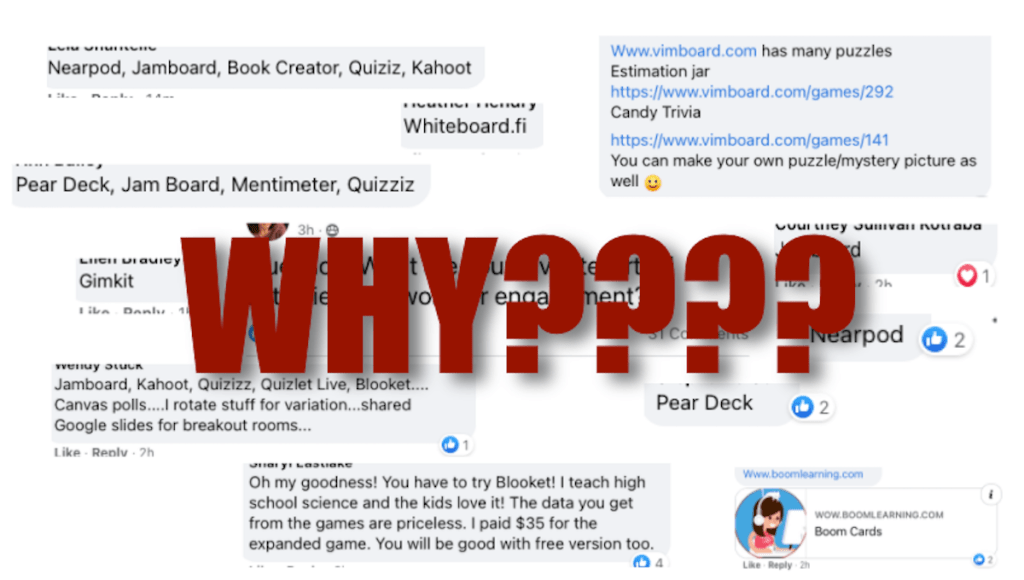
    A screenshot of a facebook post that reads "Question: What are your favorite virtual activities that work for engagement?" It shows 7 likes and 31 comments.

    Quickly teachers chimed in to offer ideas.

    A slide with screenshots of Facebook comments, including: Nearpod, Jamboard, Book Creator, Quizizz, Kahoot, Whiteboard.fi, Mentimeter

    Here’s the thing…

    The initial question didn’t ask what technology tools do teachers use to check for understanding or to provide for collaborative learning space. The question asked for “activities” that work for engagement. “Activities” signifies that the response should be a verb, but the responses were nouns.

    Why is that?

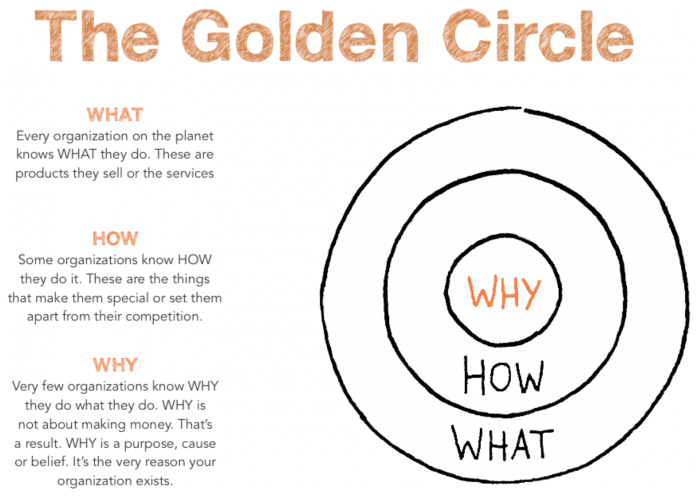
    Before I answer that, let’s look at Simon Sinek’s Golden Circle.

    Sinek’s Golden Circle asks people to start by defining the WHY. It’s what drives us to do what we do and how we do it. In education, people may define the WHY as standards, or high stakes testing, or maybe college and career readiness (the new buzz phrase) but it’s deeper than that. The WHY is (or should be) something along the lines of providing students with the skills, knowledge, and capacity to lead a meaningful life.

    Once we have an idea of what those skills and knowledge should be (WHY), we connect it with the standards we are told to teach (WHAT) and develop objectives and lessons (HOW) that guide progress towards achieving the WHY. Without the WHY, we’re back to the old factory model of “Open head, pour in content, move to next grade” education system.

    So what’s this have to do with that Facebook post?

    The teacher asked for ways (i.e. activities) to engage students in a virtual context. I would have expected responses like this one:

    “I post a photo of a Renaissance painting to facilitate student-led conversations using the Step Inside Thinking Routine so that students can explore the historical era through a persona perspective. I have them share their responses in breakout rooms so that they can engage in authentic conversations which my students seem to enjoy. They then share a summary of the conversation when we reconvene.”

    This type of answer engages in WHY. I can see from it that the teacher’s WHY includes: collaboration, critical thinking, creativity, open dialogue, and reflective thought. It also shows the WHAT by connecting to world history and art standards. And there’s even some HOW in the explanation of the activity steps and the use of breakout rooms.

    Technology products aren’t what create engagement or learning. People do that. Universal Design for Learning (UDL) defines engagement as the WHY of learning. It is how learners get engaged and stay motivated through challenge, excitement, or interest. Because engagement is the affective domain of the brain, “some learners are highly engaged by spontaneity and novelty while others are disengaged, even frightened, by those aspects, preferring strict routine. Some learners might like to work alone, while others prefer to work with their peers. In reality, there is not one means of engagement that will be optimal for all learners in all contexts; providing multiple options for engagement is essential” (UDL Guidelines).

    “Some learners are highly engaged by spontaneity and novelty while others are disengaged, even frightened, by those aspects, preferring strict routine. Some learners might like to work alone, while others prefer to work with their peers. In reality, there is not one means of engagement that will be optimal for all learners in all contexts; providing multiple options for engagement is essential.”

    UDL Guidelines

    For every product that was shared on that Facebook question as an engagement method, I can list ways in which that tool could also be used to disengage students from learning. The tool is just a tool. A hammer is great, but not when I need to loosen a screw.

    As teachers, we need to be careful not to get caught up in the edu-glitter of Ed Tech tools. Today it’s JamBoard. Before that it was a SmartBoard. And a white board. And way before that, a chalkboard. The tools shift, but our focus on the WHY should not.

    Oh yeah, back to my story…

    I never got a response from my boss. And so he never got a refresh plan from me.
  • A Friendly Reminder For You

    A Friendly Reminder For You

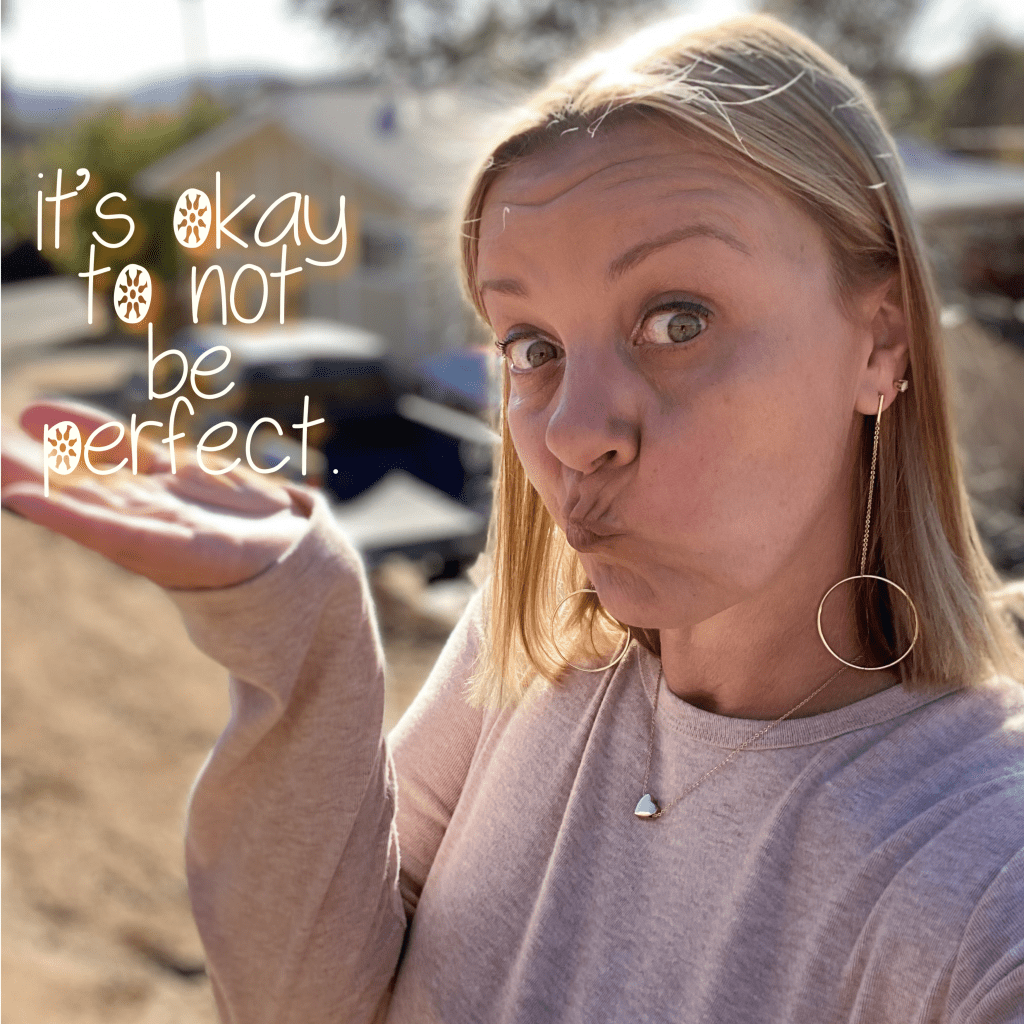
    Many of us are heading back to work today – whether that’s in an office, a classroom, a laptop screen in the kitchen, or a fabrication building, I have one friendly reminder for you:

    Hey, I said it was friendly, not easy. Truth is, we are our own hardest critic. And now, with all the extra pressures from the pandemic, the economy, the lack of social interaction, and a million other stressors, I see a lot of people beating themselves up over perceived imperfections.

    So next time you’re upset that you didn’t catch the typo before hitting send on the email, or frustrated because your lesson flopped, or angry because you set your new air fryer on fire (hey, it was an accident), please take a moment to remember that it’s okay to not be perfect. In fact, I like you better because of your imperfections.

    You got this!

  • Yes, the Kids ARE Falling Behind

    Yes, the Kids ARE Falling Behind

    I keep seeing this making the rounds and figured I’d break my self-imposed blog break by going on the record as dissenting to this claim.

    This type of statement screams privilege.

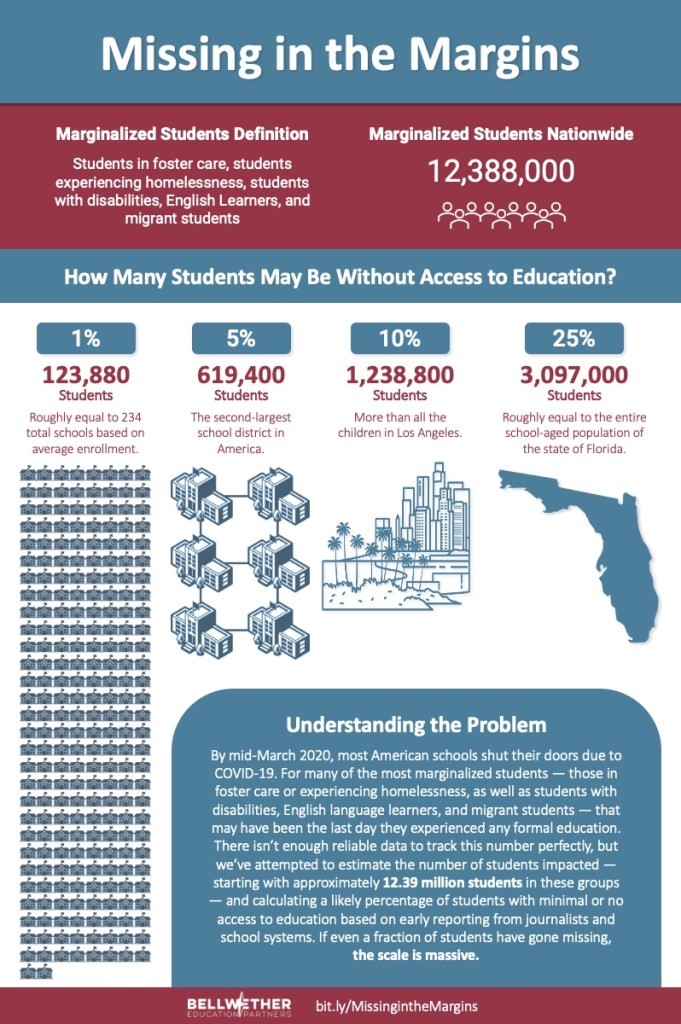
    There are millions of marginalized students NOT learning these so-called life skills right now. Millions! And not only are they not learning life skills. They aren’t learning at all. Some have disappeared completely from the system. Some are struggling to access even the most basic of technology services. And some are more concerned with food and safety needs than figuring out why their mic isn’t working on Zoom.

    (Source)

    Consider the teenagers who have chosen to work rather than return to school virtually – a trend particularly prevalent among low-income Latino families – who are now at greater risk of dropping out altogether from school (Source).

    Consider the students with special education needs whose parents aren’t always equipped to help teachers fulfill their children’s IEP. If parents need to work, their child misses classes and meetings with specialists, which not only hurts academic progress, but essential life skills attainment as well.

    There are many more groups of marginalized students who are also not learning right now.

    So how exactly are these students learning the life skills mentioned by this “Bored Teachers” statement?

    They’re not.

    But you know who is?

    The students from higher socioeconomic families that are not only learning those life skills, but may also be getting private tutors or extra parental support because their parents could take time off work or readjust their schedules. They’re continuing to plow ahead with the learning the millions of others aren’t getting.

    So let’s not try to fool ourselves, or others, into thinking that all the students are just fine … that there’s no falling behind.

    Look, I know 2020 is hard (unprecedented/impossible/etc), and the demands being placed on teachers is … well… there is no word for how crazy the demands are right now.

    I get it.

    But that doesn’t give us permission to ignore the reality of the situation, even if we are tired of hearing it. Because the truth of the matter is, there ARE millions of students falling behind.

  • A Phone, a Pizza, and a Connection

    A Phone, a Pizza, and a Connection

    My ex-husband lives a few hours away. He rents a small room behind a house in a not great part of town. When COVID hit, he got sick and lost his job. His car broke down around the same time. Because California’s unemployment system is so archaic, it took about six months for him to get any funds. And of course, that was after the federal stimulus ended.

    When you don’t have a cash flow, you have to make choices as to what to prioritize. He prioritized his cell phone, and decided to use the hot spot as his wifi for his laptop.

    Last week, my oldest daughter, with whom he shared a phone plan, decided to get her own phone plan. She transferred her phone number to the new service and let the previous provider know that she no longer needed their services.

    Instead of cutting off her phone, they cut off his.

    Of course, none of us knew this.

    So when his children could no longer contact him, and his friend had also not heard from him in days, we all assumed the worst.

    Today I called the cops to do a wellness check. When they called me an hour later, I was expecting them to ask me to come ID a body.

    Instead, it was my ex, explaining that his phone was disconnected and he wasn’t sure how he was going to get to the phone company’s office to get it resolved. Remember, he has no car. And no phone.

    That means no directory to look up the nearest phone company location. No Uber or Lyft to take you there. No internet to check email to see if there’s a message about the mix up.

    After he told me he was alive, we hung up. (Can’t really have a long conversation on a police officer’s cell phone!) I called my daughter and explained the situation.

    She called the phone company and explained what they did wrong. They restored his phone line. Only issue was that we had to somehow tell him that he needed to reboot his phone for it to work again.

    Dang it!

    The cop was long gone.

    Now what?

    My daughter had the great idea to send him something via Amazon with a note to reboot his phone. However, that would still be a day or two of waiting for the delivery to arrive and hoping he saw the little gift receipt note.

    So I went to Domino’s pizza online and placed an order. The pizza that was our favorite when we dated almost 30 years ago. And I wrote in the delivery notes that I needed them to write a note on the box to reboot his phone.

    It worked.

    A modern carrier pigeon.. haha

    Domino's pizza note that states:
Go thru side gate. Knock on door of back house. Please add note w/pizza: "Reboot phone and it should work. Laura"

    But it made me realize just how much our world becomes a prison cell without access. No phone, no internet, no connection to the world.

    How many of our students are in similar situations? And how are we bridging that divide? Do we need to start sending pizza boxes with lessons written on them?

    Why doesn’t the federal eRate program include home internet costs? Why are we still, as a nation, treating internet access as a privilege instead of a necessity? Although I guess I shouldn’t be surprised since feminine hygiene products are still charged a value-added, or sales, tax, unlike the tax exemption status granted to other products considered basic necessities.

    I’m grateful to Domino’s for helping me out today, but as a country, we have to do better than this. Our families deserve it.