Tag: The Space: A Guide for Educators

  • So You Want to Create a Flexible Learning Environment…

    So You Want to Create a Flexible Learning Environment…

    A colleague asked me for resources on flexible learning spaces. Her goal is for 6th students to use the Design Thinking mindset to redesign their own classroom. Because we know it’s not just about cool chairs and bright walls, it’s important that students and the teacher understand the WHY behind the decisions being made.

    Luckily, Twitter hashtag #learningspaces has a treasure trove of resources for teachers looking for a place to start. And attending CUE BOLD in May also provided me with access to amazing presenters and ideas around classroom environment.

    So here is the list of resources I curated for the students, in case it helps any of you:

    Tips for Designing Amazing Learning Spaces with Dr. Robert Dillon
    And here’s a visual for that YouTube video.

    Edutopia article showcasing some flexible K-8 classrooms.

    Video Series on the book The Space by Dr. Robert Dillon and Rebecca Hare

    This tweet may be good to spark a deeper conversation questioning why we need so many desks/chairs/etc in the room.

    12 Ways to Upgrade Your Classroom Design takes ideas from The Space and presents them in an easy to read blog post.

    Consider adding a Peace Corner to provide quiet spaces for reflection and emotional centering.

    Designing Brain Friendly Spaces by Dr. Robert Dillon is a short article with some targeted questions to ask while considering how space is used.

    CUE BOLD has made all the presentation slides available for those wanting to learn more. There are quite a few on learning spaces that are worth checking out. Look for Rebecca Hare, Michael Morrison, and Michelle Ho & Danielle Roja for relevant links.

    And of course, as you consider all this, please keep in mind that Pinterest is awesome for beautiful wedding decor, scrumptious recipes, and creative Outfits of the Day, but Pinterest-designed classrooms don’t always meet the needs of the learners (and they’re expensive to create!). My original blog post on that topic is still one of my most popular ones.

    Please let me know in the comments what else should be added to this list.


    And hey, if this post made you smile, or think deeply for a moment, or just scratch your head and go HMM… then share it with a friend. Or two. And subscribe to keep the posts coming!
  • Why Don’t We Put the Bed in the Kitchen?

    Why Don’t We Put the Bed in the Kitchen?

    I grew up in an Italian family. That meant a lot of our family gatherings were centered around food. Lots and lots of food. And since most food preparation happens in the kitchen, it came to be that a lot of family gathering and conversations happened around the kitchen as well.

    Apparently this same phenomena has happened in many families because we are now seeing open-concept kitchens as a selling point for homes. Understanding that the kitchen is not just about cooking, but also about communicating, designers are rethinking the traditional kitchen to incorporate this additional user need.

    A single bed in a kitchen in Stoneybatter
    A Flat in Stoneybatter

    When spaces are designed, they are designed for a purpose. A home has many spaces, and each has its purposes. It would seem bizarre to place your bed in the kitchen. Even though we know that our day consists of both cooking and sleeping, those activities require separate spaces. Likewise, most of us forego the kitchen sink and use a separate sink space to brush our teeth and apply makeup.

    And yet, when looking at classroom spaces, I see spaces that are trying to be an all-in-one environment. It’s like having the bed, sink, patio furniture, and front lawn all crammed in the kitchen. (Granted, there are some super tiny apartments in NYC that attempt to do just that, but they are the exception!)

    What do you want students to do in the space?

    This is the question Rebecca Louise Hare, Design Specialist/Science Teacher/Learning Space Designer and overall awesome person challenged us with at CUE BOLD. A space, she explained, can’t be everything to everyone all the time. Prioritizing the function of the space is key.

    Is it meant for collaborating? Physical Making? Digital Making? Reflecting? Showcasing? Working independently? Presenting? Receiving? Other? And no, you can’t just say yes. Think of how much time does it serve those purposes… and is there another space that could serve that purpose better?

    Can we showcase student learning in the hallways? In the library? On a website or IG account? This frees our classroom walls for the process of learning instead of a museum for the product of learning.

    Can students work independently outside of their assigned seat? Does it work on the floor? Under a desk? In the quad? On a bean bag chair?

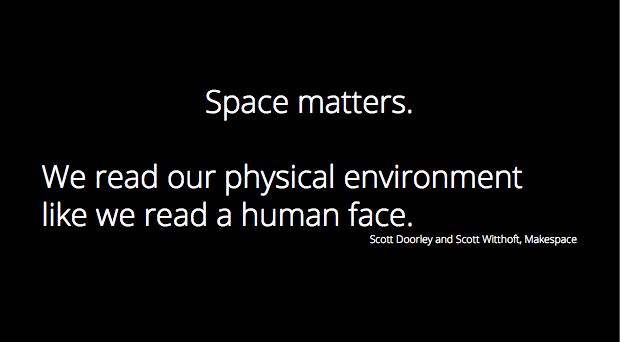
    We read our physical environment like we read a human face.

    When you prioritize the purpose of your space, the space can then support the purpose. If the kitchen is for cooking and socializing, then the inclusion of the island with bar stools and a large stove supports that purpose. The bed, the lawn, the makeup… the rest becomes clutter, distraction, barriers.

    As we head into summer break, challenge yourself by asking: What do you want students to do in the space? What do students want to do in the space? And then design it to reflect that purpose.

    Resources:

    The Space: A Guide for Educators by Rebecca Louise Hare & Dr. Robert Dillon

    Parts, Purpose, Complexities Thinking Routine