Tag: Ron Ritchhart

  • Empathy is Always Worth the Time

    There are days when we all probably ask ourselves, “Is anyone actually listening?!?” Then I read tweets from teachers like this, and I realize the ripple effects from a pebble can travel much farther than seen from shore.
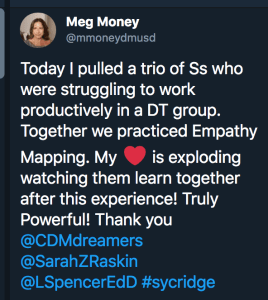
    A Tweet from Meg Money about using empathy mapping with her students

    Meg is one of those teachers I get excited to know and work with because she is willing to reflect on her practices as she continuously looks for connections that make a difference for students. After the above tweet, I asked her to blog this experience for others. Since she doesn’t have her own blog, I am giving her the space here to share. So this is Meg’s story in her own words…


    There’s a little saying that goes, “a stitch in time saves nine.”  
    Is Empathy Mapping worth the time?
    By: Meg Money, Sycamore Ridge 4th Grade teacher

    “As teachers, how do you want to invest your time?” Ron Ritchhart, Harvard’s Project Zero, asked a cohort of DMUSD teachers recently. This question has replayed in my mind time after time since.  Last week I was at a crossroads; time or making a difference? You see, our 4th grade class was in the thick of a Design Thinking challenge. All groups were collaborating ferociously and productively…all but one. But hey, it was my fault. I designed that group knowing that it had a 50-50 chance of working. This group of three included  kids who were bright and capable in their own right but different as day and night. Unfortunately I didn’t play my cards right, and now I had a group on my hands that had potential but was so far behind because productivity and collaboration were nonexistent.

    Now comes in the saying, “Timing is everything.” Fast forward two weeks to another training led by our very own DMUSD Design Team.  Paula (@CDMDreamers) and Sarah (@SarahZRaskin) led us through a Empathy Mapping exercise, and a light bulb went on. This is what my lagging group lacked… Empathy! However, this would take time; time a group was running out of.

    “How should I invest my time?” replayed one more time in my head. Yes, this is exactly what this trio of budding engineers deserved. They deserved to feel safe in a group and showcase their talents. Their assigned grouping shouldn’t be the barrier holding them back.

    I wasted no time and asked the group how they were feeling halfway through the research/prototyping phase. As you can imagine, they were frustrated and asked if they could just work alone. It was then I suggested that we come together and build empathy through the mapping exercise.

    What happened from there surpassed every expectation I’d anticipated. The kids were open, honest, polite and so insightful. They really didn’t need much prompting; they got it! They created NEED statements that immediately inspired them to hurry back to their learning. I watched in AWE as this group of young scholars immediately started approaching a difficult task with empathy and producing with the maturity of adults. I’m not going to lie, I had tears, goosebumps, and a swollen heart.

    So, was this worth the TIME? Oh, you have no idea. Just ask the group members.

    “Ms. Money, thank you for taking the time to do the mapping with us,” said one student.

    “This was the best day of the year,” another added with a hug.

    “Ms. Money, hurry, come see our idea!” shouted one from across the room.

    I will forever be reminded of this experience that truly confirmed that helping students find their potential and giving them a chance at success is absolutely worth the time. Empathy Mapping is now the frontrunner of my long list of “Must Explore and Practice” list. It is worth every second of TIME!

    Connect with Meg on Twitter at @mmoneydmusd

  • The Pyramid Scheme of Bloom and Maslow

    The Pyramid Scheme of Bloom and Maslow

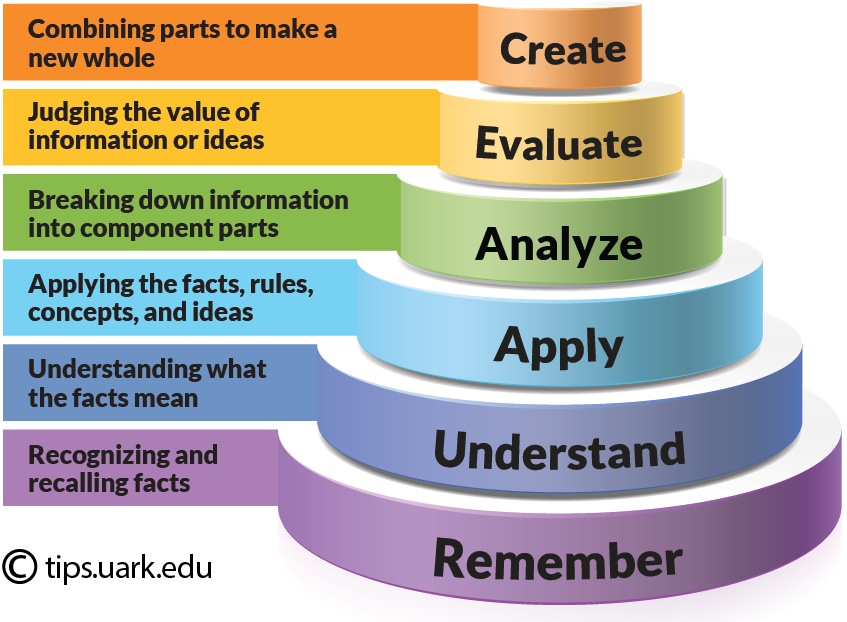
    I’m not sure when I was introduced to the triangle guys… Bloom and his taxonomy, and Maslow and his hierarchy… but it was early on in my teaching career. I remember being told how important it was that students learn the basics before moving up the hierarchy of thinking. I also remember being told that it was equally important to ensure that higher level thinking opportunities were provided within my instructional approach.  And of course, it was also critical to ensure safety and belonging needs were met as well.

    Blooms_Taxonomy_pyramid_cake-style-use-with-permission

    I taught in a Program Improvement school during the No Child Left Behind accountability era. For those of you unfamiliar, it basically meant that failure to achieve proficiency within the timeline set forth by the federal government meant punishments. Punishments ranged from being publicly branded a failure to receiving corrective actions to being taken over (or “restructured”) by the state. For teachers, it meant doing whatever it took to raise test scores, even when not in the best interest of students.

    For the not proficient students, it meant teaching to the test. Drilling senseless information in the hopes that enough would stick to the move the needle to proficiency. For them, Bloom’s taxonomy wasn’t a triangle. It was a plateau of Remember with a sprinkling of Understand. Only proficient students were provided a ladder and some time to climb and explore. But even with those students, there was a problem.

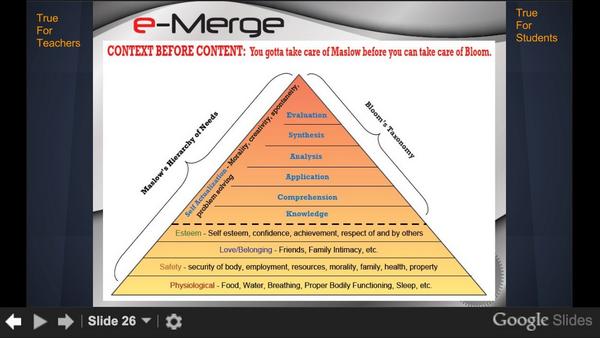
    The problem is that Bloom’s taxonomy isn’t actually a hierarchy of thinking… in fact, it was simply his theory of six learning objectives that he thought moved from lower to higher order thinking. It was not based on research in learning (see Making Thinking Visible chapter 1 by Ron Ritchhart, et al). All these years of teaching based on a triangle that has no grounding in what we know about cognitive processes… and now, to add to the confusing complexity, people are adding Maslow’s hierarchy to Bloom to send the message that students need Maslow before Bloom.

    B0E4xlWIcAEHOHl

    We need to move away from this pyramid altogether. Besides the primary two levels of physiological and safety needs, the rest of Maslow’s hierarchy does not happen in a classroom absent of cognitive development. A child will not establish a self-esteem if that child is not provided opportunities to learn and develop with his or her peers. A child is not going to feel a sense of belonging if his or her peers are engaging in complex thinking and discussion and s/he is not able to add to the richness of the conversation. Maslow, admitting that his earlier statements may have given “the false impression that a need must be satisfied 100 percent before the next need emerges,” explained that satisfaction of a needs is not an “all-or-none” phenomenon like we tend to act in education. Maslow also noted that the order of needs might adjust based on  individual unique needs. Fo example, some see self-esteem as more important than the need for love. For others, the need for creative fulfillment may supersede even the most basic needs. Therefore,  the old adage of “We must Maslow before we Bloom” doesn’t always stand firm.

    Another issue with this pyramid is that students can (and do!) analyze, synthesize and create as a way to form an understanding. Unfortunately, struggling students are often stuck in drill-and-kill mode without ever giving opportunities to engage in the higher order thinking that builds the thinking connections which truly create learning. I remember my daughter learning field hockey – she didn’t sit in a room learning every rule, every stick move, every penalty. She played. She learned. She tried out some moves and then reflected and adjusted based on her approximation of the standard. She watched others. This is how humans learn. Had she been forced to take timed tests on field hockey rules, she’d never have become the pretty good player she is today.

    When we move out of thinking of “only the proficient” can engage in complex thinking and give all students equitable opportunities to create, analyze, synthesize, etc., student learning and self-esteem will blow the top off both of those pyramids.

    Featured Image by 95C from Pixabay

  • Crafting a New Story of Learning

    Crafting a New Story of Learning

    This was a fascinating read the other night…

    From: Making the World a Better Place Starts with a Really Good Story

    Kathleen: One of the things I saw in the organizations that I interviewed is that they prioritize storytelling, not only at the executive director or CEO level, but at every single level of the organization. Everyone within the organization can be a brand ambassador for the cause, whether it’s a staff member who happens to be at a cocktail party and comes across a donor, or whether it’s a beneficiary talking to a funder about the effectiveness of the work.

    Some of the organizations that I interviewed actually did storytelling practice in their staff meetings. IDEO.org does this storytelling roulette where they spin a wheel, and on the spot, a staff member has to tell a story about a project that they worked on. It’s that repetitive practice that really helps build storytelling skills.

    Nadine: One of the great benefits of doing that is that within the organization, it builds cohesion and alignment around the messaging and the brand. It’s really a powerful internal development tool, as well as an external development tool.

    How are you empowering both staff and students to tell the story of learning at your site? I just spent a day of professional learning with every teacher in our district. Based on an activity in Ron Ritchhart’s Creating Cultures of Thinking, we looked at the story of learning we were told growing up through beliefs, behaviors, expectations, etc. Phrases such as compliance, tracking, and worksheets kept rising up.

    Our district has already spent a year researching what education should look like for our students. We met with industry experts, read countless books, went to conferences across the country, and most importantly, talked to our stakeholders: students, parents, staff, and community.

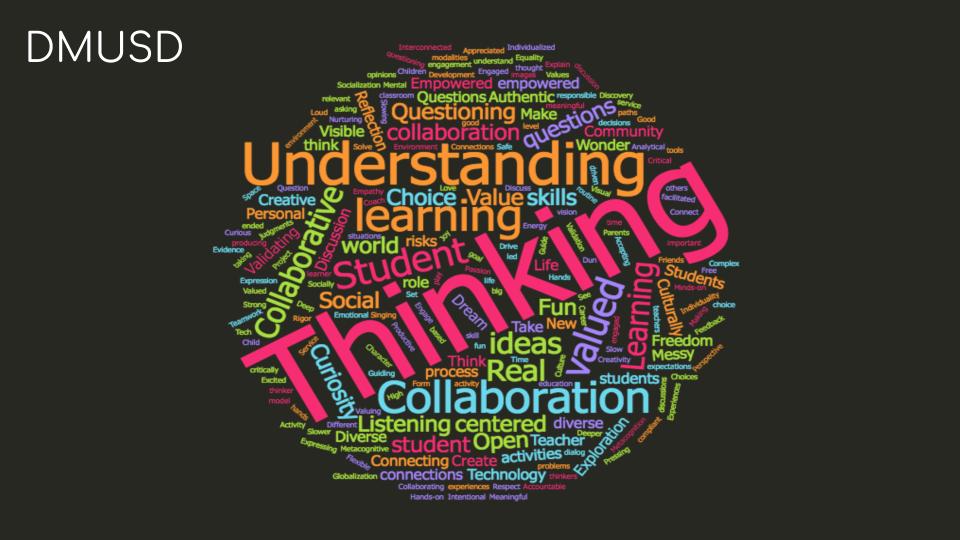
    With this information, as well as some video and article reads during our professional learning day, we began crafting a new story of education; one that values the unique geniuses of all students through strong instructional practices that promote student agency, collaboration, personalization, cultural intelligence, and design thinking. Our new story has much different phrases:

    Word Clouds from New Sticky Notes

    So how do we build a storytelling culture amongst all our stakeholders? That’s the next chapter we’re writing.

    How are you telling your story? Do you have a storytelling culture, or is a lone storyteller writing your book?

    Sign up to receive an update when I post. Type your email address in the box and click the “Subscribe” button. My list is completely spam free, and you can opt out at any time.


  • Don’t Sit On Grandma’s Couch: Contemplating the Pinterest Classroom

    Don’t Sit On Grandma’s Couch: Contemplating the Pinterest Classroom

    I remember going to my grandparents house often as a child. I loved being there. There was a pool with a slide and a jacuzzi; A pool house with a billiards table. A TV room with an awesome reclining chair (which was my grandpa’s chair, but I could sit in it when he wasn’t at home); and a driveway with an amazing two part hill that was perfect for coasting down while sitting on a skateboard.

    Clear-plastic-sofa-covers-2

    But it also had one room that was off-limits to children:  the living room. You may recall a similar room in your grandparents (or parents?) house. Perhaps the couch had a plastic cover on it. There were knick knacks everywhere that were not to be touched, moved, or even breathed on. I’m serious…sometimes, just to test her, we’d move an object. Maybe an inch. Maybe just rotate it a few degrees. And before the day was over, it’d be back in its proper placement. On special occasions, we’d take family pictures in that room, near the fireplace. But beyond that, it was definitely off limits.

    I’ve been thinking about that room a lot lately. It was part of my grandparents house, and yet it wasn’t part of my experience at their house. It was a museum of sorts. Like a giant curio closet housing my grandma’s vision of the perfect house. I think it embodied what she thought her home should be like, as though she was June Cleaver without the pearls, waiting for the Beaver to come home from school.

    The reason I’ve been thinking about that room a lot lately is because I’ve also been thinking a lot about the environment in which students spend most of their awake hours. There’s this movement, it seems, to create classrooms that are Pinterest-worthy: full of bright colors, amazing graphics, beautiful fonts, and coordinated themes. I have to say, I am often in awe when I see these classrooms on my Instagram feed because I can only imagine the hours and dollars invested in created them. They’re just, so, perfect-looking.

    And that’s the problem. Much like the plastic covered couch, many of these rooms seem to echo the desire of adults more than the students. For example, there are displays of student work perfectly-spaced apart on a wall, often with a background border that echoes the topic of the writing displayed. At first glance, it’s impressive to see every child’s writing or art or science essay showcased. But then it hit me… who are these products displayed for? Not for the students in the class. Often times, the displays are high on the wall, out of reach of students, both of their eyes and their hands.

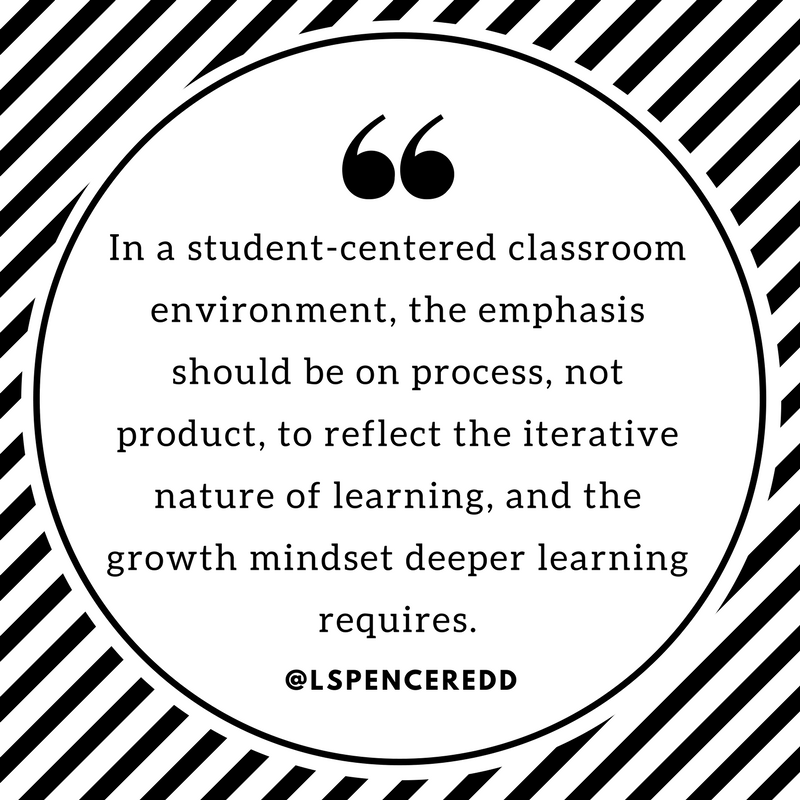
    In a student-centered classroom environment, the emphasis should be on process, not product, to reflect the iterative nature of learning, and the growth mindset deeper learning requires.

    Environment is one of the eight components in developing a culture of thinking. Environment is where learners discuss their thinking, share ideas, debate viewpoints, and engage with other learners (Ritchhart, Church, Morrison 244). In a student-centered classroom environment, the emphasis should be on process, not product, to reflect the iterative nature of learning, and the growth mindset deeper learning requires. There should be evidence of thinking, of learning, of struggling with concepts and new ideas and making meaningful connections. This process is often messy and non-linear, and reflective of student choice and agency and the individualized pace of learning. Ron Ritchhart’s The Development of a Culture of Thinking in My Classroom: Self-Assessment  provides a starting place for teachers assessing how they are developing a culture of thinking in their classroom. For the physical environment, Ritchhart includes:

    • Displays in the room inspire learning in the subject area and connect students to the larger world of ideas by displaying positive messages about learning and thinking.
    • I arrange the space of my classroom to facilitate thoughtful interactions, collaborations, and discussion.
    • My wall displays have an ongoing, inchoate, and/or dialogic nature to them versus only static display of finished work.
    • I use a variety of ways to document and capture thinking, including technology.
    • A visitor would be able to discern what I care about and value when it comes to learning.

    Erin Klein, an award-winning teacher and blogger, believes that teachers should “observe students in their natural habitat and work to accommodate their needs” (webinar). This approach, which values student voice and agency, should also consider brain research around visual environment and attention spans. “Young children with immature regulation of focused attention are often placed in elementary-school classrooms containing many displays that are not relevant to ongoing instruction.” The research showed that “children were more distracted by the visual environment, spent more time off task, and demonstrated smaller learning gains when the walls were highly decorated than when the decorations were removed.”

    So if a classroom were designed with a focus on student needs, how might student work be displayed? Would they be placed lower so that students could check out the pieces of their peers? Perhaps there would be Post-Its nearby so that students could leave feedback on pieces they enjoyed, or provide suggestions for the next revision. How about opportunities for students to self-select the piece posted, with a note asking for the type of feedback the student is seeking?

    I don’t often see these types of experiential opportunities in photos of the Pinterest-worthy classrooms.  Just like I don’t see photos of any of us sitting on grandma’s couch.

    Sign up to receive an update when I post. Type your email address in the box and click the “Subscribe” button. My list is completely spam free, and you can opt out at any time.