

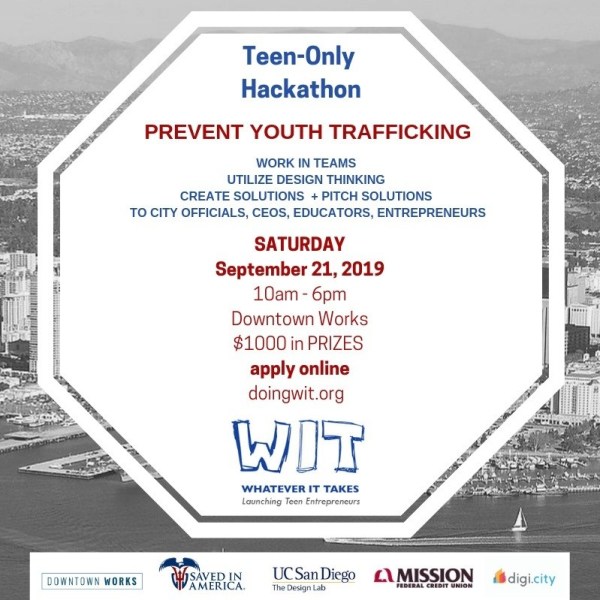
Yesterday I watched as teens came together to use their design thinking and entrepreneurial skills to tackle the subject of human trafficking, which is prevalent in San Diego. They came up with innovative ideas to increase awareness and inspire action.
The day kicked off with a motivational talk by WIT Founder, Sarah Hernholm. She stressed to them how important their voice is to solving big issues in our society. “You’re so much more than your school, your GPA, your AP course load… what matters are your ideas.”

To provide more context as to how important the issue of human trafficking is to San Diego teens, Don from Saved in America shared with the group how 3,000 teens from San Diego alone were lost within the past year. He shared signs of distress to look for in friends who may be involved in unhealthy relationships, as well. When asked why teens don’t know more about this epidemic, Don responded that it’s a hard conversation for adults to start with teens. One of the teen participants responded, “Just because it’s a hard conversation doesn’t mean we shouldn’t have it.” Another added on, “Teens have to be at the table for issues impacting teens.”

And at the table they were!
Don’s talk lit a fire in the teens. Split into smaller groups, they brainstormed solutions to:
– Ensure teens know the Human Trafficking Hotline Phone Number
– Provide education to teens on healthy vs unhealthy relationships
– Encourage parents to engage in conversations about human trafficking with their teen
– Use social media to increase awareness of human trafficking amongst teens

Design Thinking the Challenge Presented
Empathizing. Defining. Ideating. Prototyping. Testing and Refining. Teens spent six hours developing their proposed solution to one of the problems. Unlike past WIT Hackathons, this year the teens did not have an adult coach assigned to them. Instead they were trusted to use the design thinking process on their own, seek out feedback or assistance when needed, and most importantly, have their voices heard.

A Bias Towards Action
It was an honor to coach them, and a thrill to listen to their pitches. Two groups tapped in to the power of Instagram to get their message out to peers. One group connected with local and national businesses to ask that the hotline be printed on their product packaging. We had a group developing curriculum for middle and high school teachers, and another group developing signage for public transportation stops and gas stations.

Each proposal was unique, and their pitches were on point. Just like Shark Tank, students tackled all the key components of a pitch: Why, How, What, Target Market, Competition, Unique Selling Proposition, and Financials. They were scored on how well they met the challenge; their ability to address all the components; their presentation skills; the feasibility of their solution; and their adherence to the time allocation.
Change Agents
Although three groups won a monetary award, the reality is that all of the teens were winners. They came together, used empathy to tackle a tough issue, and spread the word about an issue that affects their lives. These kids are world changers!

If you haven’t heard of WIT, check it out. Hackathons and college credit courses are available for all San Diego County high school students. It’s also available in Austin, TX and New York City. And hey, if it’s not in your town (yet), reach out to Sarah and make it happen!
 Seelig’s book focuses on the four components of the Invention Cycle: imagination, creativity, innovation, and entrepreneurship. Imagination is envisioning things that do not exist. It requires engagement and the ability to envision alternatives. Creativity is applying imagination to address a challenge. Creativity requires motivation and experimentation to address a challenge. Innovation is applying creativity to generate unique solutions through focusing and reframing to generate unique solutions. And Entrepreneurship, which requires persistence and the ability to inspire others, is applying innovation, scaling ideas, and thereby inspiring others’ imagination.