I recently came across this thought-provoking quote on Facebook (no attribution) that resonated deeply with me:
These words capture a truth many of us know all too well. While receiving acknowledgment for our efforts can be uplifting, it often oversimplifies the journey behind those moments of grace under pressure.
People often say I’m a natural at public speaking and professional development. They don’t realize that beneath that exterior lies a naturally introverted person who grapples with anxiety. Balancing these public and private parts of myself is a continuous effort.
When I reflect on my own experiences, I recognize how easy it is to project confidence while concealing the internal struggles that accompany it. Behind every composed exterior, there are sleepless nights, doubts, and the weight of expectations that can feel overwhelming.
The trembling hands, the silent battles—these are parts of our story that often remain hidden. We tend to showcase our triumphs while keeping our vulnerabilities at bay.
It’s important to foster environments where authenticity thrives. Let’s create spaces where we can share not just our successes but also our challenges—where vulnerability is embraced, and our collective resilience is celebrated.
Because, in the end, every ‘you handled it well’ reflects a much greater journey of strength, one best shared together.
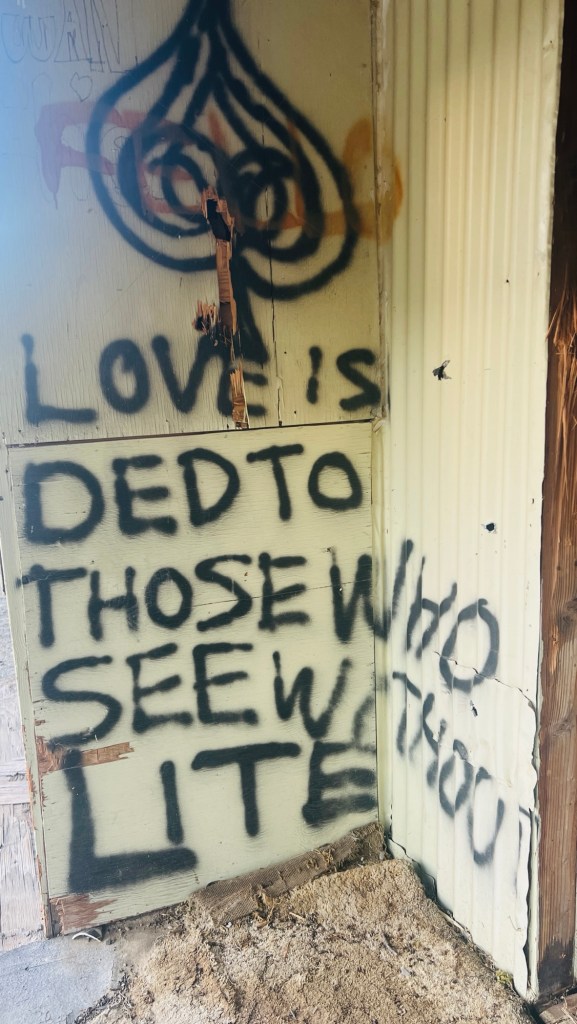
I stumbled upon this graffiti while off-roading that read, “Love is dead to those who see without light.” This resonated with me and has me reflecting on the importance of perspective in my leadership journey.
As a leader, I often face challenges that can cloud my judgment and make it easy to overlook the human aspect of my work. This graffiti serves as a poignant reminder that empathy is not just a nice-to-have—it’s essential. When I lead with empathy, I shine a light on the experiences and emotions of those around me. Taking the time to truly see my colleagues and team members beyond their titles and tasks has been transformative.
I’ve learned that listening actively and showing genuine care can make all the difference, creating an environment where individuals feel valued and understood. I’ve witnessed how a simple act of kindness or a moment of understanding can lift spirits and ignite motivation.
I strive to use empathy to transform challenges into opportunities for growth.
How do you practice empathy in your leadership? Please share your thoughts in the comments.
Life has a funny way of surprising us, doesn’t it? Recently, I found myself in a situation I’d always envisioned: an opportunity presented itself that, in my past, I would have jumped at without hesitation. It was a role I’ve always aspired to, and a chance to work with former colleagues that I love. But something unexpected happened. As I considered the opportunity, I realized my priorities have shifted. The things I once valued most have evolved, and what truly resonates with me now is a different kind of fulfillment. I discovered that the time and freedom I’ve cultivated are now my most valuable assets, and I’m deeply committed to nurturing my passions. It’s not about rejecting past aspirations, but rather about recognizing that our desires and values can change over time. Instead of focusing on what “could have been,” I’m embracing the clarity this experience has provided. It’s a reminder that success isn’t a static destination, but a journey of continuous discovery. It’s about aligning our actions with our evolving values and finding joy in the present moment. I’m incredibly grateful for the opportunity and the recognition from my former colleagues. Their belief in me fills my heart with joy. This experience has simply reinforced that my path is currently leading me in a different, equally fulfilling direction. It’s a beautiful reminder to listen to my heart and trust my intuition. It’s about honoring my personal evolution and celebrating the freedom to pursue what truly matters. And I’m excited to see where this new chapter leads.
Sometimes leadership means tackling challenges head-on, even when the initial attempt falls flat.
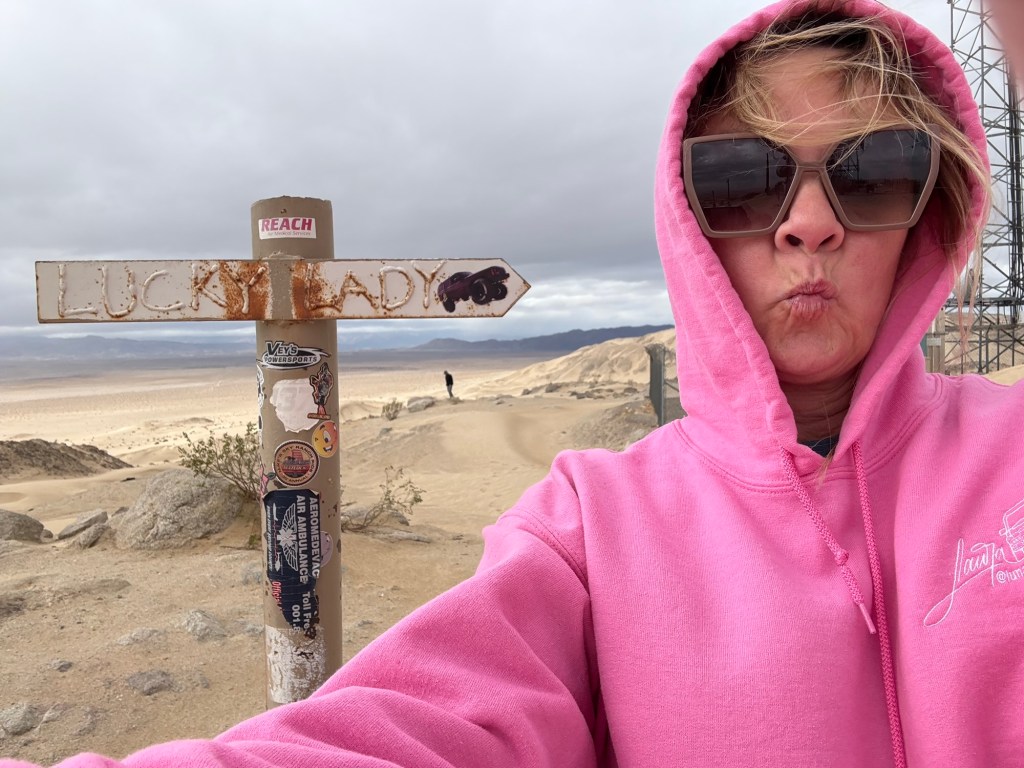
On a recent off-roading trip, a simple recovery turned into a leadership lesson. Wrong equipment, tricky incline, soft sand – we failed the first time. Most would’ve quit. But we regrouped, adjusted our approach, and got it done. Great leaders find solutions, not excuses.
Burnout often creeps in when we feel undervalued at work, leaving us drained and disheartened. It’s crucial to remember that our worth isn’t dictated by a boss’ recognition or a career title.
A quiet moment of reflection
In moments of reflection, I’ve learned the importance of seeking value in what we love outside of work. By nurturing our passions and prioritizing our mental health, we can create a sense of fulfillment that no job can diminish.
We need to invest time in ourselves and remind each other that our well-being matters most! 🌊💙
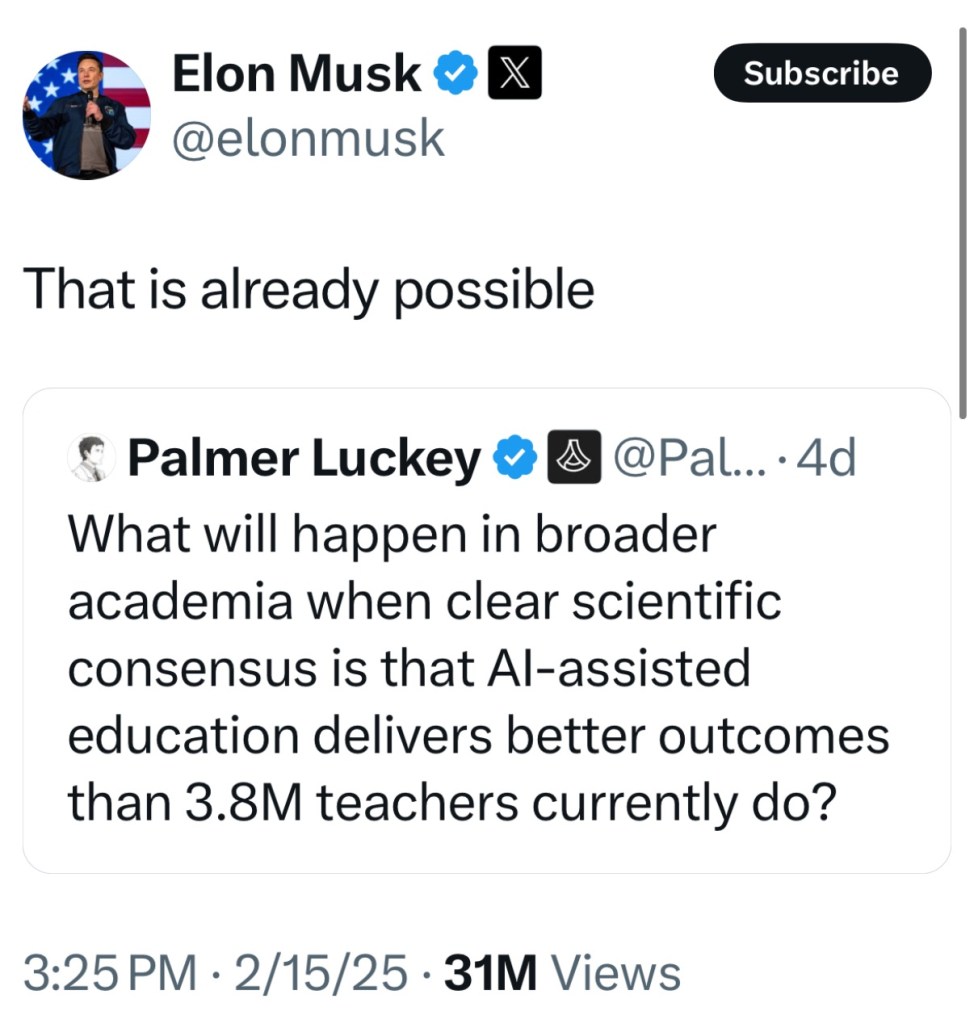
The recent buzz around AI in education, exemplified by Elon Musk’s assertion that AI-assisted learning can already outperform human teachers, has sparked important conversations. However, I believe we’re focusing on the wrong question.
We’re asking if AI will replace teachers, but we should be asking: is AI already replacing students in their own learning process? This question was recently raised on LinkedIn by Elena Beretta, who shared her observations of students leveraging large language models (LLMs) for everything from writing essays and solving homework to debugging code and even drafting theses. The driving force behind this widespread adoption? Increased productivity, she asserted. Students are drawn to the efficiency AI offers, allowing them to complete assignments in a fraction of the time. As Beretta points out, this isn’t necessarily about cheating – universities are addressing that – but about a fundamental shift in how students perceive learning. Beretta’s insights highlight a crucial trifecta of concerns: the shifting definition of learning, the delegation of “worthwhile” knowledge to AI, and the increasingly difficult role of educators. When productivity becomes the primary goal, the process of learning is devalued. If AI can instantly generate answers, what incentive do students have to grapple with critical thinking, problem-solving, and the development of structured arguments – skills that only improve through dedicated practice? This leads to AI effectively dictating what is “worth” learning, as students bypass the struggle inherent in developing these crucial skills. Consequently, educators are finding themselves in an exhausting loop, becoming less teachers and more AI-police and content verifiers. This begs the question: how can we equip students with the skills they truly need when AI makes it so easy to circumvent the learning process? I believe this situation underscores a pre-existing and deeply rooted problem in our educational system: the transactional view of schooling. For too long, students have been conditioned to see education as a series of tasks, points, and high-stakes tests, prioritizing metrics and data over genuine intellectual growth and the joy of learning. This transactional approach has already diminished the value of deep learning, and the advent of AI only amplifies this crisis. The “hustle” mentality, focused on efficiency and output, has become even more entrenched. If we don’t address this fundamental issue, we risk losing any hope of real learning taking place in schools. We need a paradigm shift, moving away from a system obsessed with productivity and embracing a performance-based model that prioritizes meaningful topics and the cultivation of essential skills. What matters most is fostering critical thinking, creativity, and a genuine love of knowledge – qualities that cannot be replicated by AI. Perhaps the disruption caused by AI can serve as a much-needed wake-up call. It’s time to fundamentally rethink our approach to education and ensure that learning isn’t just about completing tasks quickly, but about developing skills that are truly valuable and relevant for the future. This reality check could be precisely what we need to redefine learning for the better, shifting our focus from mere efficiency to the cultivation of human potential.







 Laura K Spencer, Ed.D.