Year: 2018

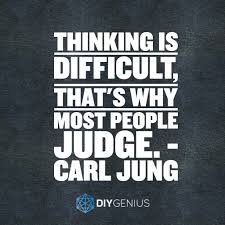
  • Compliant Geniuses? Think Again.

    Compliant Geniuses? Think Again.

    downloadOur district mission statement centers around our calling to  “ignite genius and empower students to advance the world.” That’s a pretty tall order!

    Especially when, as Seth Godin explains (“The Long Term” podcast), students typically spend 90-95% of their school day on either doing what they’re told, aka compliance, or finding the right answer, also compliance!

    If only 5-10% of the day is open for a student to think bigger thoughts, then how in the world can we ever expect students to find their genius?

    Looking for the right answer? It’s easy. You can’t.

    If we truly want students to find their genius, then we need to provide the opportunities for them to dig in to complex problems. Complex problems does not mean a calculus problem, or balancing scientific equations. What I’m talking about here are complex LIFE problems. Problems that, quite honestly, don’t have answers. Things like:

    • Overpopulation and resource scarcity (Although, if you watched the last Avengers movie, this problem does have a potential solution… No Spoilers allowed!)
    • Economic development of the global poor
    • Nuclear security

    When we allow students time, resources, and freedom to explore complex problems like these, and even more so, when we let them explore the world of no resolutely right answer, we are building their capacity for original thought. We are building their capacity for grit. We are building their capacity for learning from failure.

    And in doing so, we are building their capacity to ignite their own genius.


  • Why Don’t We Put the Bed in the Kitchen?

    Why Don’t We Put the Bed in the Kitchen?

    I grew up in an Italian family. That meant a lot of our family gatherings were centered around food. Lots and lots of food. And since most food preparation happens in the kitchen, it came to be that a lot of family gathering and conversations happened around the kitchen as well.

    Apparently this same phenomena has happened in many families because we are now seeing open-concept kitchens as a selling point for homes. Understanding that the kitchen is not just about cooking, but also about communicating, designers are rethinking the traditional kitchen to incorporate this additional user need.

    A single bed in a kitchen in Stoneybatter
    A Flat in Stoneybatter

    When spaces are designed, they are designed for a purpose. A home has many spaces, and each has its purposes. It would seem bizarre to place your bed in the kitchen. Even though we know that our day consists of both cooking and sleeping, those activities require separate spaces. Likewise, most of us forego the kitchen sink and use a separate sink space to brush our teeth and apply makeup.

    And yet, when looking at classroom spaces, I see spaces that are trying to be an all-in-one environment. It’s like having the bed, sink, patio furniture, and front lawn all crammed in the kitchen. (Granted, there are some super tiny apartments in NYC that attempt to do just that, but they are the exception!)

    What do you want students to do in the space?

    This is the question Rebecca Louise Hare, Design Specialist/Science Teacher/Learning Space Designer and overall awesome person challenged us with at CUE BOLD. A space, she explained, can’t be everything to everyone all the time. Prioritizing the function of the space is key.

    Is it meant for collaborating? Physical Making? Digital Making? Reflecting? Showcasing? Working independently? Presenting? Receiving? Other? And no, you can’t just say yes. Think of how much time does it serve those purposes… and is there another space that could serve that purpose better?

    Can we showcase student learning in the hallways? In the library? On a website or IG account? This frees our classroom walls for the process of learning instead of a museum for the product of learning.

    Can students work independently outside of their assigned seat? Does it work on the floor? Under a desk? In the quad? On a bean bag chair?

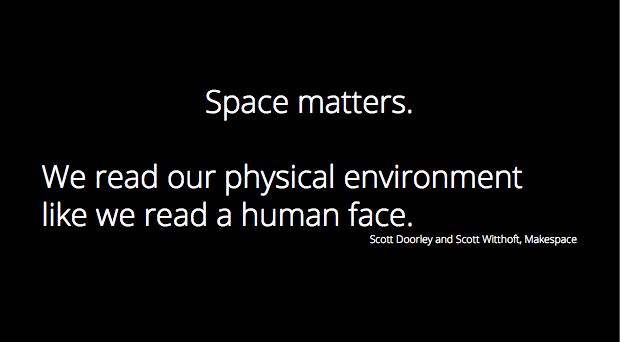
    We read our physical environment like we read a human face.

    When you prioritize the purpose of your space, the space can then support the purpose. If the kitchen is for cooking and socializing, then the inclusion of the island with bar stools and a large stove supports that purpose. The bed, the lawn, the makeup… the rest becomes clutter, distraction, barriers.

    As we head into summer break, challenge yourself by asking: What do you want students to do in the space? What do students want to do in the space? And then design it to reflect that purpose.

    Resources:

    The Space: A Guide for Educators by Rebecca Louise Hare & Dr. Robert Dillon

    Parts, Purpose, Complexities Thinking Routine

  • Eat a Good Breakfast and Get Plenty of Sleep!

    Eat a Good Breakfast and Get Plenty of Sleep!

    (Warning: This may cause you to disagree with me, and that’s okay! Share your comments below)

    fd495738d893a765ffa40edd2fcec112
    Found on Testing Motivation Pinterest Page.

    Don’t lie…

    When you read that title, what immediately jumped in to your head? If you’re an educator, I’d bet fifty bucks that state testing, or some other high stakes accountability assessment, leapt into your mind.

    Why?

    Why do we harp on students to eat a good breakfast and get plenty of sleep during testing season? (Is it truly a season???)

    Why do we leave students notes of encouragement on their desks during testing?

    Why do we ask parents to make sure students are at school on time, and that appointments be scheduled before or after school on testing days?

    Maybe the better question is …

    Why don’t we do this every day?


    … What messages are we sending about our values when we roll out the compassion ticker tape parade one time a year? And when that parade just happens to coincide with the test upon which schools are judged? Do we value the student or the test score?

    All those awesome desk notes and hallway banners and granola snack packs I have seen on Twitter and Facebook this past month are fabulous. They truly are. So let’s make sure they don’t just happen during state testing.

    Let’s make sure students know that EVERY SINGLE DAY they matter! Because they do. (And so do you, awesome teachers!)


  • Is It Possible to Do Good Better?

    Is It Possible to Do Good Better?

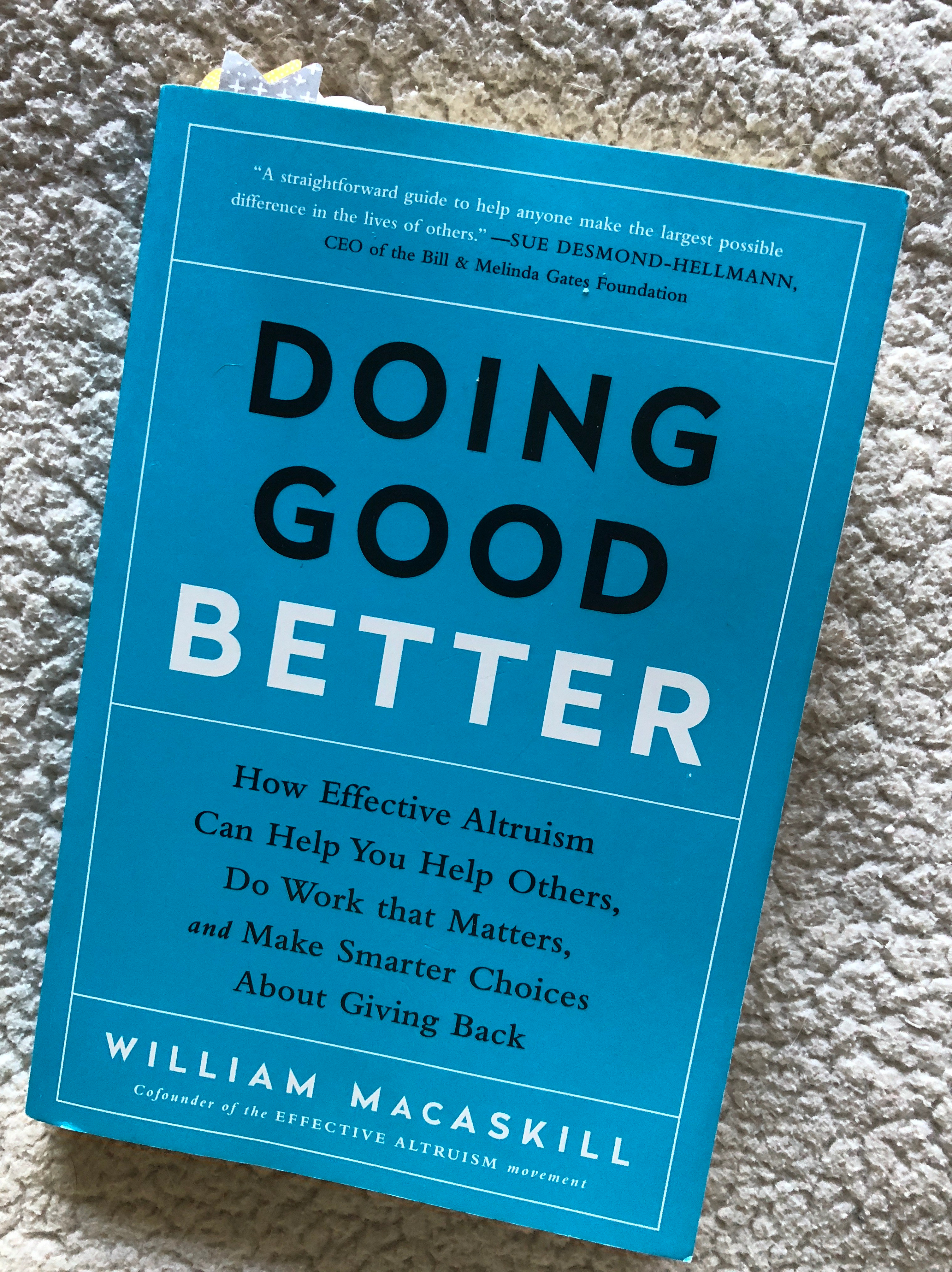
    Doing Good Better bookAccording to William Macaskill, it is. That’s the premise behind his book, Doing Good Better: How Effective Altruism Can Help You Help Others, Do Work That Matters, and Make Smarter Choices About Giving Back. 

    Macaskill and colleagues developed effective altruism, which uses data and some snazzy principles to help people make a huge difference in the world. It’s about asking “How can I make the biggest difference I can?” and then using evidence and reasoning to find the answer. It’s not about more money, or volunteering more hours. It’s more about being impartial in analyzing the options to choose what’s best for the world. (Spoiler alert: many of the options that we choose aren’t the best ones!)

    I picked up this book because of Design Thinking. Weird, maybe… but as we ask students to prototype solutions to complex problems, I’ve been grappling with what to do with those solutions. Are they solutions that warrant being pushed into the world? Have similar solutions already been tested? Should we tap into the passion students show towards specific subjects and encourage them to do something to make a difference, or redirect their energy to areas in which it is possible to truly make a difference? And hey, are we even tackling the right problems?

    According to Macaskill, it’s not enough to do something. It needs to be the best thing, so that the thing done makes the difference it should make. When it comes to helping others, Macaskill says that “being unreflective often means being ineffective.” He shares multiple examples of programs that sound great on paper, like PlayPumps  and Fair Trade but in actuality do little good for the people they intend to serve. In fact, some programs not only don’t do good, but they can cause harm, like Scared Straight, and boycotting sweat shops (seriously…!)

    So what does this have to do with elementary students and design thinking?

    If we are going to present students with opportunities to solve complex problems, and build in them a sense of agency that they can make a difference in the world, then isn’t it also our responsibility to make sure that they do good in a way that actually helps others? Shouldn’t we teach them how to identify work that matters? And how to make smart choices about ways to give back?

    Although I’m not sure I agree with all of Macaskill’s premises, I do think this is an area which warrants a deeper dive. If we are going to teach advocacy, global citizenship, and cultural intelligence, then it is important that we also provide students with the tools needed to help them make smart decisions, just like we need to do with media literacy and fake news. We need to make sure that critical thinking stays prominent in this work.

    We need to ask ourselves if we are doing good, or if we are doing good better.


  • There’s More to Her Than Meets the Eye

    There’s More to Her Than Meets the Eye

    When school dress codes focus the majority of their attention on what girls should not be allowed to wear, it sends a message.

    A powerful message.

    A message that girls are the problem. Their bodies are distracting to boys. And that boys shouldn’t have to be responsible for curtailing their sexist behavior.

    This needs to stop.

    It breeds harassment. And misogyny. And a blame the victim culture.

    Proud of my daughter for standing up for her rights. For her body. For her voice.

    Take a few minutes and read her post. Words of support always loved:

    There’s More to Me Than Meets the Eye

  • I Have Fallen in Love with Cad Monkeys, Dinosaur Babies, and T-Shaped People!

    Well, not literally! But I did thoroughly enjoy the book Cad Monkeys. Dinosaur Babies, and T-Shaped People: Inside the World of Design Thinking and How it Can Spark Creativity and Innovation by Warren Berger (That title is quite a mouthful!!). If you don’t believe me, consider the fact that I used up almost all of my super cute Target bin book tabs in this one book!

    Book tabs on my book

    I truly don’t even know where to start to describe all I learned from Berger. His deep dive into the world of design, and designers, read like a novel – fascinating characters, interesting plot developments, and a universal theme to do the right thing.

    You know what? I’m just going to share some of my tabbed inspirations and see where it goes:

    * It can be difficult to step back and look at one’s life with a fresh eye, but this is part of what design can teach us: how to view things sideways, how to reframe, rearrange, experiment, refine, and – maybe most important of all – how to ask “the stupid questions” that challenge assumptions about the way things have been done in the past.

    * Jumping the fence…attempting to make the leap from the realm of known achievability (what we know is possible) to the much larger surrounding space (what we don’t know how to do yet).

    * Everything a business does matters; that every action communicates a message to the world and also has consequences on some level.

    * Jim Hackett, CEO of Steelcase: “There is an over celebration of getting things done” and not enough patience for “thinking as part of doing.”

    * Dean Kamen: “We have to do whatever it takes to get ideas out there into the world. Otherwise, you’re just doing science fair projects.”

    * Mark Noonan: “Instead of just asking a question, you have to take ownership of it.”

    * Bruce Mau: Process enables experimentation. “It’s like a safety net.” People tend to feel more comfortable experimenting with new ideas and venturing onto unfamiliar turf when they carry with them an established method of working and solving problems. It means that even if they don’t quite know what they’re doing, they always know what to do.”

    This book is like the Lorax, in that it speaks for design. And even though it’s about design, these quotes also speak to the heart of education. They speak to the work we must do to ensure student learning experiences are relevant to the world they inhabit today, and the future world problems they will be inheriting.

    I leave them here, then, without my commentary so that they can speak to you as well. Tell me, what do you hear?