Everywhere I turn, people seem exhausted. Not just by the pace of change, but by the growing sense that our systems, especially in education, are still answering the wrong questions.
We’re designing for efficiency when what we need is empathy. We’re measuring content mastery when what’s slipping through the cracks is human development.
I keep coming back to a question I shared recently with educators at our Elite kickoff:
What if school wasn’t built for content delivery, but for human development?
It’s not just a question for classrooms. It’s a lens for our entire society.
If we keep treating education like a conveyor belt of content, we’ll keep producing students who know what to memorize, but not how to belong, contribute, adapt, or lead.
But if we build schools where curiosity is safe, connection is prioritized, and hope is cultivated? Then maybe, just maybe, we’ll raise a generation that can heal what’s fractured and build what’s missing.
Because in a volatile world, content is important. But character, compassion, and critical thinking are essential.
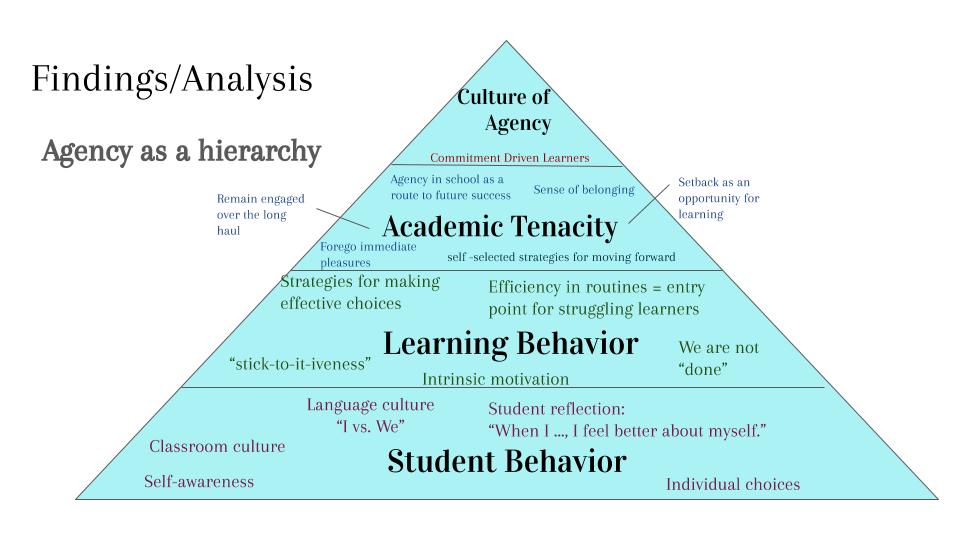
I spent a year digging deeply into the concept of student agency with teacher teams. We tried to define what agency looked like for a particular grade level, and then how to use that definition to create a classroom culture that provided opportunities for students to develop and exhibit agency.
Lately, as I work on creating learning experiences for virtual learners, I’ve been thinking a lot about the agency work. How do students who aren’t in a classroom develop and exhibit agency? Do they have to already have agency in order to be a successful virtual learner? Is this a chicken or the egg debate?
Executive Function
The other day I stumbled upon a webinar by Sucheta Kamath, founder and CEO of EXQ, called The Back-to-school Brain: Developing Executive Function Skills to Shape a Successful School Year. Kamath dove into the importance of Executive Function skills for students. According to Kamath, executive function is the ability to serve the self (goals), done by oneself, by managing self …and if one can’t, it’s the ability ask for help, by oneself.
In other words, if an idea is originated by a parent or teacher, than it is the parent or teacher’s executive functioning skills getting worked, and not the student.
This isn’t far off from the definition of student agency. One definition I like states that “Agency refers to the power to make choices. Students with agency are those who feel a high level of responsibility and ownership for their own learning (source).” In order to have that high level of responsibility and ownership, students would need to have executive functioning.
So then…if a teacher is setting up a classroom to provide opportunities for students to develop and exhibit agency, then how much of that opportunity is based on the teacher’s executive functioning skills and agency and how much of it is building the child’s skills? In other words, if the teacher says, “I’m creating this writer’s workshop to build agency” then has the responsibility and ownership been placed on the teacher instead of the student?
Slide from Kamath’s presentation. EF = Executive Function
This becomes an important question when considering two important executive functioning skills – to adapt and to shift flexibly. Throughout a school day, students are expected to transition multiple times through a variety of different transition types:
leisure to leisure – from lunch to free play, or during station rotation with fun experiences
work to leisure – finishing up an assignment before recess or the end of the school day
leisure to work – coming back to class after recess, or lunch, or an assembly
work to work – shifting from math instruction to science instruction
Disengaging from one experience and then reengaging with a different experience is exhausting, especially when it is a work to work adjustment. Before students can take ownership of learning, they must successfully navigate these transitions.
Kamath recommended that teachers ensure the expectations match the level of skill readiness. It may be unrealistic for a kindergartner to know how to put away math and pull out writing without direction, but it is not unrealistic for a middle school student. So before judging a child for failure to exhibit agency, it may be necessary to provide help in executive functioning,
A tip from Kamath: Use timers to warn about upcoming transitions (not just when time is up!), as well as provide visual reminders. Have different timer sounds for different transition types.
Function Before Agency
So if executive functioning skills must stem from the student’s self management, and self-management is required in order to exhibit responsibility and ownership, which are demonstrations of agency, then it stands to reason that students need to have age-appropriate executive functioning in order to demonstrate agency in learning.
Our Role as Educators
Helping students discover their sense of purpose, and then assisting them in using their executive functioning skills to set them on a course to achieve that purpose, will create a personal drive to learn, and thus lead them to take agency, or ownership and responsibility, of that learning.
As mentioned in my Exploring Agency and Personalization blog on December 15th, I’ve been working with teachers to to better understand the principles of agency and personalization. As these are key elements of our district’s vision and mission, it is important to be able to articulate what those principles are, how they manifest in an elementary school classroom, and what impact they have on student learning. When I asked teachers to reflect on their growth, one teacher took the time to write an eloquent response. With her permission, I am sharing it here.
I used to believe that all good teachers foster agency in their classroom. It is something that just naturally starts to happen for most kids, and something that might happen very slowly, or in a limited capacity for others. After all, the reality is that some kids just have more buy-in to their own learning than others. Our students come to us with different personalities, hopes, dreams, family values, and beliefs about their schooling. Our students come to us with a vast spectrum of experiences, fostered from within and outside of our school district. Changing or growing their pre-existing belief system is no easy task. But now I believe that supporting every student in the ways they approach their own learning is quite possibly our most important task as educators.
@MrsMackieD3 Tweet: Sharing Learning@Home with our classmates = engaged learners
After working closely with my team and the other hub participants, my thinking on student agency has really changed into a belief that supporting student growth in agency is slow and steady, and is fostered most effectively over time. When we can support students in building these habits of mind, they build a foundation for success in life that will extend beyond their school experience. Agency is grown through hard work and understanding. Building grit and academic tenacity takes focus, attention, and buy-in, from students and teachers alike. Growing agency for students is about goal setting and asking the tough questions about the WHYs of their learning experiences. Questions and considerations about learning that I have been asking my students to become aware of are: Why are you doing this? Why does it matter? Who are you doing this FOR? Is this for you, me, your parents? What you do, make, say, accomplish each day matters – for YOU. Otherwise, what is the point? Providing learning experiences and opportunities for students to grow this mindset should be the point…for all of us. Spending time, scaffolding opportunities for students to make decisions about their learning behaviors with intention is hard work. But it is important work. Helping students build an awareness about their own contributions and responsibilities toward their learning outcomes is one of the most important contributions we can make to them as lifelong learners. This is the work, the learning, the growing, that is most certainly worth doing.
Emily Mackie has been teaching elementary students for 13 years. She strives to make the classroom a student-centered space which fosters curiosity, exploration, creativity, and FUN so that all children feel safe, valued, and loved. You can find her on Twitter at @MrsMackieD3
I had the pleasure of listening to 5th grade students share their proposals to relaunch the lunch experience at their school. There were a few issues that the students were looking to solve:
Students who get hot lunch need healthy, delicious food choices everyday to include vegetarian choices in order to avoid food and money waste and get nutrition for the rest of the day
Students need more time in order to play, eat, line up, and transition to be relaxed.
Students need choices and flexibility in seating in order to feel valued, respected, and trusted.
Students need a way to change the music at lunch in order to have amore enjoyable lunch experience.
Regardless of the need being solved, a theme quickly emerged – Agency. Or lack thereof.
One student explained in his presentation: “In the classroom we are always told to be ‘Be quiet!’ by the teacher. And then at lunch we are told to ‘Be quiet!’ by the lunch aides. When do we get to unwind and let our energy out?”
Another student shared that “KidzBop is dreadful,” so as a reward for behaving, it is truly missing the mark.
Other students shared that the playground should be a place to play freely, and not be limited in choices by the adults supervising the area.
And when it came to food, many were in agreement that having parents place orders at the start of the month did little to satisfy their taste buds later in the month.
Regardless of the need being solved, a theme quickly emerged during the presentations – Agency. Or lack thereof. These students wanted to have input into the routines impacting their day. They wanted choice. They wanted freedom. They wanted voice.
Their proposals were all awesome: Music committees to analyze lyrics of songs requested by students so as to create playlists; student-generated rules to provide equitable access to playground; and healthy food vending machines that not only provide choice, but also generate revenue for the campus.
Today’s students are tomorrow’s leaders. If they are to lead well, we must give them opportunity to develop agency. You never know… they just may do a better job than we are!
P.S. I’ll be excited to hear what changes result! Final presentations are next week, right before Spring Break. Stay tuned…
Sign up to receive one update when I post. Type your email address in the box and click the “Subscribe” button. My list is completely spam free, and you can opt out at any time.