Tag: SDCOE

  • Designer or Design Thinker?

    Designer or Design Thinker?

    Innovation is when something new is created and implemented that adds value. Inventions happen every day, and every year inventions find their way into our classroom. 

    It’s only when an invention adds value that they become an innovation. A lot of times we get caught up in the invention, or the idea. I call this the glitter dust syndrome. 

    Ever receive a card with glitter on it? It’s pretty and you’re excited to receive it. But after you read the card and put it out for display, you see it… glitter. It’s everywhere. It’s stuck on your clothes, your skin, your carpet.

    It added no value to the card. In fact, sometimes the message of the card gets lost because you’re too busy cleaning up the glitter. If there is no value add, there’s no innovation. Just invention. 

    So how do we determine whether something is going to be a value added innovation in our classroom or a case of glitter dust?

    Design thinking.

    We are all designers. Every lesson plan you write, every bulletin board you create, every assessment you assign, even the outfit you put together for today. But that doesn’t mean you’re a design thinker. Human-centered design requires us to step away from our own needs, our own assumptions, and look at the world through the lens of others. 

    Design Your Mask

    During my keynote presentation at SDCOE’s Learning and Innovation Summit Saturday, I asked everyone in the room to design a mask that they could wear without holding it. They also had to be able to see through it. One piece of cardstock paper was the only material provided. The timer was set for three minutes.

    Just about everyone was able to design a mask and wear it. But then I asked them to trade masks with the person sitting next to them. Quickly, they realized that their mask didn’t quite fit their colleague as well as it fit them. Maybe the eye slits were off, or the way it latched on to their face didn’t quite work. Those who used their glasses to hold it on had to also give their glasses to the colleague, which caused some blurry moments!

    Why didn’t the mask fit as nicely on the colleague as it did on the designer? What needed to happen for the mask to fit somebody else?

    Innovation in Education

    Human-centered design requires us to step away from our own needs, our own assumptions, and look at the world through the lens of others.

    When considering innovation in education, it’s important to differentiate between invention and innovation. What is the value add for our students? Is there one? Schools implement adaptive tech programs that promise to increase reading scores. Tables on wheels are placed everywhere. Social-emotional curriculum is purchased. 

    But whose face are we designing the mask for when we do so? Are we simply covering our students in glitter dust?

    When we recognize that our mask doesn’t fit everyone else like it fits us, we realize how our bias, our experiences, our beliefs, impacts student learning. And we start becoming human-centered designers. 

    This is the difference between designers and design thinkers. 

    This blog post is adapted from a keynote I gave at SDCOE’s Learning and Innovation Summit Feb 8, 2020.

  • Exploring Agency & Personalization

    For the past few months, I’ve had the pleasure of working alongside our county office’s Assessment, Accountability, and Evaluation Unit, as well as some of our teachers, to better understand the principles of agency and personalization. As these are key elements of our district’s vision and mission, it is important to be able to articulate what those principles are, how they manifest in an elementary school classroom, and what impact they have on student learning. 

    To dive deeper in to these principles, I have been meeting with three teacher hubs to further explore the principles of agency and personalization. Hubs consist of a grade level team at a school site that meet weekly around this topic. By participating in a cycle of Plan, Do, Study, Act, teachers dig in to better understand how the principle they are focused on is developed in, and impacts, their students.

    For example, a hub studying student agency might ask:

    What is agency? What impact does it have on DMUSD students? What do we want to accomplish?

    What common activities will we engage students in to increase agency?

    How will we communicate the work, results, and resources to stakeholders?

    How will we measure agency?

    Each teacher hub meets weekly for approximately 6-8 weeks. During these meetings, teachers discuss articles read on the topic, ideate methods to bring these principles to life in the classroom, and after prototyping those ideas with students, time is spent reflecting and refining the idea. This cycle is repeated as many times as needed in order to gain a deeper understanding of the principle.

    Personalization Brainstorming
    This is an example of our initial ideation as to ways we personalize in an elementary classroom.

    In January, the three hubs will convene together to share their findings with each other. Their findings will be documented and passed along to new hubs. The new hubs will then analyze the findings of the group and expand on it within their own time together as a hub cycle. 

    This is part of a developmental evaluation approach, which is much like the R&D process private sector product development teams use. It allows us to provide feedback about how a major systems change is unfolding; generate evidence for how an innovation may need to change or adapt before taken to scale; and then spreading the resulting ideas/knowledge to have a broader impact.

    The idea is that, as the hubs expand, we will reach consensus as to what these principles mean for our students and can then provide districtwide professional learning so that all students, and all teachers, have a common vision and plan moving forward. It’s been an amazing experience to join these teachers on a learning journey. I’m excited to see the results.

  • Innovate Forward: Our Story

    Innovate Forward: Our Story

    When you know your ‘why’ then your ‘what’ has more impact,
    because you’re working towards your purpose.
    – Michael Jr. 

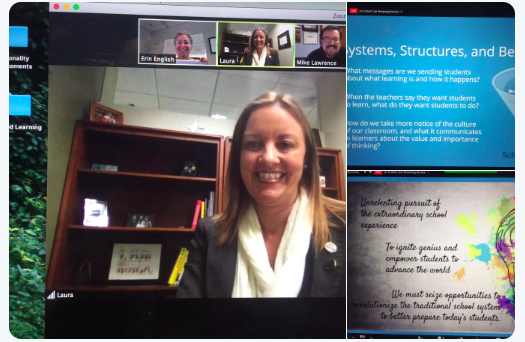
    Today I was fortunate to present at the online #InnovateSD conference hosted by San Diego County Office of Education, thanks to an invitation extended to me by PowerSchool Senior Director of Educator Engagement Mike Lawrence.

    At around 1 hour and 18 minutes of this YouTube video is my presentation.

    Screen Shot 2018-11-02 at 11.46.11
    Sorry – it won’t allow embedding

    I’ve asked about the story of learning to over 300 educators over the past year, and regardless of age, background, or socioeconomic status, the answers were largely the same. The story of learning has been one largely comprised of compliance. Even those who shared about projects and experiential learning still shared a common message that you must do what you are told if you are to be labeled successful.

    Many of our practices and our beliefs are so ingrained that they are institutionalized. After all, most educators have been in the school system since the age of four or five. It’s all many of us have ever known so it’s not a surprise that we don’t notice the messages we send through our systems, structures, and beliefs, or why we send them.

    This video is about how Del Mar Union is pushing back on those systems, structures, and beliefs. It’s about the importance of providing students with the foundations and the experiences needed to think and to know their voice matters. It may be the story of Del Mar, but I am hopeful that it becomes the story of learning for all of us.