Tag: relationships

  • Life Over Work

    Life Over Work

    In today’s fast-paced world, it’s easy to fall into the trap of equating our worth with our workload. However, we must remember that life isn’t about finding a balance; it’s about prioritizing what truly matters—our well-being and happiness.

    Days off are not just a luxury; they’re essential for recharging our minds and spirits. By fully embracing these moments away from work, we nourish our creativity, strengthen our relationships, and cultivate joy in our lives.

    As I tell my team, enjoy your days off to explore, relax, and connect with what brings you joy. After all, it’s the experiences outside of work that enrich our lives and inspire us when we return.

  • Let Them Speak

    Let Them Speak

    I attended a student panel on eSports. Six high schoolers had given up their time to come talk to educators about gaming and eSports leagues.

    Within five minutes, the questions had shifted away from students and were directed at the adults. Questions like:

    What about the violence? What about the hardware needs? What protocols need to be established?

    * Sigh *

    It’s fascinating how I read daily on Twitter about the importance of relationships over everything else, and yet these students were so quickly set aside in favor of adult needs. They were there to share their passion, and pretty much got a “yea, but” in response.

    I raised my hand to comment.

    “There’s a lot of adult talk happening right now, so I want to bring this back to the students. Why game? What compels you to that world?” A few of the people in the room turned and smiled at me, as if to say, “I see what you did there.”

    Student responses were powerful. One shared about a rough upbringing, in which money was tight and life wasn’t kind. “Games,” he said, “comforted me when life could not.” A couple others talked about meaningful friendships being developed, and the time they spend enjoying each other’s company.

    When finished, the next person called upon started his question with, “I have one for the students but also one for the adults…”

    And so it went.

    People…

    We can’t just talk about student voice, and empowerment, and relationships mattering if we don’t mean it. That panel of students deserve to be heard. They deserve respect. They deserve awe and maybe even a bow for being willing to talk to their fiercest critics, adults, about their passions.

    Don’t silence them with your adulting.
  • Relationships. Culture. Twitter. OY!

    Relationships. Culture. Twitter. OY!

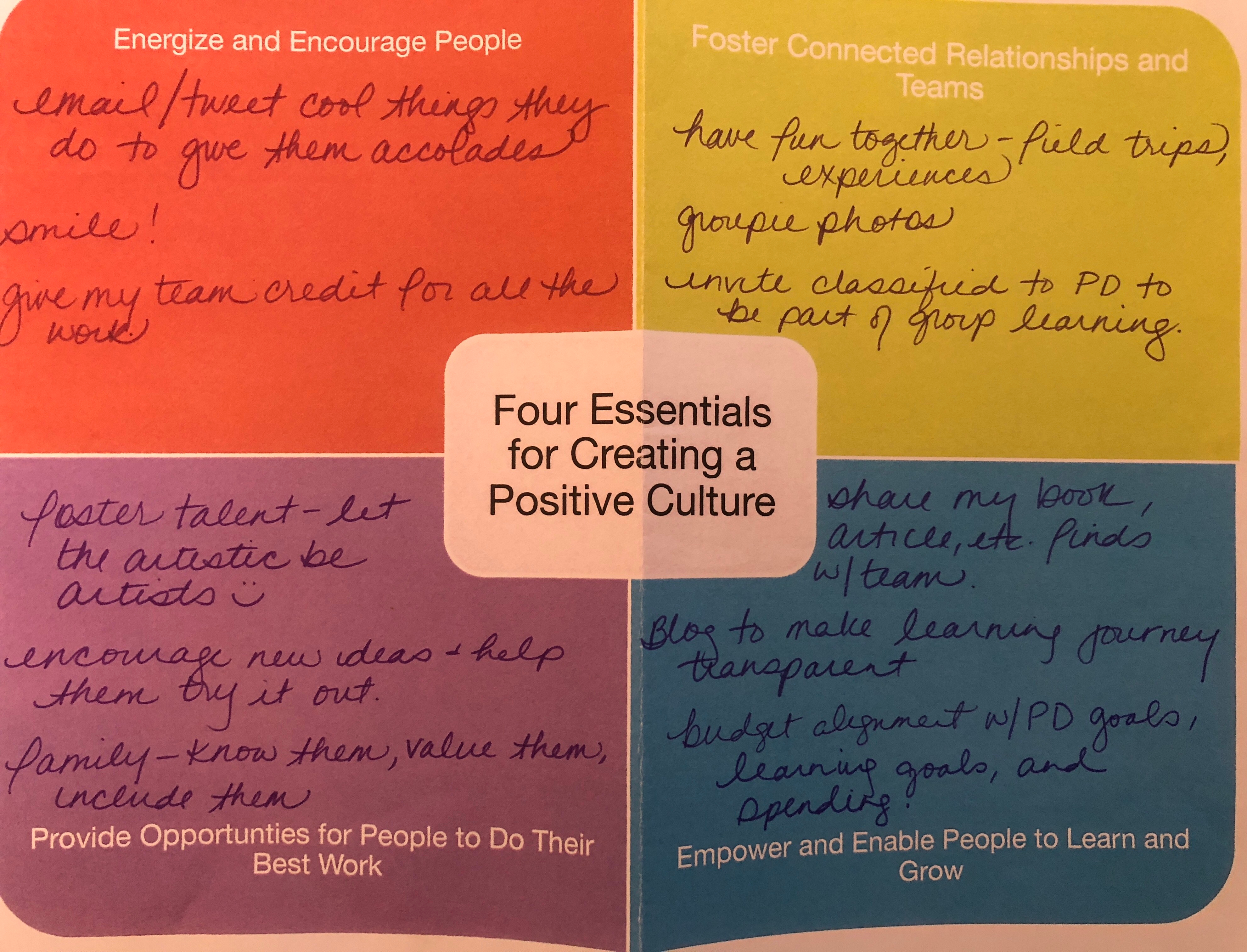
    I was at a Women in Educational Leadership the other day, and one of the sessions presented by a local superintendent was on culture. She shared four essentials for creating a positive culture. They are:

    • Energize and Encourage People
    • Foster Connected Relationships and Teams
    • Provide Opportunities for People to Do Their Best Work
    • Empower and Enable People to Learn and Grow

    After she shared the categories, she had us walk around the room and get ideas from others as to ways in which to provide those essentials. That time to talk about our ideas, elaborate on them and create new ones together created our own positive culture. In those few moments with each other we were truly listening, engaging with each other and building a sense of connection.

    It’s what’s missing on Twitter. Lately, Twitter seems to be filled with dime store platitudes lacking any depth. If I could get a dime for every time someone says relationships are the key… the key to student engagement, the key to school culture, the key to learning gaps… without explaining just how to develop those relationships, I could pay off my student loans!

    So I’m sharing my notes from our walkabout and challenging everyone to add an item. Let’s not just talk relationships and culture. Let’s talk about the work we are/should/can do to create positive cultures that truly promote relationships.

    Four Essentials for Creating a Positive Culture

    Notes from my walkabout. Template provided by Supt Candace Singh


  • Has It Only Been a Year?

    To culminate the school year, my Innovation and Design team published a blog post reflecting on all that we accomplished, and more importantly, all that we LEARNED, this past school year.

    It’s crazy to think we’ve only been working together for one school year, and yet in that time, we co-planned with classroom teachers to create 65 design thinking units. There were other design thinking opportunities provided to students that we weren’t directly involved in, too.

    Below is an excerpt from that reflection. I share it here because I think the learnings are universal to many. You can view the original blog post as well, which also includes a fun infographic.

    *****

    When people think and act like a designer, they must be able to see not just what is, but what might be (Berger, Cad Monkeys). The design thinking opportunities teachers facilitated for students this year truly exposed students to what might be by helping students discover their inner genius, and then empowering students to use that genius to advance the world. We watched in awe as students demonstrated sincere empathy and felt a call to action within, and outside of, design thinking experiences. We felt joy when watching the faces of teachers as they saw their students demonstrate their passion for learning. And we enjoyed seeing those proud parents listen to their children present their prototype solutions at packed exhibitions!

    And we learned a lot, too! We learned…
    – how important it is to always start with why and to know the priorities. When people understand the why and have an opportunity to be a voice in building the how and what, there is a greater success in change efforts.
    – that every site and teacher, just like every student, has unique qualities requiring a customized approach to integrate design thinking experiences.
    – connecting with industry experts to not only dive deeper into the content standards and relevant application to careers today, but to provide high-quality feedback on student thinking, exponentially increases student learning. And that expeditionary partnerships with local organizations is truly a game changer that leads to extraordinary experiences for students!
    – a constant feedback loop is important from all stakeholders. Feedback, or better yet, feedforward, is an art form, and we are all working towards being master artists.
    – our beliefs and experiences inform our actions. It is critical to give people an opportunity to experience something new for themselves so that they are empowered to contribute to leading change initiatives.

    DMUSD Innovation & Design Team
    DMUSD Innovation & Design Team


  • The Punctuation in Your Classroom

    The Punctuation in Your Classroom

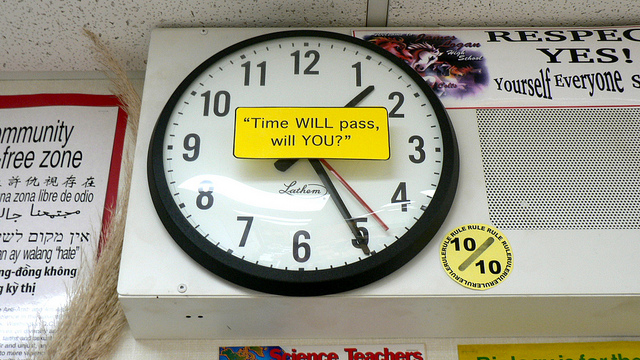
    Photo Source: Flickr, Eric E Castro 

    I learned the other day that ending a text message with a period can be interpreted as insincere. Such a simple, innocuous dot now carries more hidden messages than it was ever intended to convey. Likewise, the messages we think we’re sending in our classrooms may not be the messages received by students. Consider these… Time WILL pass, will YOU? Does this imply a nurturing, supportive environment that believes ALL students deserve every opportunity to be successful? I’m not so sure.

    Students not paying attention in class? Lock up devices. Does this show trust? Relationship building? I wonder if the teacher’s device is locked up during meetings as well. Or how about this sign I saw in a classroom:  “Work hard in silence. Let success be your noise.” A companion sign read, “The way to get started is to quit talking and begin doing.” Does this mean we don’t value collaboration? Team work? I wonder how Edison and Einstein would have fared had they been forced to work in silence. When I attended Project Zero at Harvard University, I went through an exercise called Parts – Purposes – Complexities.  

    The simplified steps are: Choose an object or system and ask:

    • What are its parts? What are its various pieces or components?
    • What are its purposes? What are the purposes for each of these parts?
    • What are its complexities? How is it complicated in its parts and purposes, the relationship between the two, or in other ways?

    This helps us (and students) slow down and make careful, detailed observations. This is done by looking beyond the obvious features of an object or system to stimulate curiosity and raise questions. When we did this at Project Zero, we were asked to list EVERY SINGLE ITEM in our classroom, and then to question its purpose and its complexity. So many a-ha moments happened from this activity as people really started to question each and every object, and why it was there. They began to see the messages, the periods at the end of the sentences.

    So as you look around your classroom, ask yourself, what messages are you sending? What punctuation is on those messages?