 |
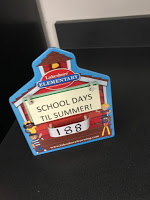
| Photo Source: Flickr, Eric E Castro |
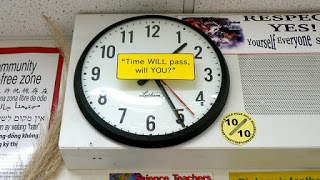
I learned the other day that ending a text message with a period can be interpreted as insincere. Such a simple, innocuous dot now carries more hidden messages than it was ever intended to convey. Likewise, the messages we think we’re sending in our classrooms may not be the messages received by students. Consider these… Time WILL pass, will YOU? Does this imply a nurturing, supportive environment that believes ALL students deserve every opportunity to be successful? I’m not so sure.

Students not paying attention in class? Lock up devices. Does this show trust? Relationship building? I wonder if the teacher’s device is locked up during meetings as well. Or how about this sign I saw in a classroom: “Work hard in silence. Let success be your noise.” A companion sign read, “The way to get started is to quit talking and begin doing.” Does this mean we don’t value collaboration? Team work? I wonder how Edison and Einstein would have fared had they been forced to work in silence. When I attended Project Zero at Harvard University, I went through an exercise called Parts – Purposes – Complexities.
The simplified steps are: Choose an object or system and ask:
- What are its parts? What are its various pieces or components?
- What are its purposes? What are the purposes for each of these parts?
- What are its complexities? How is it complicated in its parts and purposes, the relationship between the two, or in other ways?
This helps us (and students) slow down and make careful, detailed observations. This is done by looking beyond the obvious features of an object or system to stimulate curiosity and raise questions. When we did this at Project Zero, we were asked to list EVERY SINGLE ITEM in our classroom, and then to question its purpose and its complexity. So many a-ha moments happened from this activity as people really started to question each and every object, and why it was there. They began to see the messages, the periods at the end of the sentences.
So as you look around your classroom, ask yourself, what messages are you sending? What punctuation is on those messages?