Tag: laura spencer

  • Let Them Speak

    Let Them Speak

    I attended a student panel on eSports. Six high schoolers had given up their time to come talk to educators about gaming and eSports leagues.

    Within five minutes, the questions had shifted away from students and were directed at the adults. Questions like:

    What about the violence? What about the hardware needs? What protocols need to be established?

    * Sigh *

    It’s fascinating how I read daily on Twitter about the importance of relationships over everything else, and yet these students were so quickly set aside in favor of adult needs. They were there to share their passion, and pretty much got a “yea, but” in response.

    I raised my hand to comment.

    “There’s a lot of adult talk happening right now, so I want to bring this back to the students. Why game? What compels you to that world?” A few of the people in the room turned and smiled at me, as if to say, “I see what you did there.”

    Student responses were powerful. One shared about a rough upbringing, in which money was tight and life wasn’t kind. “Games,” he said, “comforted me when life could not.” A couple others talked about meaningful friendships being developed, and the time they spend enjoying each other’s company.

    When finished, the next person called upon started his question with, “I have one for the students but also one for the adults…”

    And so it went.

    People…

    We can’t just talk about student voice, and empowerment, and relationships mattering if we don’t mean it. That panel of students deserve to be heard. They deserve respect. They deserve awe and maybe even a bow for being willing to talk to their fiercest critics, adults, about their passions.

    Don’t silence them with your adulting.

  • Don’t Wait for the Postmortem to See if You’re Sick

    Don’t Wait for the Postmortem to See if You’re Sick

    “Educators have long complained that end-of-year, “summative” assessments are not useful because the results are not available until fall when their students have moved on to the next grade.”

    (Is this the end of end-of-year testing? Education Dive)

    Okay… I’m not a high stakes (I mean “end-of-year”) testing fan either, but …

    Summative assessments are like a postmortem. It gives you feedback after the fact. And although it can be disaggregated by student, the data isn’t really about each child. It’s about the system. Did the system educate this group, and these sub-groups, of students to the predetermined appropriate level dictated by some guy in a suit in an office building somewhere? If not, then the system needs to evaluate its methods and make adjustments. If it did, then other systems ask for the silver bullet solution to apply to their own system.

    It was never set up to be anything different or better than that. It’s not about Martin. It’s about 356 Martins in grade 6, 70 of which are “low-socioeconomic” Martins, 95 of which are “two or more races” Martins, and 64 of which are “English Learner” Martins.

    If you’re waiting for a postmortem to decide if you need to cut back on the greasy foods, you’re doing it wrong.

    Get Your Check-Ups

    If you want useful data to make instructional adjustments, you have to go to the doc for routine check-ups, aka formative assessments. You need blood work, your heart listened to, and maybe a good ol’ knock on the knees to check those reflexes!

    Relying on state accountability test data to make modifications is too late – you’re already in the morgue.

    In successful learning environments, whether they be a formal classroom or a behind-the-wheel driving lesson, learning is assessed multiple times a day, and adjustments made as needed by the teacher. Madeline Hunter included Checking for Understanding, Guided Practice, and Individual Practice as critical elements of good teaching because they inform the teacher as to appropriate next steps. Formative assessment is not about a multiple choice test given on Tuesdays, but rather an ongoing practice to determine if the instruction is having its intended outcome.

    (Hey, doctors say they “practice” medicine… coincidence?)

    State tests will never replace this teacher function. Nor should they try.

    Now, if only we could reduce the testing window and give teachers more TIME to analyze and discuss their formative and summative assessment data with peers throughout the year.

    Now THAT would make a difference!

  • Boxes Aren’t For Thinking

    Boxes Aren’t For Thinking

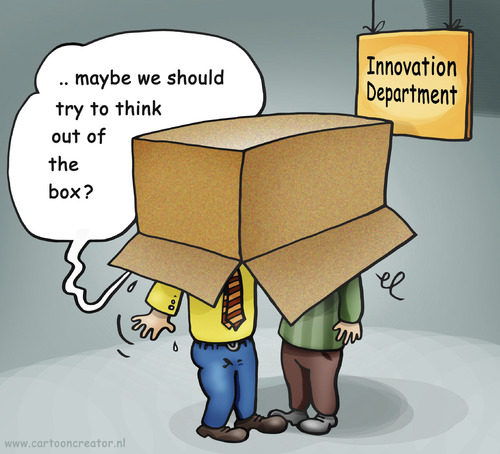
    How do you innovate from inside the box?

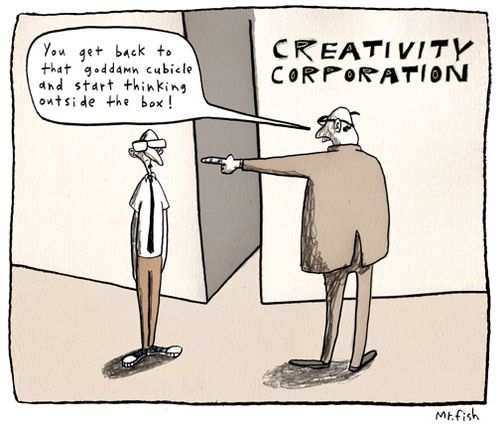
    “Think outside the box” is probably one of the most overused statements. No matter what the situation, or problem, inevitably someone will say, “We need to think outside the box.”

    The problem with thinking outside the box is that leadership often wants to create a box to contain the thinking outside the box. In other words, think outside the box, but only insofar as the thinking stays within the organization’s predetermined box.

    Today I had a meeting scheduled with a director at the San Diego Zoo to discuss an upcoming zoo-sponsored hackathon, and potential connections with K-12 education. In lieu of the traditional phone call introduction and conversation, we decided to meet at the zoo. And since it was a beautiful day, our meeting was a walk and talk around the zoo instead of inside the administration building.

    Without the confines of the box, we found our conversation expanding beyond the original topic of discussion. Discussions of elephant emotions and giraffe spot patterns sparked conversations about augmented reality and wildlife conservation. We were able to dream big about ways to build student advocacy in to zoo fieldtrips while talking UX design and hackathons.

    I walked away from the meeting with ideas and energy to pursue those ideas.

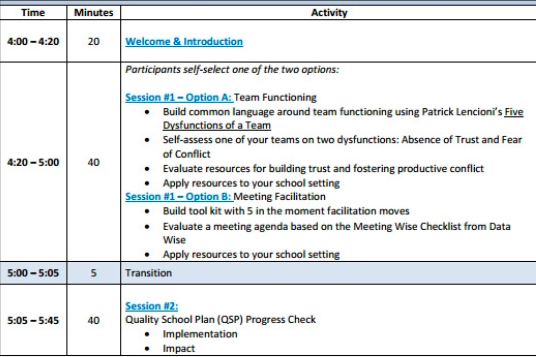
    This freedom of time and space to connect with others, to engage in meaningful dialogue, and to reflect on possibilities is not often provided for educators. The box confines, and the box dictates, what should be thought about and when. Look at any PLC or meeting agenda and you’ll probably see something like this:

    We want teachers to be innovative. We want schools to be transformative. But we don’t provide opportunities for that because we control the interactions. Topics are outlined, times are allotted, and thinking stays inside the box.

    It used to be that teachers could go to conferences as a way to think outside the box (although in reality, they were just thinking inside a different box… but it was still outside their own box, so that was cool).

    But now I’m seeing more and more districts and schools self-hosting their own professional development “mini-conferences” which are, effectively, keeping people in the box.

    One of my favorite design thinking exercises is a premortem experience, in which you write about what could go wrong with a proposed solution.

    Looking from a premortem lens, ask yourself, what would happen if we took the box away? What’s the worst that could happen if we asked teachers to go for a walk in the park with a colleague and talk? Or to visit a local business (or zoo) and walk and talk with someone there? If we removed the box, even for an hour, what might come of it?

    Honestly, I can’t picture the world ending. But what I can picture are people being exposed to new ideas and information, and considering the implications for their teaching and learning.

    If we want classroom learning to be relevant, and we want teachers to provide real-world connections, it can’t be done inside the box.

    We need to build opportunities for educators to think freely, to wander open spaces, to connect with people they don’t get to connect with, and to think without agendized topics and time constraints, so that we can truly start to think outside the box about education.

  • How May I Be of Service

    How May I Be of Service

    As some of you know, I took a career break this summer. My first break from working since I was 14 1/2 years old. It was both terrifying and exhilarating. One of the by-products of that break was being able to connect with people I previously felt too busy to connect with, and provide them with any expertise, crazy ideas, or just goofiness they desired.

    I spent time in classrooms co-teaching or observing lessons with teacher friends, as well as dispensing tech support and professional trainings for clerical (aka classified in edu world) staff. I also volunteered as a Designer-in-Residence at UCSD, and have been enjoying stretching my brain in the world of academia. In fact, yesterday I sat in a room full of computer science students and listened to Professor Ravi Chugh talk about “Bi-Directional Programming with Direct Manipulation.” I may even be able to fool you into thinking I understood the talk if I throw out acronyms like PL and GUI and terms like output-directed programming 😛.

    The Curse of Averageness, or is it?

    This opportunity to expand and immerse reinforced a concept I read recently in Mark Manson’s book, The Subtle Art of Not Giving a #@%!: A Counterintuitive Approach to Living a Good Life. Mark writes:

    Most of us are pretty average at most things we do. Even if you’re exceptional at one thing, chances are you’re average or below average at most other things.

    Mark Manson

    Assuming that’s true, then it would make sense to seek out those who may be exceptional in an area in which we are average (or below, gasp!) and improve our own skillset. But the fact of the matter is, we don’t. Instead, we internally judge ourselves for not being up to par because society (aka the media) focuses on the exceptional only, not the average. The best of the best… and the worst of the worst. It sells. Can’t deny it.

    It’s crazy. We all have something to offer. Sure, we may not be extraordinary, but we have something dang nabbit! I may never be able to create a PL to GUI bi-directional platform for programmers, but I can certainly help streamline your Gmail madness, or recover a lost password for your (okay my) grandpa’s bank account. And I can certainly ramble on and on about the talks I have listened to, or books I read, in an attempt to provide a nugget of inspiration for someone else. It’s not extraordinary, but it’s me. It’s what I have to offer.

    So How May I Be Of Service to You?

    So here it is… I started two new ventures to share my averageness with the world, and I hope it brings you some extraordinary value.

    YouTube – I have no desire to be a YouTube star, as you’ll see by the low-fidelity quality of my videos. But I am starting to post some tech tips on there. These are tips that illicited “oohs” and “ahhs” when I shared them at a recent professional development. Short, relevant, and (hopefully) applicable.

    Podcast – Again, no desire to be a podcast star, but sometimes I have ideas, and I share them with people and then I think, that’s too much energy to try to write in my blog. And then, poof, it’s gone. So after chatting with Paula last night about hackathons and entrepreneurs, I grabbed my phone and recorded my thoughts. And so here’s the first episode. I don’t know how often I’ll post these, but I will. And who knows – maybe you’ll be in the next one. Again, super low fidelity. In fact, episode 1 was recorded in my car sitting in traffic (hands-free of course).

    I hope that these ventures in sharing encourage others to share their little bit of above average with others. After all, it’s the community that helps us grow.

    And since you’re here, and reading this, do me a favor…leave a comment. Let me know what you’re thinking… what’s your above-averageness that you can share with others? What do you wish I would share with you?

    And then, subscribe. Subscribe to this blog, or the YouTube, or the podcast, or all of it. Because those subscriptions show love, and value, and make me feel like maybe being average is a pretty cool feeling to have.

  • Teens Doing Whatever It Takes to Draw Attention to Human Trafficking

    Teens Doing Whatever It Takes to Draw Attention to Human Trafficking

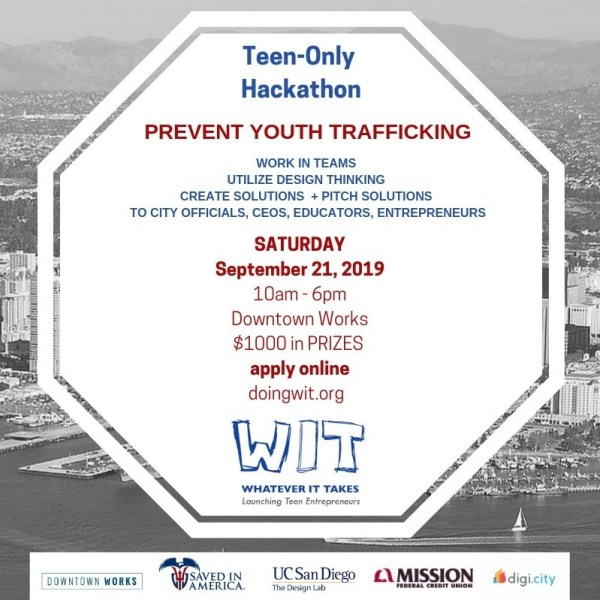
    Yesterday I watched as teens came together to use their design thinking and entrepreneurial skills to tackle the subject of human trafficking, which is prevalent in San Diego. They came up with innovative ideas to increase awareness and inspire action.

    The day kicked off with a motivational talk by WIT Founder, Sarah Hernholm. She stressed to them how important their voice is to solving big issues in our society. “You’re so much more than your school, your GPA, your AP course load… what matters are your ideas.”

    Sarah and Don sharing with teens about the issue of human trafficking.

    To provide more context as to how important the issue of human trafficking is to San Diego teens, Don from Saved in America shared with the group how 3,000 teens from San Diego alone were lost within the past year. He shared signs of distress to look for in friends who may be involved in unhealthy relationships, as well. When asked why teens don’t know more about this epidemic, Don responded that it’s a hard conversation for adults to start with teens. One of the teen participants responded, “Just because it’s a hard conversation doesn’t mean we shouldn’t have it.” Another added on, “Teens have to be at the table for issues impacting teens.”

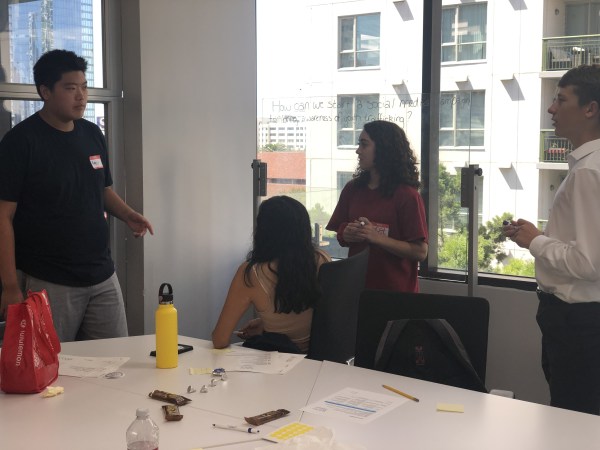
    Brainstorming ways to encourage teens to avoid unhealthy relationships.

    And at the table they were!

    Don’s talk lit a fire in the teens. Split into smaller groups, they brainstormed solutions to:
    – Ensure teens know the Human Trafficking Hotline Phone Number
    – Provide education to teens on healthy vs unhealthy relationships
    – Encourage parents to engage in conversations about human trafficking with their teen
    – Use social media to increase awareness of human trafficking amongst teens

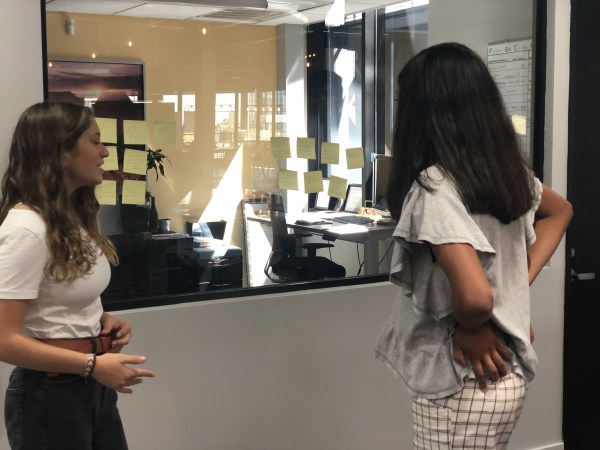
    Sorting ideas on how to encourage parents to engage in conversations with their teens about human trafficking and unhealthy relationships.

    Design Thinking the Challenge Presented

    Empathizing. Defining. Ideating. Prototyping. Testing and Refining. Teens spent six hours developing their proposed solution to one of the problems. Unlike past WIT Hackathons, this year the teens did not have an adult coach assigned to them. Instead they were trusted to use the design thinking process on their own, seek out feedback or assistance when needed, and most importantly, have their voices heard.

    Students had not met prior to the day, but by the end, they were family.

    A Bias Towards Action

    It was an honor to coach them, and a thrill to listen to their pitches. Two groups tapped in to the power of Instagram to get their message out to peers. One group connected with local and national businesses to ask that the hotline be printed on their product packaging. We had a group developing curriculum for middle and high school teachers, and another group developing signage for public transportation stops and gas stations.

    Hotline Heroes is partnering with local and national companies to add the hotline to product packaging.

    Each proposal was unique, and their pitches were on point. Just like Shark Tank, students tackled all the key components of a pitch: Why, How, What, Target Market, Competition, Unique Selling Proposition, and Financials. They were scored on how well they met the challenge; their ability to address all the components; their presentation skills; the feasibility of their solution; and their adherence to the time allocation.

    This video uses a snack analogy to discuss healthy vs unhealthy relationships

    Change Agents

    Although three groups won a monetary award, the reality is that all of the teens were winners. They came together, used empathy to tackle a tough issue, and spread the word about an issue that affects their lives. These kids are world changers!

    If you haven’t heard of WIT, check it out. Hackathons and college credit courses are available for all San Diego County high school students. It’s also available in Austin, TX and New York City. And hey, if it’s not in your town (yet), reach out to Sarah and make it happen!

  • A Tribute to My Bestie

    On July 31st, I lost my best friend. She died, unexpectedly, of a blood clot after battling breast cancer and undergoing reconstructive surgery.

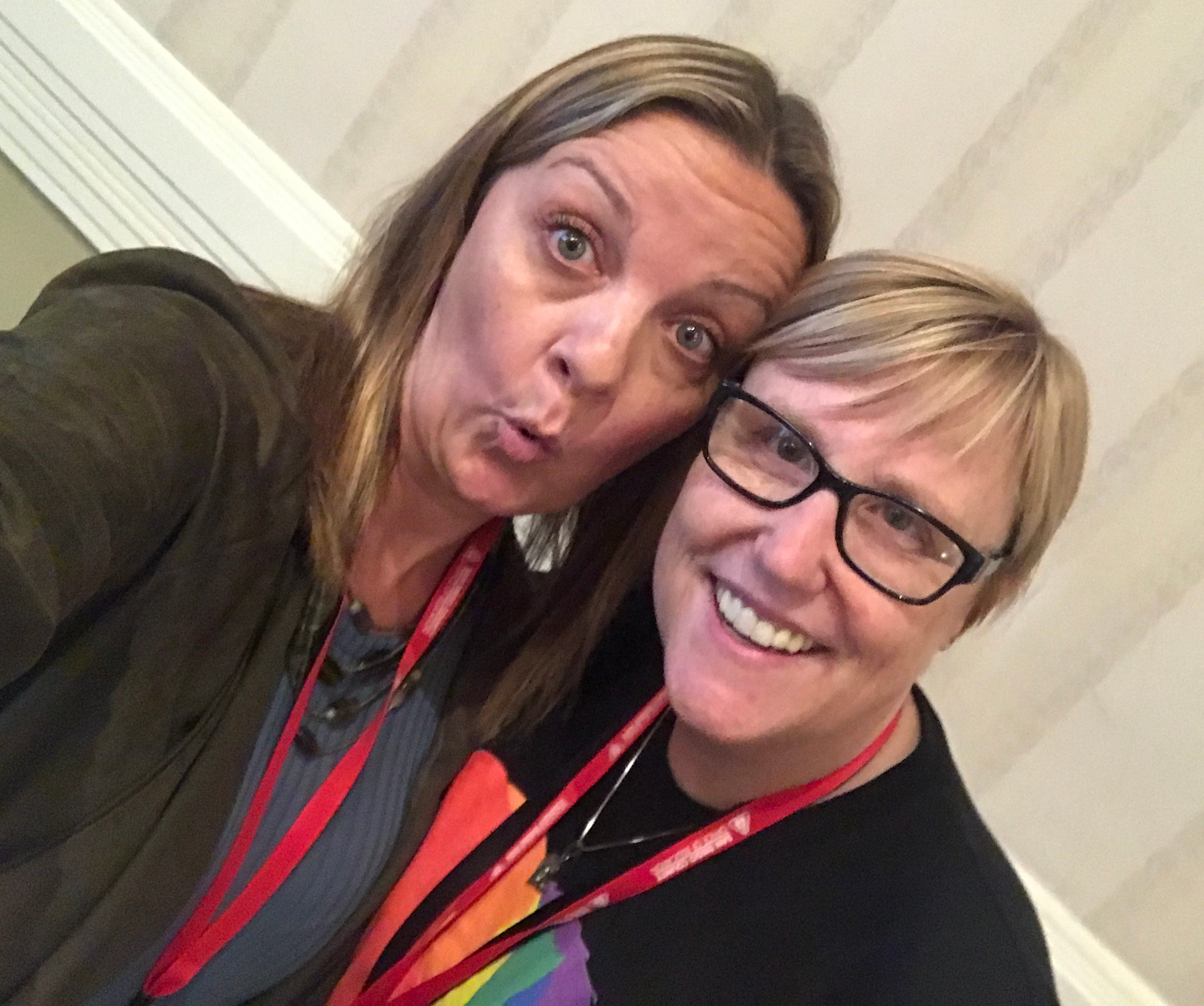
    Laura and Christine smiling for the camera
    Christine and me at the SDCOE Equity Symposium

    Christine’s been my best friend since I moved to San Diego in 2000. Before her, friendships for me were fleeting. They came, they went, and that was life. But Christine… she was a different story.

    I could fill this blog with stories about our friendship. Stories about us learning hip hop dancing – okay, failing to learn hip hop dancing. Although we could do the sprinkler and the lawn mower better than anyone… just ask our 8th grade students!

    Or about the time we hauled the new kayak into the middle of her cul-de-sac and pretended to row the open ocean, all the time yelling, “Are we there yet?” for a yearbook video. 

    There are stories from our 14 hour bus trip to Reno that we thought was going to be on a train.

    And stories about our attempt to start our own greeting card company.

    Like I said, so many stories! 

    A couple years into our friendship, we were talking about growing old and Christine mentioned all the trouble we’d get into at the nursing home. I remember saying to her, “I won’t know you when I’m 80.” I’ll never forget the look on her face. In total seriousness, she said to me, “That’s the meanest thing you could ever say to me. Of course we’ll know each other. We’re besties.” 

    That day, she changed my perspective on not only friendship, but on life.

    A few years later, we sat beside her mom Jean’s bed as her mom’s fight with cancer was coming to an end … we had been chatting light-heartedly while Jean slept when Christine’s brother Eric noticed that Jean had quietly passed away. I remember us talking about how she was able to finally let go because she knew we were all going to be okay. 

    Even though Christine may not be around when I’m 80 to perform all those old folk home antics, I have to believe that, like Jean, Christine knew everyone she loved was going to be okay because she made everyone better by knowing her.

    They say the body is 70% water, but for Christine Fax-Huckaby, it was all heart. She was a passionate educator; a passionate animal advocate; a passionate fighter for equity; and a passionate wife, friend, and colleague. For 23 years, Christine touched the lives of students and staff as a public school teacher and mentor in both Lemon Grove and Sweetwater.

    Christine was always a cheerleader for me.

    She believed in the ability of each student to achieve his/her inner greatness, and never let them settle for less. She had just as much love for animals. Whether they were hers or not, Christine loved every fur baby she ever saw. She was constantly rescuing dogs and cats, finding them their fur-ever home. Although truth be told, a lot of times that home ended up being her own!

    I’m sad without her in my physical life. Sad without her laughter, her jokes, and her unconditional love.

    Winnie the Pooh said it best: If ever there is a tomorrow when we’re not together there is something you must always remember… You are braver than you believe. Stronger than you seem and smarter than you think. But the most important thing is even if we are apart I’ll always be with you.