Tag: Inclusion

  • Designing Belonging: What a Pizza Box Taught Me About Connection

    Designing Belonging: What a Pizza Box Taught Me About Connection

    I’ve written before about the time I ordered a pizza to reconnect my ex-husband to the outside world. No car. No phone. No internet. A disconnection, both literal and emotional. We used Domino’s delivery notes as our 21st-century carrier pigeon. It worked, but only because someone made the effort to reach out, to bridge the gap, to make belonging possible when the system failed.

    I was thinking about that moment when I read Design for Belonging by Susie Wise.

    “The work of belonging is to counteract [othering]. It is to open up spaces and places so that all people regardless of their backgrounds can join in and contribute.”

    I can’t stop thinking about how often we overlook the micro-moments where belonging breaks, and how many more we ignore where it could be rebuilt.

    That pizza box moment was belonging by design, even if I didn’t have a name for it then. It was messy. Unconventional. A little ridiculous. But it worked.

    And maybe that’s the real design challenge: how do we notice when belonging is fractured? And more importantly, what do we do next?

    When Wise talks about the “design levers” of rituals, roles, spaces, systems, it isn’t just a nice framework for planners and strategists. It’s a lifeline for educators, leaders, and humans trying to hold fragmented communities together. Especially when those communities are separated by distance, devices, and distraction.

    I’ve seen this in classrooms. In Zoom faculty meetings. In Twitter (“X”) threads that start with good intentions and devolve into ego matches. And I’ve felt it in the silence after someone says something unintentionally harmful, followed by… nothing.

    That’s where the work is.

    We talk a lot about invitation. How do we invite students into learning? Colleagues into collaboration? Families into school systems that weren’t built with them in mind?

    But Wise pushes us further. She explains that invitation isn’t just about showing up. It’s about showing up in a space that sees you. Hears you. Values your perspective.

    That only happens with intention.

    I think about how many times I’ve created systems that worked “in theory” but didn’t feel like belonging in practice. The school-wide email that no one read. The virtual office hours that no one joined. The peer feedback protocol that favored the loudest voices. None of those were belonging, even if they were well-designed.

    Because belonging isn’t the form. It’s the feeling.

    Wise also talks about dissent and repair—two words we don’t sit with enough in schools.

    We love our norms and expectations and “we’re all in this together” mantras. But what happens when someone pushes back? When they say, “This space doesn’t feel safe for me,” or “That comment hurt”?

    Too often, we go straight to defense. Or worse—silence.

    But real belonging means we stay. We sit in the discomfort. We acknowledge the impact even if it wasn’t our intent. We ask what repair could look like—and then we act.

    Sometimes that action is a redesign.
    Sometimes it’s an apology.
    Sometimes it’s a damn pizza box with a handwritten message to reboot the phone so messages arrive. haha

    I don’t have a neat ending here. Belonging is squiggly like that. It’s a process, not a product. But what I’m learning from Susie Wise, and remembering from my own messy, human moments, is this:

    We can design for belonging in every space we touch.
    Even the ones that feel too big, too broken, too remote.
    Even the ones held together by pizza and Post-it notes.
    Especially those.

  • Connectors Connect: Day 2 at #SXSWEDU

    Connectors Connect: Day 2 at #SXSWEDU

    Next time I decide to stay up and blog at 1am, I hope I remember how tired I am today and force myself to go to sleep! Seriously… what was I thinking?!?

    Today’s SXSWEDU experience was truly about connections. Yes, I attended some sessions, but a lot of the thought-provoking ideas came from conversations. Here’s my attempt to recap it for my readers (and for me!)

    This morning’s breakfast learning was centered on personalized learning. Elliot Washor from Big Picture Schools talked a lot about how we need a broader understanding of what smart is. Students should be given credit for how they’re learning outside of school. Unfortunately, our current system has biases around what smart is, and how students should learn and understand. If students don’t fit that mold, they are not deemed successful.

    Which is ironic, because school is probably the least likely place for learning to occur. It’s rigid…controlled. Time is predetermined. When to learn, what to learn, when to eat, where to sit, how to write, what to write, etc. It’s hard, virtually impossible, to have agency in that situation. And yet we expect these students to enter the work/college realm ready to make important decisions on their own.

    Testing is individual, but learning is communal. Think about that – Edward Clapp from Harvard discusses the false narrative of the lone creative genius, when we know that every genius got there through connections and conversations with others. Yet we test the individual, and not just test, but test on random knowledge that we have arbitrarily assigned to a grade level.

    Schools still promote a falsely constructed concept that learning is linear, which creates a huge inequitability situation (yes, I may have made up that word…) Students don’t need literacy/numeracy to have complex thoughts. They also don’t need it to develop and/or contribute to creative processes. So why do we take away the exploration courses from students who are in remedial classes…double math instead of robotics or engineering? We need to flip it around. Give those students access!!! Joe, Design 39 Principal, sums it up well. “Our school structures are human-made… if they get in the way, change it. That’s our role.”

    And all that thinking was before 10am! This is why I enjoy SXSWEDU.


    It was the perfect segue into the next session attended, which was The Gift of an Inclusive MakerSpace. Sam Patterson (@SamPatue) opened by reminding the audience that MakerSpace work is about teaching collaboration. It’s not about the circuits. Patrick Benfield elaborates. “If all you have is a hammer, then all the kids end up looking like nails.” Equity and personalization in education means we have to realize that we aren’t just a hammer and the students aren’t just nails. MakerSpaces are a great place to do that because it fosters the collective creative genius.


    Bridging Divides Through Verbatim Performance, a 30 minute presentation by NYU Professor Joe Salvatore (@profjoesal).

    Verbatim Performance is an arts-based investigation grounded in objective observation and precision. It’s not satire, but is a group of ethnodramatists/ ethnoactors who specialize in the techniques and ethics of the form. The performers are charged with ability to have empathy for the person/role they perform in order to truthfully render the performance.

    Why do they do all this, you ask? Because, as actress Anna Deavere Smith explains, “If you say a word often enough, it becomes you.” Verbatim performance disrupts preconceived notions and biases. These actors aren’t just recreating a moment in time. The gender or race roles are switched to force people to look at the moment through a different lens. Through these experiences, the audience is asked to consider what happens to perception and understanding of various moments when the gender of the speakers is flipped.

    There are a few applications of verbatim performance.

    Media literacy
    – Objective/subjective observation
    – Rhetorical devices
    – Point of view

    Building empathy
    – breathing as another person

    Analyzing & Strategizing
    – Embodied analysis
    – Seeing ourselves (much stronger/deeper than watching video)
    – ‘Knowing” the opponent

    Disrupting consumption
    – “Chewing our food” (consuming media – not chewing makes us sick, puke, choke…)

    So what is the role of verbatim performance in my world? I’m excited to explore how to use a simplified version as a way for students to explore empathy for each other, for characters in a book, for adults in society… Can this approach help with social-emotional learning?


    But in all honesty, like I said in the intro, the power of today’s learning was in the conversations.

    Breakfast conversations with Brooke (@TobiaBrooke) and Marisa (@MarisaEThompson) may have inspired Brooke to rethink the concept of learning in her classroom, but it also rekindled an idea to form a community of learners with our neighboring school districts, in which they teach.

    Spending time with the MakerSpace panel after the session to discuss the deconstruction of making and how to inspire students to understand how systems work gave me ideas for new student experiences.

    Talking to Professor Salvatore after his session connected me with an educator who is modifying his work for 3rd graders, and opened my mind to ideas for teachers who are working on a Humans of New York storytelling project.

    Lunch with a Twitter friend I had not yet met was an amazing connection. Kami Thordarson (@kamithor) is doing amazing work on personalized learning through design and technology. Her design camp for teachers has my gears spinning like crazy! And I’m excited to explore collaboration models for professional learning concepts.

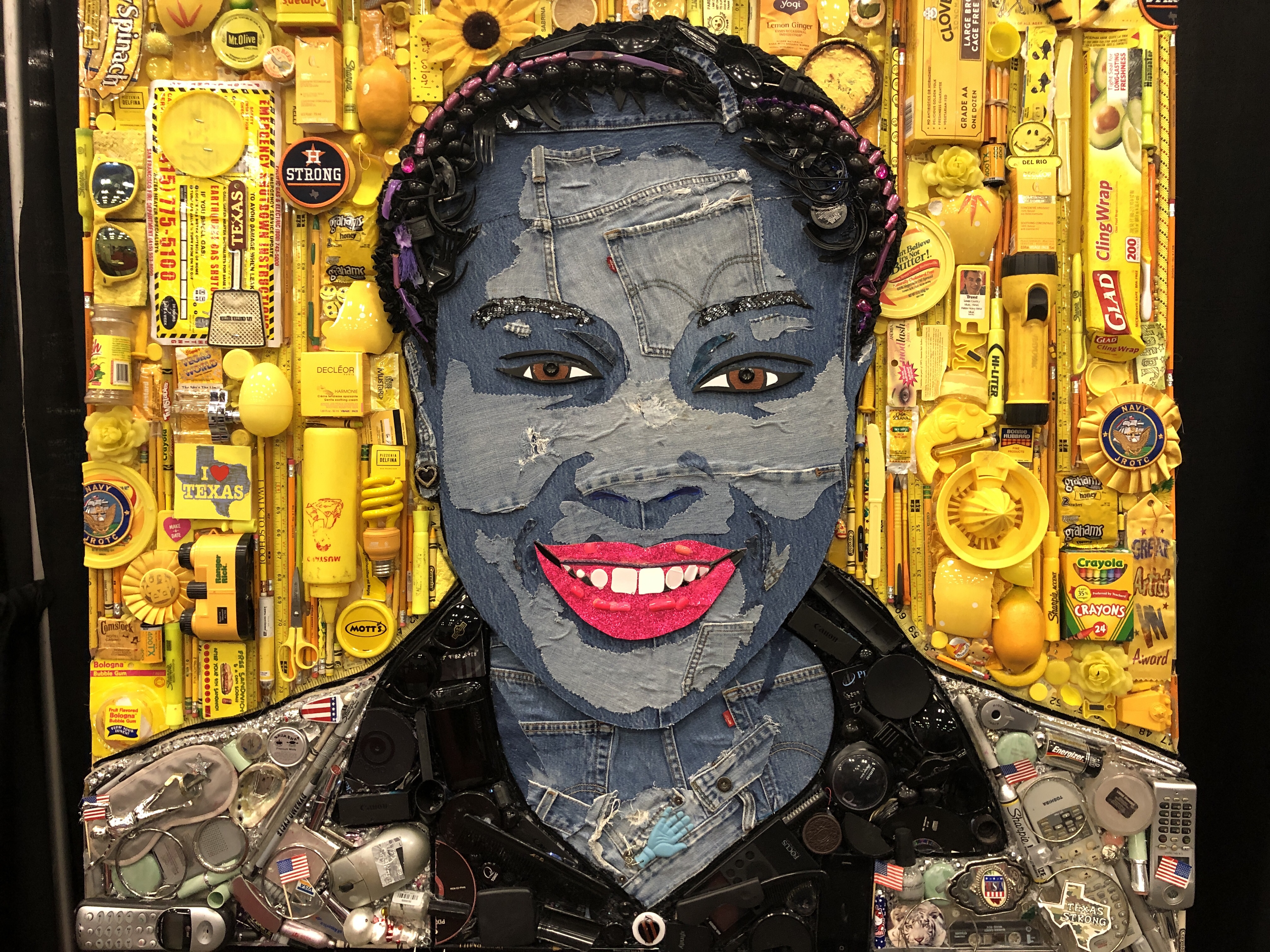
    Exhibition hall connections have me thinking about a variety of topics: different furniture configurations to create happy learning spaces; how to share our learning (#ShareYourLearning) on a larger scale; and how to tell the story of our learners through projects like What We Are Made Of, which is a mosaic portrait series created to uplift student voices and explore the multi-layered experiences of youth across America.

    A photo of a mosaic of an African-American woman surrounded by yellow objects that represent her background.
    What We Are Made Of is a mosaic portrait series created to uplift student voices and explore the multi-layered experiences of youth across America.