Tag: #dtk12chat

  • Amplifiers Create a New Story: Day 3 at #SXSWEDU

    Amplifiers Create a New Story: Day 3 at #SXSWEDU

    …I may ramble in this post. It’s 1am. I’m tired! Have a head cold. But wanted to share my learnings…

    🤪🤪

    Do I really have to go home tomorrow?

    It’s going to be hard to walk away from the synergy of woke educators at this conference, but I know that I have much work to do when I return to San Diego.

    Not the work of answering emails and finishing tasks (although there is plenty of that as well), but the work of amplifying the conversations and ideas that have taken place here the past few days so that words don’t just stay words, but instead become actions.


    David Hogg and Dan Rathers sitting in chairs talking
    David Hogg and Dan Rathers

    I started today hearing the voice of the new generation, David Hogg of March For Our Lives, rethink advocacy in this new era. He shared how he had never truly understood what empathy was until he saw his 14 year old sister collapse under the weight of finding out that four of her friends died in the Marjory Stoneman Douglas shooting. As.a teenage boy full of hormones, he didn’t know what to do with those emotions, but he knew he didn’t want shooting to be just another news story with no change/impact.

    Advocacy is born from passion, from desire, from need. So often in education we stifle that drive or relegate to an elective, after school, or GATE program. Education says it is preparing students for the world of work, but when a teenager can say that he never felt empathy until his senior year of high school, then what have we truly prepared them for? What kind of future doesn’t require empathy?

    When pressed as to what prepared Hogg, and others like him, to be advocates, he credited experience with speech and debate classes; theater, TV production, and journalism. The very nature of these programs built the skills needed for activism. Hogg learned that it is not his place to speak for others, because he has not shared their experiences. But he can certainly elevate their voices, spotlight them.

    When Hogg was asked what his advocacy work had accomplished, he paused before explaining, “We’ve accomplished a little in an area where nothing is expected so we’ve accomplished a lot.” This ability to see progress, to chart a path and stick with it, and to amplify voices through empathy… this is how schools should be preparing students not for the world of work, but for the world of life. The world they’re in now.


    There was also a panel of three female teenage entrepreneurs sharing their stories today, and although they weren’t activists like David Hogg, they had a voice that was being amplified through their start-up companies and non-profit organizations. But it wasn’t an easy journey to become a teen entrepreneur.

    Entrepreneurship is like a varsity sport, one of the women explained. “We’re working on it during ALL our spare time..thinking about it all the time. We need adult mentorship outside of the classroom to help us find our way.

    But instead, many received truancy letters for taking time out of school to pursue their passion. “Attending an economic summit in Boston shouldn’t result in punishment at school!” Reminds me of conversations yesterday as to what learning is valued, and how antiquated our current learning value system is. How ironic that students are penalized for being successful outside the school walls.

    Instead of punishing them, the young ladies asked for mentorship, for people to help them amplify their voice and their passions. People who would offer personal reciprocity by sharing their own struggles; helping alleviate self-doubt; and asking tough questions along the way. Sounds like they were asking for support with the soft skills, the skills that matter most.

    One of the women explained, problem solving is just as important as reading and math. As entrepreneurs, they are learning how to fail and grow early. They’re using their creativity to think outside the box to create positive change for society.

    And yet, these opportunities aren’t well integrated in elementary schools because the hard skills are pushed more than innovation. Only the gifted, the affluent, or the lucky get to participate. It doesn’t have to be this way. Some ideas shared were to run a pop up shop for a day as part of an entrepreneur project or to have students pick an inconvenience and design a solution.

    The advice given to one of the entrepreneurs is just as applicable to all the educators in the audience: You need to take the first step before you’re even ready to take it. A small step is better than no step.


    Amplifying voices should be happening all over our schools. “Libraries are like the quarterback [you never knew you had],” so why aren’t school and district leaders leveraging the power we have in our buildings? The library, in many schools, is the biggest classroom in the school. What if we reimagined the space as a systemic gateway to change?

    In the 30 minute Reinvention: Designing Future Ready Libraries session, Carolyn Foote articulated that students deserve access to inviting, accessible, collaborative, flexible, tech-rich and literacy centered libraries that support academic and enriching experiences. I’d add that those spaces also support student passions. They elevate the voice of the students by providing them with the resources needed to find and nurture that voice.


    #dtk12chat crew posing for a photo
    #DTK12Chat Live!

    Like every other day, today wasn’t just about the sessions. It was about the connections made between sessions. The best part of Wednesday at #SXSWEDU is actually the #dtk12chat that happens live from the Hilton lobby. There were so many inspiring stories shared about innovation, transformation, and creative change. More importantly, new friendships were forged, and old friends were embraced.

    Dan Rathers, in the panel conversation with David Hoggs, shared the line from a Barbra Streisand song, “Hearts can inspire other hearts with their fire.” Well, I certainly plan on bringing a fire back to San Diego!

  • My Community of Weavers: Day 1 at #SXSWEDU

    My Community of Weavers: Day 1 at #SXSWEDU

    David Brooks, Executive Director of the Aspen Project, kicked off SXSWEDU with a call to all educators to build a community of weavers, and not rippers. According to the program guide, Weave: The Social Fabric Project, operates with the premise that social fragmentation is the central problem of our time—isolation, alienation and division. Weave seeks to work with people that are rebuilding communities and creating social capital to spur a movement to repair the national fabric—to identify and celebrate these groups, synthesize the values that move them, and help forge a common identity.

    These are some key ideas that resonated with me during Brooks’ talk:

    When you’re down in the valley, you can either be broken, or broken open …

    Pain that is not transformed gets transmitted.

    The soul gives us moral responsibility. It yearns for social righteousness

    I’ve never seen a program turn around a life. I’ve only seen relationships turn around a life.

    The thing the heart desires more than anything is fusion with another.

    During the panel discussion after, I felt drawn to Darius Baxter, who at 25 years old, was already co-founder and Chief Engagement Officer of GOODProjects. Darius believes that leading with love, with the heart is critical to get out there and solve problems. He said that we need to see the story of justice in every aspect of life.

    Darius also discussed the need for Localism in education. He reminded us that we experience America differently based on where we live. Southern hospitality is different than New York City hustle and bustle. Urban, rural, and suburban lives are different as well. Schools need to recognize that and innovate for their own needs. Standardized approaches don’t work. Won’t ever work.


    After the keynote, I attended Fact vs Fiction: Why Media Literacy Matters. In this panel talk, the focus was on why people need to be media literate in order to be considered literate in today’s society. Being an active citizen is a key of civics, and people have to understand media to fully participate as an informed citizen. Therefore, media literacy skills can and should be taught in every subject area, and should start in elementary school. Media literacy is a solution-based strategy to deal with information flow and disinformation. But just focusing on truth/false is limiting. Students need to learn the nuance of information and how we process/understand/make information.

    Unfortunately, teachers need training so they understand that critical thinking isn’t the ONLY component of media literacy. Create and Act are also part, since we live in a participatory culture now.

    The panel discussed how “Fake news” has become a cultural joke. Don’t like something? Just call it fake news. This is different than propaganda, which is an intentional spread of misinformation to shift beliefs and actions.

    I also learned about NewsGuard, a Chrome extension to help identify “fake” websites using a rating system algorithm.


    In the Unlocking Time to Fuel Student-Centered Learning session, the focus was on how the structures of time in a school impact and impede student learning.

    Everything in school is time-bound:
    – District/School calendar
    – school bell schedule
    – academic programming (master schedulule)
    – staff time/responsibilities outside the classroom

    Given that, is it any surprise that many students feel like they’re “doing time” instead of learning? How can educators change the mindset to not doing time, but doing learning? The shift needs to happen at all levels of school AND also in the community.

    When you’re “doing time” there is no opportunity for “flow.” The traditional school bell schedule pretty much ensures that once you get started in deep learning, the bell will ring and you have to get your brain to move to a different concept/place for the next class. What adult could function well in that type of environment?


    My last workshop for the day was Engaging Communities in Rethinking Schools. There were some great food for thought statements on the slides, such as:

    “For many years school improvement efforts have been “done to” communities – not “done with” them. That is slowly changing.

    Authentic community engagement begins with a mindset shift: listening first, then working in collaboration with parents and community stakeholders.

    “It takes careful planning and purposeful action to build partnerships that involve school, family, and community.” – Joyce Epstein

    Authentic engagement is not information sharing or feedback gathering, it is meaningful collaboration and shared decision-making

    When engaging stakeholders authentically, conduct outreach early on and report back about how feedback was used.

    Healthy Feedback Loop –
    – Cultivate strong relationships (build trust)
    – Seek Feedback (diverse array of stakeholders)
    – Listen and Learn (analyze feedback trends and share out)
    – Take Action (incorporate feedback into decision making)
    – Share Back (help stakeholders understand how feedback was used

    Healthy feedback loop visual

    Kenya Bradshaw, VP of TNPT, said that many schools/districts place a false sense of urgency in the work we do and then say there was no time for community engagemen. She called “bullsh*t” on most of the excuses, reminding educators that we know the budget cycle and predictions way before cuts need to be made, and that most change initiatives are discussed behind closed doors long before they are brought to the stakeholders most impacted by those changes. And she cautioned that change initiatives won’t stay if you don’t engage the community – it will leave with changes in superintendent, school board, and/or other senior leadership.

    Bradshaw asked, How/When are students included in processes? We do stuff TO students in education, most often without involving them in the process. When done well, authentic engagement has a positive impact on student outcomes, as shown in various research studies cited in the presentation.

    Teachers posing for a groupie.

    The focus on authentic engagement seemed to be the theme today at SXSWEDU, not only in sessions but in my connections with colleagues I haven’t seen since last year’s event… or others I just met today. I’m looking forward to more authentic engagement tomorrow. And seeing that it is almost 1am, I think I need to get some sleep so I’m ready for that!

  • The People You’ll Meet….

    The People You’ll Meet….

    Before I arrived at the SXSW EDU conference, I spent time looking through the conference app, marking sessions that correlated with goals I have for my department. Little did I realize just how much I was going to learn at this conference, and the bulk of it did not happen in those sessions. It happened in the personal connections I made. In the friendships I built.

    Those connections will fuel my soul and keep my mind churning with ideas and possibilities long after I forget the “how to” details of the sessions. They remind me why I am an educator; they share in my passions; they push my thinking; and they teach me through their actions and reflections. Can’t get that in a one hour session on learning environments!

    Next time you head to a conference, ask yourself, “What friendships will I form?” before you ask yourself, “What new things might I learn?”


  • Design Thinking: One Bite at a Time

    Design Thinking: One Bite at a Time

    Today, my Design Engineering team, along with two 6th grade teachers, had the pleasure of engaging in a Google Hangout with Ellen Deutscher, co-founder of #DTK12Chat, inventor of Design Dot cards, and just an overall awesome Design Thinker, teacher, and human being. The original intent of the call was to discuss Design Dots. If you haven’t yet seen Ellen’s Design Dots, it’s a deck of 50 cards with quick ideas to integrate design thinking into ELA instruction.

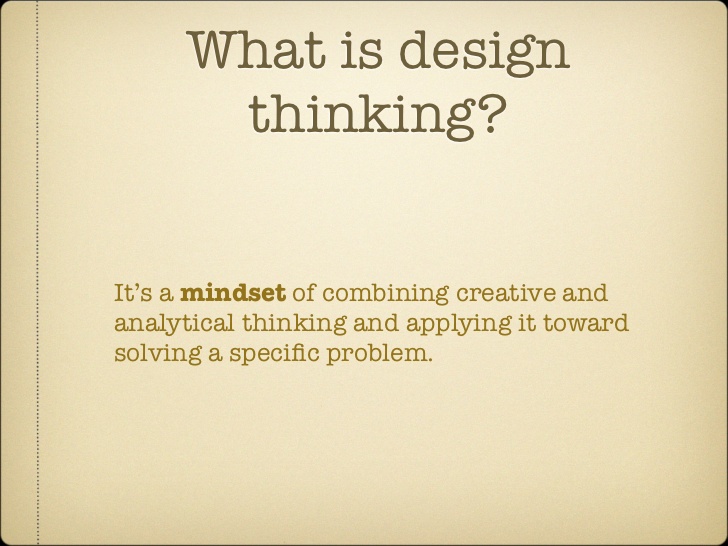
    What is design thinking?

    Quickly, the conversation became a rich conversation around how design thinking creates a mindset shift for students. When teachers build in students the core abilities needed to navigate the design thinking process, students not only develop a greater understanding of how to use design thinking processes to solve problems, but they also become more empathetic to the world around them. They begin to see needs in the world, and act as changemakers. But in order to make that thinking shift, teachers need to be intentional in using the language of design thinking in all they do, and not just during design thinking challenges. Key to this is realizing that design thinking does not have to be a start to finish project. It can happen in “little bites,” Ellen reminded us. Each element – empathy, define, ideate prototype, test – can stand on its own or be combined with the others, depending on the task at hand.

    Consider, during the course of a school day, the myriad of tasks students are completed. Now tweak them to reflect the design thinking approach. Can you ideate when writing an essay? What about when working to solve a math problem? When discussing story characters, can students build empathy for those characters? Can they define the problem the character is facing, and then develop a needs statement? How can students prototype during science labs? And test those prototypes? When the language becomes part of what teachers and students use throughout the day, students realize that Design Thinking is not just a project done once a year like a science fair. It’s a catalyst for change.

    When asked how to show parents the value in integrating design thinking with standards in the classroom, Ellen pointed us to Mary Cantwell, creator of DEEP Design Thinking. Mary, Ellen told us, had generated a list of the skills she observed students demonstrating through a design thinking experience.

    Not surprisingly, these skills match up with our district’s “Skills That Matter Most,” one of three key levers in our five year plan to ignite student genius by transforming the learning experience. And also not surprisingly, these skills are often listed by employers as being in high demand for the employees they hire.

    So how might we develop the design thinking mindset in today’s students so as to help them develop the skills that matter most for their future success? Well, for starters, we can do it one bite at a time.

    Sign up to receive an update when I post. Type your email address in the box and click the “Subscribe” button. My list is completely spam free, and you can opt out at any time.