Tag: Design Thinking

  • Designing Belonging: What a Pizza Box Taught Me About Connection

    Designing Belonging: What a Pizza Box Taught Me About Connection

    I’ve written before about the time I ordered a pizza to reconnect my ex-husband to the outside world. No car. No phone. No internet. A disconnection, both literal and emotional. We used Domino’s delivery notes as our 21st-century carrier pigeon. It worked, but only because someone made the effort to reach out, to bridge the gap, to make belonging possible when the system failed.

    I was thinking about that moment when I read Design for Belonging by Susie Wise.

    “The work of belonging is to counteract [othering]. It is to open up spaces and places so that all people regardless of their backgrounds can join in and contribute.”

    I can’t stop thinking about how often we overlook the micro-moments where belonging breaks, and how many more we ignore where it could be rebuilt.

    That pizza box moment was belonging by design, even if I didn’t have a name for it then. It was messy. Unconventional. A little ridiculous. But it worked.

    And maybe that’s the real design challenge: how do we notice when belonging is fractured? And more importantly, what do we do next?

    When Wise talks about the “design levers” of rituals, roles, spaces, systems, it isn’t just a nice framework for planners and strategists. It’s a lifeline for educators, leaders, and humans trying to hold fragmented communities together. Especially when those communities are separated by distance, devices, and distraction.

    I’ve seen this in classrooms. In Zoom faculty meetings. In Twitter (“X”) threads that start with good intentions and devolve into ego matches. And I’ve felt it in the silence after someone says something unintentionally harmful, followed by… nothing.

    That’s where the work is.

    We talk a lot about invitation. How do we invite students into learning? Colleagues into collaboration? Families into school systems that weren’t built with them in mind?

    But Wise pushes us further. She explains that invitation isn’t just about showing up. It’s about showing up in a space that sees you. Hears you. Values your perspective.

    That only happens with intention.

    I think about how many times I’ve created systems that worked “in theory” but didn’t feel like belonging in practice. The school-wide email that no one read. The virtual office hours that no one joined. The peer feedback protocol that favored the loudest voices. None of those were belonging, even if they were well-designed.

    Because belonging isn’t the form. It’s the feeling.

    Wise also talks about dissent and repair—two words we don’t sit with enough in schools.

    We love our norms and expectations and “we’re all in this together” mantras. But what happens when someone pushes back? When they say, “This space doesn’t feel safe for me,” or “That comment hurt”?

    Too often, we go straight to defense. Or worse—silence.

    But real belonging means we stay. We sit in the discomfort. We acknowledge the impact even if it wasn’t our intent. We ask what repair could look like—and then we act.

    Sometimes that action is a redesign.
    Sometimes it’s an apology.
    Sometimes it’s a damn pizza box with a handwritten message to reboot the phone so messages arrive. haha

    I don’t have a neat ending here. Belonging is squiggly like that. It’s a process, not a product. But what I’m learning from Susie Wise, and remembering from my own messy, human moments, is this:

    We can design for belonging in every space we touch.
    Even the ones that feel too big, too broken, too remote.
    Even the ones held together by pizza and Post-it notes.
    Especially those.
  • Leading with Heart: 4 Ways to Unlock Potential and Stay on Course

    Leading with Heart: 4 Ways to Unlock Potential and Stay on Course

    Leadership is more than just guiding people through tasks and goals—it’s about creating an environment where potential is unlocked, and everyone feels seen and supported. In Make Possibilities Happen, Grace Hawthorne lays out crucial insights about transforming ideas to reality. I think her ideas can also reshape how we approach leadership, both in our personal and professional lives. Here are my four key takeaways from the book, each deeply connected to leading with empathy.

    1. Never Mistake Information for Knowledge It’s easy to gather data and present facts, but knowledge goes deeper than surface-level information. When we lead with empathy, we take the time to understand the why behind the facts and connect them to the real human experience. This involves listening actively and seeking to understand each person’s perspective, ensuring that our decisions reflect not just what we know, but also the context, feelings, and needs of those we lead.
    2. Air Navigation’s 1-in-60 Rule: Stay on Course with Your Goal In aviation, the 1-in-60 rule suggests that even a small deviation from the course can lead to big mistakes if not corrected. In leadership, it’s easy to get distracted by minor issues or challenges. However, staying focused on the ultimate goal ensures that we remain on track, and it’s empathy that helps us course-correct with care. When we empathize with the challenges people face, we understand when adjustments need to be made, always with a clear focus on the bigger picture.
    3. Avoid Getting Too Lost in Minutiae—Be Both the Torchbearer and the Bellows In our day-to-day work, it’s easy to become bogged down by the small, often inconsequential details. However, Hawthorne warns against losing sight of the “spark”—the inspiration, the vision, the passion that drives us. As leaders, we need to be the ones who not only carry the torch but also fuel it. We balance between being hands-on with details and stepping back to lead with purpose. By practicing empathy, we ensure our teams feel motivated, recognized, and energized to move forward, without getting overwhelmed by the small stuff.
    4. Ask the Right Questions and Solve for the Right Thing Leadership is about asking the right questions—especially those that address the heart of the issue, not just the surface problems. Empathy requires us to understand what people truly need and what obstacles stand in their way. By solving for the right thing, we can empower others and foster an environment where growth and collaboration flourish.

    When we lead with empathy, we embrace these lessons to not only guide our teams effectively but also to create spaces where individuals can thrive, innovate, and feel valued.

  • The Why is the Key to the What and the How

    The Why is the Key to the What and the How

    He who has a why to live for can bear almost any how.

    Friedrich Nietzsche

    I have been thinking about teachers a lot lately. Many of you are working on revising, rewriting, or simply writing curriculum and lesson plans that ares responsive to the different teaching you’ll be doing as a response to COVID. I know how daunting the task can be, especially when there are so many unknown variables. When I started teaching, I was always told to focus on my circle of control and understand that I can’t always impact the areas of concern.

    But now, it seems like those areas have gotten all scrambled together. All the circles are intertwined as we venture into distance learning, many for the first time. Before COVID, I couldn’t control what happened at home, so I didn’t assign homework and chose to focus the learning within the classroom structure. But now, all the students are at home so does that change the circle of concern to a circle of control?

    I recently rewrote a doctorate course for University of San Diego called Learning Design and Technology (which I am now teaching). When I accepted the contract, I assumed the students would all be teachers wanting to branch out with online and blended learning, which is who I taught this course to in the past.

    But that was pre-COVID.

    When COVID hit, I adjusted the course to reflect the new reality for teachers. But when students started joining the course, I realized I had to make even more adjustments because my students weren’t traditional teachers. One was from the Department of Defense who was asked to put some aviation material online. One was a photojournalist looking to inspire social justice through photography. And one was a USD employee trying to find ways to encourage students to study abroad (even though the program is currently COVID suspended).

    Revising the course was difficult, of course. But it wasn’t impossible because I had a firm grasp of the “why” for the course.

    “In today’s digitally connected global environment, it is important to be able to design and provide learning in ways that people can engage with, understand, and implement.”

    Course “Why”

    Making adjustments when the “why” was clear made the “how” and the “what” less daunting. And yet oddly, it’s something most teachers are never asked to consider. I look back at my teacher training and I see a lot of coursework on “how” and “what” but the only “why” seemed to be standards or high-stakes testing. (And by the way, neither of those are a why, but you already know that!)

    So where did the why come from? From empathy. From looking at past courses and talking to former students to see what experiences resonated with students. It came from talking to my current students to understand their reality. It came from reading articles published by the World Economic Forum to look at future forecasts, and from listening to my peers on Twitter share their current reality and fears with each other. Is it perfect? Nope. But it is a guide. And that guide informs my course corrections.

    So as you continue wrestling with the how and what, please remember that changes will most definitely continue to come your way. But if you take time to identify the why, and then ground yourself in it, those changes won’t be quite as soul-crushing as they may seem right now. In fact, they may lead to some amazing opportunities to engage and enrich students in ways you had not before considered.

    You got this!

  • Designer or Design Thinker?

    Designer or Design Thinker?

    Innovation is when something new is created and implemented that adds value. Inventions happen every day, and every year inventions find their way into our classroom. 

    It’s only when an invention adds value that they become an innovation. A lot of times we get caught up in the invention, or the idea. I call this the glitter dust syndrome. 

    Ever receive a card with glitter on it? It’s pretty and you’re excited to receive it. But after you read the card and put it out for display, you see it… glitter. It’s everywhere. It’s stuck on your clothes, your skin, your carpet.

    It added no value to the card. In fact, sometimes the message of the card gets lost because you’re too busy cleaning up the glitter. If there is no value add, there’s no innovation. Just invention. 

    So how do we determine whether something is going to be a value added innovation in our classroom or a case of glitter dust?

    Design thinking.

    We are all designers. Every lesson plan you write, every bulletin board you create, every assessment you assign, even the outfit you put together for today. But that doesn’t mean you’re a design thinker. Human-centered design requires us to step away from our own needs, our own assumptions, and look at the world through the lens of others. 

    Design Your Mask

    During my keynote presentation at SDCOE’s Learning and Innovation Summit Saturday, I asked everyone in the room to design a mask that they could wear without holding it. They also had to be able to see through it. One piece of cardstock paper was the only material provided. The timer was set for three minutes.

    Just about everyone was able to design a mask and wear it. But then I asked them to trade masks with the person sitting next to them. Quickly, they realized that their mask didn’t quite fit their colleague as well as it fit them. Maybe the eye slits were off, or the way it latched on to their face didn’t quite work. Those who used their glasses to hold it on had to also give their glasses to the colleague, which caused some blurry moments!

    Why didn’t the mask fit as nicely on the colleague as it did on the designer? What needed to happen for the mask to fit somebody else?

    Innovation in Education

    Human-centered design requires us to step away from our own needs, our own assumptions, and look at the world through the lens of others.

    When considering innovation in education, it’s important to differentiate between invention and innovation. What is the value add for our students? Is there one? Schools implement adaptive tech programs that promise to increase reading scores. Tables on wheels are placed everywhere. Social-emotional curriculum is purchased. 

    But whose face are we designing the mask for when we do so? Are we simply covering our students in glitter dust?

    When we recognize that our mask doesn’t fit everyone else like it fits us, we realize how our bias, our experiences, our beliefs, impacts student learning. And we start becoming human-centered designers. 

    This is the difference between designers and design thinkers. 

    This blog post is adapted from a keynote I gave at SDCOE’s Learning and Innovation Summit Feb 8, 2020.

  • Boxes Aren’t For Thinking

    Boxes Aren’t For Thinking

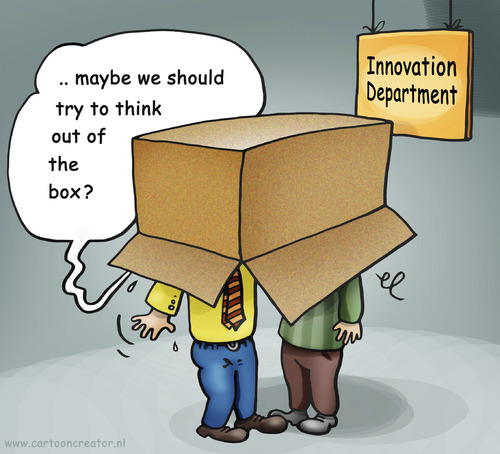
    How do you innovate from inside the box?

    “Think outside the box” is probably one of the most overused statements. No matter what the situation, or problem, inevitably someone will say, “We need to think outside the box.”

    The problem with thinking outside the box is that leadership often wants to create a box to contain the thinking outside the box. In other words, think outside the box, but only insofar as the thinking stays within the organization’s predetermined box.

    Today I had a meeting scheduled with a director at the San Diego Zoo to discuss an upcoming zoo-sponsored hackathon, and potential connections with K-12 education. In lieu of the traditional phone call introduction and conversation, we decided to meet at the zoo. And since it was a beautiful day, our meeting was a walk and talk around the zoo instead of inside the administration building.

    Without the confines of the box, we found our conversation expanding beyond the original topic of discussion. Discussions of elephant emotions and giraffe spot patterns sparked conversations about augmented reality and wildlife conservation. We were able to dream big about ways to build student advocacy in to zoo fieldtrips while talking UX design and hackathons.

    I walked away from the meeting with ideas and energy to pursue those ideas.

    This freedom of time and space to connect with others, to engage in meaningful dialogue, and to reflect on possibilities is not often provided for educators. The box confines, and the box dictates, what should be thought about and when. Look at any PLC or meeting agenda and you’ll probably see something like this:

    We want teachers to be innovative. We want schools to be transformative. But we don’t provide opportunities for that because we control the interactions. Topics are outlined, times are allotted, and thinking stays inside the box.

    It used to be that teachers could go to conferences as a way to think outside the box (although in reality, they were just thinking inside a different box… but it was still outside their own box, so that was cool).

    But now I’m seeing more and more districts and schools self-hosting their own professional development “mini-conferences” which are, effectively, keeping people in the box.

    One of my favorite design thinking exercises is a premortem experience, in which you write about what could go wrong with a proposed solution.

    Looking from a premortem lens, ask yourself, what would happen if we took the box away? What’s the worst that could happen if we asked teachers to go for a walk in the park with a colleague and talk? Or to visit a local business (or zoo) and walk and talk with someone there? If we removed the box, even for an hour, what might come of it?

    Honestly, I can’t picture the world ending. But what I can picture are people being exposed to new ideas and information, and considering the implications for their teaching and learning.

    If we want classroom learning to be relevant, and we want teachers to provide real-world connections, it can’t be done inside the box.

    We need to build opportunities for educators to think freely, to wander open spaces, to connect with people they don’t get to connect with, and to think without agendized topics and time constraints, so that we can truly start to think outside the box about education.

  • Imagining Joyful Learning Spaces

    Imagining Joyful Learning Spaces

    This past month our innovation team has been fortunate to work with a school staff that is looking to reimagine their library space. Currently a traditional space with plain walls, a large circulation desk, and giant book shelves, the staff is wanting to build a space that reflects the joy of learning they want students to experience every day. In their words:

    Imagine a space where students of all ages and adults could create, innovate, and explore the world in an inspiring and natural environment designed to enlighten and change the world! Students need a way to access a variety of learning and discovery spaces in order to respect their age and place in the world and ignite their inner genius and advance the world.

    We’ve been using the design thinking process to guide us on the journey, which has been a fabulous way to keep us grounded in the WHY of our work. Today, I realized that a consistent theme kept reemerging during every brainstorm or prototype session – JOY.

    Adults design schools. Adults who have been schooled for years on how to build buildings. And then adults come in and furnish those buildings. They paint the walls. They choose the chairs. Somewhere in that process, the children become secondary. And often times, so does joy.

    Which brings me to the book Joyful by Ingrid Fetell Lee.

    In her book, Fetell Lee points out that joy isn’t reserved for religious gurus that have attained enlightenment. In fact, it can be found all around us. She summarizes 10 big ideas in which joy can be found:

    1. Harness the power of color.
    2. Live abundantly.
    3. Find your freedom.
    4. Discover harmony.
    5. Fill your life with playful shapes.
    6. Surprise yourself.
    7. Go higher.
    8. Feel the magic.
    9. Spread the love.
    10. Start anew.

    Schools, and libraries, should truly be places of joy. They should allow for playful wonder. Fetell Lee explains that “play etches itself deeply into our memories for a good reason: it is the only known activity that humans engage in solely because it produces joy. ”

    Play lets us practice give-and-take, through which we learn empathy and fairness. It also promotes flexible thinking and problem solving, which increases our resilience and help us adapt to change. When we play, our awareness of time diminishes, and our self-consciousness fades. Play can put us in a powerful flow state, which allows us to let go of everyday worries and be absorbed in the joy of the moment.

    Joyful, by Ingrid Fetell Lee

    Children understand joy. All you have to do is listen to them dream up the new library to know that they can see that which adults often forget. Their vision of the space includes waterfalls, cafes, and a loft… they see color, comfortable seats, and places for both quiet and social gatherings. They hear music and feel texture. They break down the barriers and let in nature’s beauty. They get it.

    And so did the adults in the room today. I’m excited for the future wonder and joy that awaits the students and staff as they turn their prototypes into a joyful place that ignites genius and empowers students to advance the world.

    Stay tuned…