Tag: culture

  • Moving Too Fast to Notice Your Life

    Moving Too Fast to Notice Your Life

    Sandstone Canyon is easy to miss if you’re moving too fast. It branches off Fish Creek Wash without much announcement. A sign. A turn. If you weren’t already in the mood to slow down, you’d keep going.

    Once you’re inside, the walls come up quickly. Fifty, maybe seventy feet. The wash is still sand and crushed dirt, still not what anyone would call technical, but there isn’t much extra space. You notice that right away. The way the canyon quietly narrows your choices.

    We’re used to places that reward momentum. Sandstone doesn’t. It rewards paying attention. And not just in the “don’t hit anything” sense. This is a canyon that took millions of years to become a canyon. The walls hold light differently depending on the time of day. The color shifts as you move. If you’re only focused on getting through it, you miss most of what’s actually there.

    Most of the time, you’re moving slowly through it a little stunned, watching the walls change and trying to take in how improbable it all is.

    Every so often, you have to wait for someone coming the other way, or ease past a narrow section. That part isn’t difficult. It just makes it very clear that you don’t get to decide the pace.

    Most days, you do.

    In normal life, days are mostly a series of things to get through. The goal becomes finishing. Clearing. Moving on. You move from one thing to the next at a speed that feels efficient and, over time, becomes automatic.

    Nothing is wrong, exactly. You’re just always moving. And living at that speed flattens things. Even good days start to feel thin.

    Out in Sandstone, that’s harder to maintain. The canyon keeps interrupting you. The walls keep catching the light. The scale of it keeps insisting that you’re moving through something that does not care how quickly you’re trying to get to the end.

    You leave, of course. You always do. You go back to regular days and regular weeks and all the usual noise.

    But places like this change your sense of tempo, even if only briefly. They remind you what it feels like when time has texture again.

    And then, slowly, you start moving too fast.

    Until the next place makes you notice.
  • Gratitude Reimagined: Spotlighting Authentic Appreciation

    Gratitude Reimagined: Spotlighting Authentic Appreciation

    Subscribe to continue reading

    Subscribe to get access to the rest of this post and other subscriber-only content.

  • Finding Humanity in the “Enemy”: Empathy’s Crucial Role in Kahane’s “Collaborating with the Enemy”

    Finding Humanity in the “Enemy”: Empathy’s Crucial Role in Kahane’s “Collaborating with the Enemy”


    Just finished Adam Kahane’s Collaborating with the Enemy, and it’s truly shifted my perspective on conflict and collaboration. What struck me most powerfully was the central role of empathy, not as a soft skill, but as a vital tool for transformation.
    Kahane’s gems, like “Adversaries aren’t the enemy—they’re key to transformation,” and “Listening is an act of courage,” really hammered this home. It’s easy to dismiss those we disagree with, to paint them as the “other.” But as Kahane emphasizes, true progress requires us to look beyond those surface differences and recognize the shared humanity beneath.
    He doesn’t sugarcoat it. Listening to someone you fundamentally disagree with is hard. It takes courage to set aside your own biases and genuinely try to understand their perspective. But that’s precisely where empathy comes in. It’s not about agreeing, it’s about acknowledging their experience, their fears, and their motivations.
    Think about the concept of “polarization is an invitation, not an obstacle.” This is only possible if we approach those on the other side with a willingness to understand. If we see polarization as a battleground, we’ll only dig our heels in deeper. But if we see it as an invitation to explore different perspectives, to find common ground, we can unlock transformative possibilities.
    Kahane’s work reminded me that empathy isn’t just a feel-good emotion. It’s a strategic necessity. It’s the key to unlocking the wisdom hidden within conflict, to finding solutions that benefit the whole. By truly listening and understanding, we can move beyond the limitations of our own perspectives and create a more collaborative and just world.
    Ultimately, Collaborating with the Enemy teaches us that profound change starts with personal transformation. It begins with the willingness to see the humanity in those we consider “enemies,” and to embrace the power of empathy to bridge divides and foster meaningful collaboration.

  • Life Over Work

    Life Over Work

    In today’s fast-paced world, it’s easy to fall into the trap of equating our worth with our workload. However, we must remember that life isn’t about finding a balance; it’s about prioritizing what truly matters—our well-being and happiness.

    Days off are not just a luxury; they’re essential for recharging our minds and spirits. By fully embracing these moments away from work, we nourish our creativity, strengthen our relationships, and cultivate joy in our lives.

    As I tell my team, enjoy your days off to explore, relax, and connect with what brings you joy. After all, it’s the experiences outside of work that enrich our lives and inspire us when we return.

  • Empathy as a Catalyst for Innovation in Organizational Culture

    Empathy as a Catalyst for Innovation in Organizational Culture

    In today’s whirlwind of constant change and relentless pursuit of “the next big thing,” it’s easy to lose sight of the human element. But here’s a truth that might surprise you: empathy, that good old-fashioned ability to connect with others on a heart-to-heart level, is actually a secret weapon for igniting innovation.
    Think about it. When leaders cultivate a culture where everyone feels safe to speak their mind, to toss out those “what if?” ideas without the fear of being shot down, that’s where the magic happens. That’s where creativity flourishes, and those lightbulb moments illuminate the path to progress.
    Empathy isn’t just about being “nice” or creating a harmonious workplace (though those are definitely perks!). It’s about tapping into a rich tapestry of perspectives, understanding the unique needs of your team, your students, your community. It’s about seeing the world through their eyes and creating something that truly resonates.
    As educators, we know this firsthand. When we take the time to truly understand our students—their backgrounds, their challenges, their dreams—we can create learning experiences that spark their curiosity and ignite their passions. We can design a curriculum that speaks to their hearts, teaching strategies that resonate with their learning styles, and support systems that empower them to thrive.
    And it’s not just about the classroom. Empathy can fuel innovation in any organization, from a bustling tech startup to a quiet non-profit. By valuing and incorporating diverse viewpoints, leaders can spark breakthroughs that not only achieve success but also make a real difference in the world.
    So, let’s ditch the “me” mentality and embrace the power of “we.” Let’s lead with empathy, listen with our hearts, and watch as innovation blossoms all around us.In a world where businesses constantly strive for innovation, empathy stands out as a major driver for creative problem-solving and a positive workplace culture. An empathetic approach to leadership encourages a culture of openness, where ideas are shared freely without fear of judgment. This environment is fertile ground for innovation, as employees feel supported to think outside the box and challenge the status quo. Moreover, empathy enables leaders to understand and connect with diverse customer needs, leading to the development of products and services that resonate on a deeper level with the market. In educational settings, empathetic leadership can influence curriculum development, teaching strategies, and student-support systems, by actively considering the varied experiences of learners. By valuing and incorporating different viewpoints, leaders can propel their organizations towards innovative breakthroughs that not only have commercial success but also enact positive societal change. Embracing empathy within leadership is not just about creating a harmonious work culture; it’s about setting the stage for continuous innovation and growth.

  • Relationships. Culture. Twitter. OY!

    Relationships. Culture. Twitter. OY!

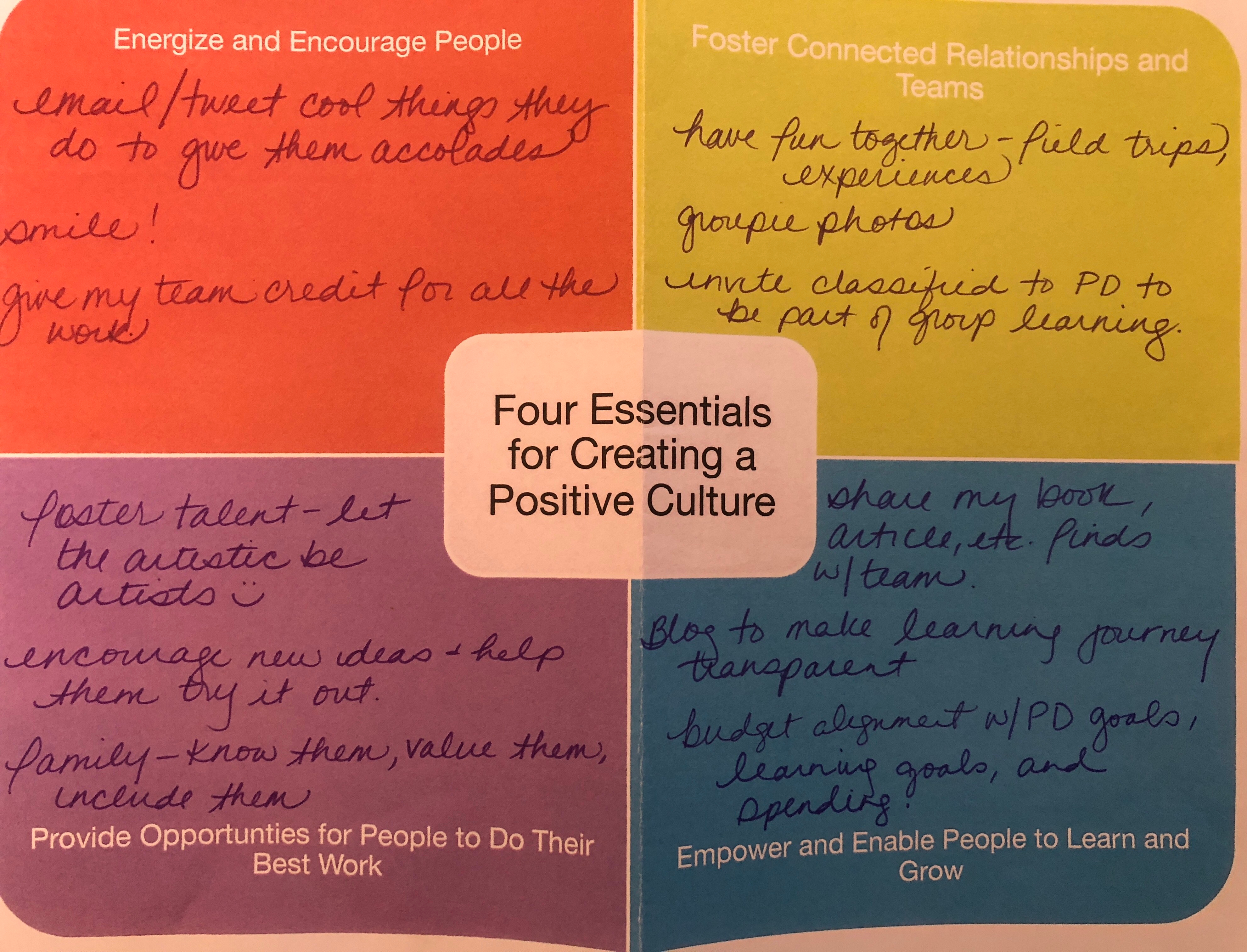
    I was at a Women in Educational Leadership the other day, and one of the sessions presented by a local superintendent was on culture. She shared four essentials for creating a positive culture. They are:

    • Energize and Encourage People
    • Foster Connected Relationships and Teams
    • Provide Opportunities for People to Do Their Best Work
    • Empower and Enable People to Learn and Grow

    After she shared the categories, she had us walk around the room and get ideas from others as to ways in which to provide those essentials. That time to talk about our ideas, elaborate on them and create new ones together created our own positive culture. In those few moments with each other we were truly listening, engaging with each other and building a sense of connection.

    It’s what’s missing on Twitter. Lately, Twitter seems to be filled with dime store platitudes lacking any depth. If I could get a dime for every time someone says relationships are the key… the key to student engagement, the key to school culture, the key to learning gaps… without explaining just how to develop those relationships, I could pay off my student loans!

    So I’m sharing my notes from our walkabout and challenging everyone to add an item. Let’s not just talk relationships and culture. Let’s talk about the work we are/should/can do to create positive cultures that truly promote relationships.

    Four Essentials for Creating a Positive Culture

    Notes from my walkabout. Template provided by Supt Candace Singh