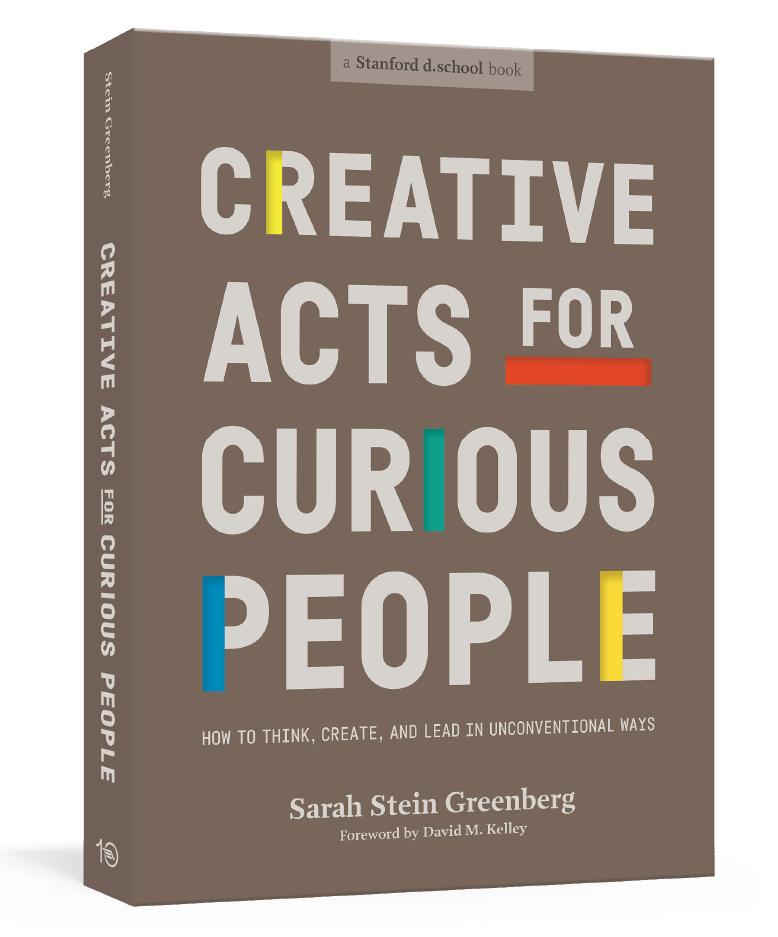
It’s been a few months, but I’m still processing the lessons I’m taking away after sitting in on the d.school book club chat with Sarah Stein Greenberg about her fantastic book, Creative Acts for Curious People.
The entire conversation was a masterclass in leading creative teams, and it completely reshaped how I think about my own role as a leader. Here are my biggest takeaways.
It’s Not About Being ‘Creative’—It’s About Being Curious
The first thing that really clicked for me is that we put too much pressure on the word “creativity.” Sarah mentioned that for many, it feels exclusive. She offered a much more accessible starting point: curiosity.
Curiosity is the “gateway,” the entry point that helps people embrace their own creative abilities.
We got to experience this firsthand when she led us through the “Seeing Exercise.” She showed us an ambiguous picture and asked, “What’s going on in this picture?” As I always do, I tried to find the “right” answer. But the real lesson came later when someone asked what was actually happening in the photo. Sarah said she has intentionally never looked it up. She likes to “sit with that feeling of not knowing” because it’s a constant reminder of what our teams feel when faced with ambiguity.
My takeaway: My job as a leader isn’t to have all the answers. It’s to model a deep and genuine curiosity and to create situations that encourage my team to slow down, observe, and question their own assumptions.
Psychological Safety Isn’t Magic; It’s Architecture
We all talk about wanting our teams to feel safe enough to share wild ideas, but how do you actually build that? Sarah’s approach treats safety not as a feeling, but as a direct result of intentional design.
She described her “My Favorite Warmup Sequence,” and it was a revelation. It’s not a random icebreaker. It’s a carefully structured process designed to “build psychological safety piece by piece.” You start with a safe one-on-one interaction. Then, that pair joins another pair to become a quartet, and the activity becomes a little more playful. It gently eases people into a state of vulnerability and connection, rather than demanding it all at once.
My takeaway: I need to stop thinking about team-building as just “fun activities” and start thinking about it as a structured process. True psychological safety comes from designing interactions that strategically build trust over time.
You Have to Make the Work Visible
When a project gets really complex, it’s easy for a team to feel overwhelmed and paralyzed. I learned that a leader’s critical role here is to fight that fog by making abstract challenges tangible and visible.
Sarah mentioned a concept called “distributed cognition,” which is about taking the ideas out of your head and putting them into a shared space so you can expand your ability to think about them. She offered two specific assignments from the book that I can use right away:
- Map the Problem Space: At the beginning of a project, this helps a team get all their thinking out and organized, creating a shared view of the landscape.
- The 100-Foot Journey Map: When you’re deep in a project and drowning in data, this tool helps you physically map out every step of a complex process, bringing immense clarity to the system.
My takeaway: I can’t expect my team to navigate complexity inside their own heads. My role is to provide the structures and frameworks that allow us to get it all out on the wall, see it together, and find the key leverage points.
The Biggest Risk Is Often Doing Nothing at All
Perhaps the biggest mindset shift for me was how Sarah reframed risk. We often focus on the risks of trying something new, which can scare teams into inaction. But she challenged us to consider the other side of the coin.
What is the risk of not acting? What is the risk of continuing on the current path?
This question alone changes the entire conversation. To put it into practice, she pointed to the “Expert’s Assumptions” activity in the book. The process is simple: have the team list all the assumptions and constraints they believe are true for a project. Then, pick one, flip it, and spend just 10 minutes imagining what you could build if that constraint didn’t exist. It’s a structured, low-risk way to give people permission to be radical.
My takeaway: My job is to reframe the conversation around risk. By helping my team challenge their assumptions and consider the cost of inaction, I can unlock a more innovative and courageous approach to problem-solving.
Final Thoughts
Leaving the book club, I realized the most profound shift for any leader isn’t in finding better answers, but in learning to ask better questions and build better rooms. Modern creative leadership isn’t about being the source of every great idea; it’s about being the facilitator of them. The real work is architecting the environment where your team’s collective genius can finally show up. The most powerful question we can ask ourselves isn’t, “What’s my vision?” but rather, “Have I created the conditions for theirs to emerge?”

 Laura K Spencer, Ed.D.