Year: 2018

  • What Do I Think I Know and What Do I Have to Learn?

    You never know what you will learn when you step outside your bubble.

    The other day on LinkedIn I saw an event posted by Garry Ridge, CEO of WD-40. It was the Annual Breakfast for the MS in Executive Leadership program at University of San Diego, followed by a panel about servant leadership, creating a culture of values, and how business skills empower performance. All invited. “Why not?” I thought. I’m on vacation, so let’s see what this is all about. A fortuitous decision!

    On the panel:  Ken Blanchard, best selling author of over 50 books on leadership, Garry Ridge, and Barbara Lougee, Associate Dean of Graduate Programs and Associate Professor of Accounting. I have pages of notes (for future blog posts), but today I want to write about one inspirational nugget.

    Garry Ridge, CEO of WD-40, has a constant drive to learn. When he took over as CEO of WD-40, he asked himself, “What do I think I know and what do I have to learn?” Garry realized there was much to learn and therefore enrolled in USD’s first MSEL cohort. How many CEOs decide to go back to school? What tremendous sense of self and lack of ego is required to be able to answer that question when many would consider him to already be at the pinnacle of his career!

    My Post (1)

    It made me wonder when the last time was that I truly asked myself what I thought I knew and what I needed to learn. When I accepted my current position as Executive Director of Innovation and Design, there was a lot to learn. I knew I had to become well versed in Design Thinking. And I quickly realized there were a lot of cultural and pedagogical values in my district that I needed to familiarize myself with, but what did I truly think I knew? And what did I have to learn?

    It’s a question I’m still answering, and I think that’s the point. The more I learn, the more I realize I need to learn more. And then the more I learn, the more I realize that what I thought I knew wasn’t fully developed, and therefore there’s still more I need to learn. Not just about pedagogy and Design Thinking, either. About organizational systems. About change management. About culture. About thinking. About people and values. About visions and missions and the work to carry them out. About industry. And careers. And the Fourth Industrial Revolution. About Sinek’s Golden Circle. And the list goes on and on.

    But what if I asked students that question? Ask a student what they think they know, and what they need to learn. Most may look at you like you’ve lost your marbles. Or they may tell you about the facts that need to be memorized for an upcoming exam. Or the items missed on a previous test. Or the homework that is waiting for them at home.

    But none of that is learning. It’s just playing school.

    When classrooms promote student agency, and the personalization of learning that must co-exist with agency, then students can better articulate their learning because they understand both the purpose and the end goal. Perhaps a student would share how s/he is developing a narrative to include more descriptive elements so as to draw the reader in. Or another student may share that s/he is developing a strategy to approach a complex math problem using known algorithms. Another may say that he thinks he knows how to solve a playground situation, but needs to spend more time empathizing with the users to see if the prototype will solve the underlying issue.

    In each of these answers, students are owners of their learning journey. The teacher, approaching classroom leadership as a side-by-side relationship, is providing the space and the time so that each student’s learning is nurtured.

    That’s what personalization of learning is all about. Every student and teacher being able to ask, “What do I think I know and what do I have to learn?” and being able to answer it, and then travel down the path that not only answers that initial question, but opens up a hundred more.

  • Personalization Isn’t a Fancy Computer Program

    Personalization Isn’t a Fancy Computer Program

    Laura presented the idea of “personalization of learning,” meaning more in how does the teacher understand the student, build on their interests, and create learning opportunities for the student.  I can get behind this idea.

    The personalization of learning creates the opportunity for more depth and authenticity, whereas “personalized learning” seems to be more about knowing the “stuff”.                                                      – George Couros

    When George Couros mentioned me in his post, “Personalized Learning Vs Personalization,” I was honestly a bit surprised when I started to receive tweets and messages asking for more information, because I just assumed everyone saw it the same way as I did. And then, serendipitously, an article in my inbox called “A Confession and a Question on Personalized Learning” explained the problem with personalized learning, as it is constructed now.

    Larry Berger, CEO of Amplify, shared how computerized personalized learning programs are failing to live up to the promise. Not only have they not been able to map out a scope and sequence for learning, they don’t know how to measure truly where students are and what they need, and the library of lessons that are needed to teach students is only about 5% complete. But more important than all that, Berger writes is that:

    Just because the algorithms want a kid to learn the next thing doesn’t mean that a real kid actually wants to learn that thing.

    So we need to move beyond this engineering model. Once we do, we find that many more compelling and more realistic frontiers of personalized learning opening up.

    Which brings me to the question that I hope might kick off your conversation: “What did your best teachers and coaches do for you—without the benefit of maps, algorithms, or data—to personalize your learning?”

    In asking the question of what the best teachers and coaches do to personalize learning, we get at the heart of this topic. Personalization is, at its core, about relationships. It’s about knowing your students as unique human beings, and then finding ways to let them explore their sense of self through experiences that are not laid out, step by step, in a neat package by the teacher but rather require the students to find their own way to the finish line.

    An example:

    Over the past month, third graders at one of our schools have been studying the Kumeyaay Native Americans. An area of focus, placed by the teachers, was on culture and traditions. As the Kumeyaay adapted to outside influences, and disruptions to their way of life, they found ways to preserve their traditions for future generations. As the culmination to this unit, students participated in a weeklong Design Sprint.

    Objective: How might we understand the Kumeyaay journey of change over time and their desire to retain cultural customs, so as to better understand how to tell our own story in an ever-evolving time?

    To kick off the week, students heard stories from a Kamishibai storyteller. They discussed the elements of storytelling, and participated in an improv activity called “Pass the Gift” to explore how body gestures can be used to convey a story.


    From there, we asked students to think about an important tradition in their family. Using a chalk talk thinking routine, students wrote a tradition down on butcher paper. After conducting a gallery walk to see what everyone else wrote, students came up with categories for the different tradition types – topics ranged from dinner with the family to summer vacations to SuperBowl parties.

    And then the true personalization happened… students were told to decide on the best method to preserve the story of that tradition. They didn’t have to write an autobiography, with 5 paragraphs and a hook opener. They had to really think about what could not only best capture their story, but what would the user (their family) respond to best. The mediums chosen varied: movies, slideshows, stop-motion animation, painting, sculptures, comic strips, written narratives, and even a few Kamishibai story boxes!

    After students finished their projects, they shared them with 6th grade buddies to receive feedback. They’ll adjust the prototypes after break to prepare them for Open House. One teacher commented, after the Design Sprint ended, “The students shared their projects today with their sixth grade buddies and it was truly one of the most powerful moments we have ever witnessed in the classroom.”

    Personalization can take many forms. In this case, the artistic medium not only let students express themselves creatively, but it also provided a way for both the introvert and the extrovert, the verbal-linguistic and the logical-mathematical, the second language learner and the gifted child, to connect with the academic standards in a meaningful, relevant way.

    ** This is the first in a series of posts on Personalization of Learning. Sign up to receive an update when I post. Type your email address in the box and click the “Subscribe” button. My list is completely spam free, and you can opt out at any time.

  • Design Thinking: One Bite at a Time

    Design Thinking: One Bite at a Time

    Today, my Design Engineering team, along with two 6th grade teachers, had the pleasure of engaging in a Google Hangout with Ellen Deutscher, co-founder of #DTK12Chat, inventor of Design Dot cards, and just an overall awesome Design Thinker, teacher, and human being. The original intent of the call was to discuss Design Dots. If you haven’t yet seen Ellen’s Design Dots, it’s a deck of 50 cards with quick ideas to integrate design thinking into ELA instruction.

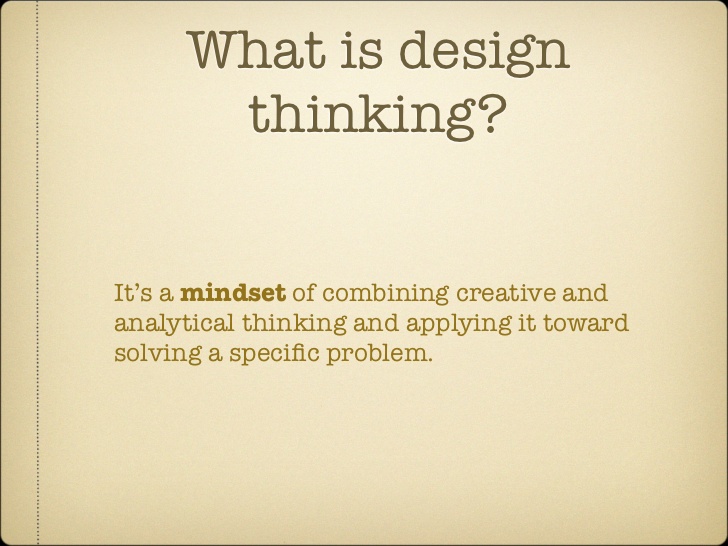
    What is design thinking?

    Quickly, the conversation became a rich conversation around how design thinking creates a mindset shift for students. When teachers build in students the core abilities needed to navigate the design thinking process, students not only develop a greater understanding of how to use design thinking processes to solve problems, but they also become more empathetic to the world around them. They begin to see needs in the world, and act as changemakers. But in order to make that thinking shift, teachers need to be intentional in using the language of design thinking in all they do, and not just during design thinking challenges. Key to this is realizing that design thinking does not have to be a start to finish project. It can happen in “little bites,” Ellen reminded us. Each element – empathy, define, ideate prototype, test – can stand on its own or be combined with the others, depending on the task at hand.

    Consider, during the course of a school day, the myriad of tasks students are completed. Now tweak them to reflect the design thinking approach. Can you ideate when writing an essay? What about when working to solve a math problem? When discussing story characters, can students build empathy for those characters? Can they define the problem the character is facing, and then develop a needs statement? How can students prototype during science labs? And test those prototypes? When the language becomes part of what teachers and students use throughout the day, students realize that Design Thinking is not just a project done once a year like a science fair. It’s a catalyst for change.

    When asked how to show parents the value in integrating design thinking with standards in the classroom, Ellen pointed us to Mary Cantwell, creator of DEEP Design Thinking. Mary, Ellen told us, had generated a list of the skills she observed students demonstrating through a design thinking experience.

    Not surprisingly, these skills match up with our district’s “Skills That Matter Most,” one of three key levers in our five year plan to ignite student genius by transforming the learning experience. And also not surprisingly, these skills are often listed by employers as being in high demand for the employees they hire.

    So how might we develop the design thinking mindset in today’s students so as to help them develop the skills that matter most for their future success? Well, for starters, we can do it one bite at a time.

    Sign up to receive an update when I post. Type your email address in the box and click the “Subscribe” button. My list is completely spam free, and you can opt out at any time.


  • Naturally, Adults Are Trying to Stop Them

    This news article published yesterday:

    Teenagers are running for governor in Kansas. Adults are trying to stop them

    In a state where the youth voting rate is even worse than the dismal national average, more than half a dozen Kansas teens are running for statewide office in 2018 — a sort of viral movement against apathy that could, in theory, make a high school student governor.

    Naturally, adults are trying to stop it.

    Naturally. Because that’s what adults do. Squash the ideas of our youth that do not fall in line with the status quo.

    George Couros,  in a presentation to parents, asked if any of their children want to be YouTubers when they grow up. As was expected, a few people made an audible scoff at the idea. And yet, people are doing it. In 2017, the average salary of the top 10 YouTubers was over $10 million a year. Entrepreneurial people who saw an avenue to create content that expresses their creativity have turned an outlet in to a source of income.

    And now, teenagers in Kansas, after finding a loophole in the Kansas state laws, are running for Governor. Not because they want to make a mockery of the state, but because they know they have a voice worth hearing. Jack Bergeson, a 17 year old Junior,  explained his reasons for running in written testimony to the state legislature: “Allow me to clear up a misconception: I am not running for governor as a stunt, or a gag. I am running for governor because of the minimum wage worker that has to work three jobs just to get by. I am running because our education system has been lagging behind other states. I am running to get money out of politics. But most importantly, I am running to get as many people involved in politics as possible.”

    Jack, and others like him, are looking for ways to make their voice heard. To fight against apathy. To make a difference. They are tired of living within the confines we have placed upon them by our systems, structures, and beliefs. They are ready to start building their own. And as educators, it is our moral duty to equip them with the skills they need to do so. What is the point of teaching facts, history, math, science, etc if they are not also taught how to create new knowledge, new experiences, new ideas and amplify those to the world?

    desire-path-usability-600x600I agree with George when he says that we should be helping students find their path. There should be nothing “natural” about blocking their way. Especially not in education.
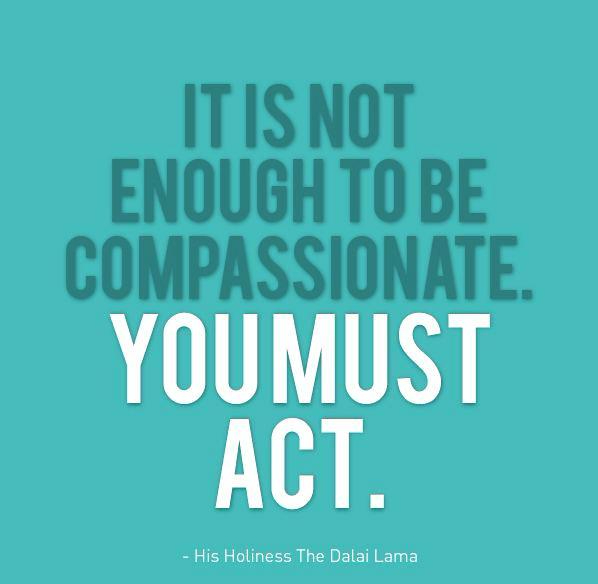
    One day, I hope articles like this one will read: Naturally, adults are trying to help them pave the way.

  • Empathy: Are We Walking the Walk?

    Empathy: Are We Walking the Walk?

    This morning on Twitter, Sam Patterson posted:

    I responded, in the moment, with a quick tweet about the need for active listening and not just a passive head nod.

    But then it got me thinking…

    Why do we need to teach kids empathy? Research has shown that children develop empathy when about two years old. A two year old will see someone upset, and offer a teddy bear, or favorite blanket, to help console the person. Although the solution provided may not meet the needs of the upset person, for the two year old, it is a way to reach out and provide comfort.

    Dr. Martin Hoffman, who researched empathy in children, said that it isn’t until around age 7 that children begin to really be able to “walk in someone’s shoes” and provide a response that is more appropriate to the situation. because they are learning how to see a situation from someone else’s point of view.

    It’s in adolescence, Hoffman explains, that children can start thinking abstractly enough to understand the plight of others, such as homeless or or oppressed. Hoffman labels this stage comprehensive empathy and explains that it is at this point that children are first able to understand how the interplay of life’s experiences may color attitudes, feelings, and behaviors.

    Ask (most) any parent or educator and they will tell you that empathy is an important trait for children to possess. “Of course we want our kids to care for others. How silly of you to ask!” wouldn’t be an unheard of response. And yet, research conducted at Harvard University showed that, while 96 percent of parents say they want to raise ethical, caring children, and cite the development of moral character as “very important, if not essential,” 80 percent of the youths surveyed reported that their parents “are more concerned about achievement or happiness than caring for others.” Sadly, the percentages were no different when students were asked what topped teacher concerns. Surveyed students were three times as likely to agree as disagree with the statement “My parents are prouder if I get good grades in my class than if I’m a caring community member in class and school.”

    Why is there such a huge disconnect between the traits we think we value, and the values our children are actually being provided?

    Could it be because the messages we send are stronger than the words we say?

    When students see signs like the ones above that scream “I don’t care what your issues are, just do your work,” we are stripping the empathy away.

    When we force compliance  on meaningless assignments in our quest for higher test scores, we are stripping the empathy away.

    When we send students to the principal’s office without hearing “their side” of what happened, we are stripping the empathy away.

    And when we hear a student speak, but don’t listen to what they’re saying, we are stripping the empathy away.

    justice-scalia-quotes-on-religion-best-ideas-social-issues-international-day-for-compassion-and-empathy-only-go-so-farSo why do we need to teach students empathy? Because adults are the reason they are losing it in the first place.

    Need tips on how to build empathy? via Teaching empathy: Evidence-based tips . Have others? Please share them below.


    Sign up to receive an update when I post. Type your email address in the box and click the “Subscribe” button. My list is completely spam free, and you can opt out at any time.


  • Bringing the Invention Cycle to Design Thinking

    Imagination leads to creativity.
    Creativity leads to innovation.
    Innovation leads to entrepreneurship.
    ~ Tina Seelig

    Engaging in the Design Thinking process is a human-centered approach to creative problem solving. Regardless of what you call the stages of the process, or how you draw the progression, at its core is a belief that people can make the(ir) world a better place by engaging in divergent thinking practices. What is sometimes missing in the implementation of design thinking, especially in the classroom, is an understanding of how ideas develop and take shape. Enter Stanford University Professor Tina Seelig, who teaches a creativity course at Stanford, and her book Creativity Rules. 

    1_pVd4Ieg64ETU6a_xzR5lNASeelig’s book focuses on the four components of the Invention Cycle: imagination, creativity, innovation, and entrepreneurship. Imagination is envisioning things that do not exist. It requires engagement and the ability to envision alternatives. Creativity is applying imagination to address a challenge. Creativity requires motivation and experimentation to address a challenge. Innovation is applying creativity to generate unique solutions through focusing and reframing to generate unique solutions. And Entrepreneurship, which requires persistence and the ability to inspire others, is applying innovation, scaling ideas, and thereby inspiring others’ imagination.

    When considering the Invention Cycle, it’s important to understand how the four components build upon each other. As Seelig explains, imagination requires curiosity, engagement, and the ability to conceive of ideas in your mind. Creativity then fills a specific need and are manifest in the world. With creativity, new ideas only need to be new to the creator, and not the world. However, with innovation, the ideas are new to the world, not just the inventor. Therefore, the world must be looked at from a fresh perspective by challenging assumptions, reframing situations, and connecting ideas from disparate disciplines. Once the innovative idea is developed, it is entrepreneurship that brings the unique ideas to scale.

    Because Design Thinking is focused on problem solving, and not selling a new product, entrepreneurship is not called out as part of the process, although it does fit in the test/feedback stage. Spencer and Juliani noted in Launch that marketing skills help students learn how to share their work with an authentic audience. Building on that principle. then, entrepreneurial skills teach students how to go beyond simply sharing the work and actually bring an idea to fruition. Seelig explains:

    It’s a crime not to teach people to be entrepreneurial. We’re each responsible for building our own lives and for repairing the broader problems of the world. Skills related to innovation and entrepreneurship are the keys to seeing and seizing those opportunities. People should emerge from school with agency, feeling empowered to address the opportunities and challenges that await them.

    According to thought leaders, the advances in technology are moving us towards an  imagination economy. This economy is defined as one in which “intuitive and creative thinking create economic value, after logical and rational thinking has been outsourced to other economies.” Looking at the Invention Cycle as a transparent layer atop the Design Thinking process, it becomes even more evident that we do our students a huge disservice if we do not provide meaningful ways for them to develop their imaginative, creative, innovative, and entrepreneurial skills. Like all soft (but critical!) skills, these can be developed and are critical to students (and their teachers), regardless of their career paths.

    Sign up to receive an update when I post. Type your email address in the box and click the “Subscribe” button. My list is completely spam free, and you can opt out at any time.